202 - The Child Opportunity Index and WIC Participation
Saturday, April 25, 2026
3:30pm - 5:45pm ET
Publication Number: 2194.202
Claire Branley, UMass Chan Medical School, Worcester, MA, United States; Stephanie Ettinger de Cuba, Boston University School of Public Health, Boston, MA, United States; Sharon M.. Coleman, Boston University School of Public Health, Boston, MA, United States; Felice Le-Scherban, Drexel University Dornsife School of Public Health, Philadelphia, PA, United States; Ana Poblacion, Boston University School of Medicine, Boston, MA, United States; Maureen M. Black, University of Maryland School of Medicine, Baltimore, MD, United States; Deborah A.. Frank, Boston University School of Medicine, Brookline, MA, United States; Arvin Garg, UMass Memorial Children's Medical Center, Worcester, MA, United States; Stephenie Lemon, UMass Chan Medical School, Worcester, MA, United States
MD/PhD Candidate UMass Chan Medical School Worcester, Massachusetts, United States
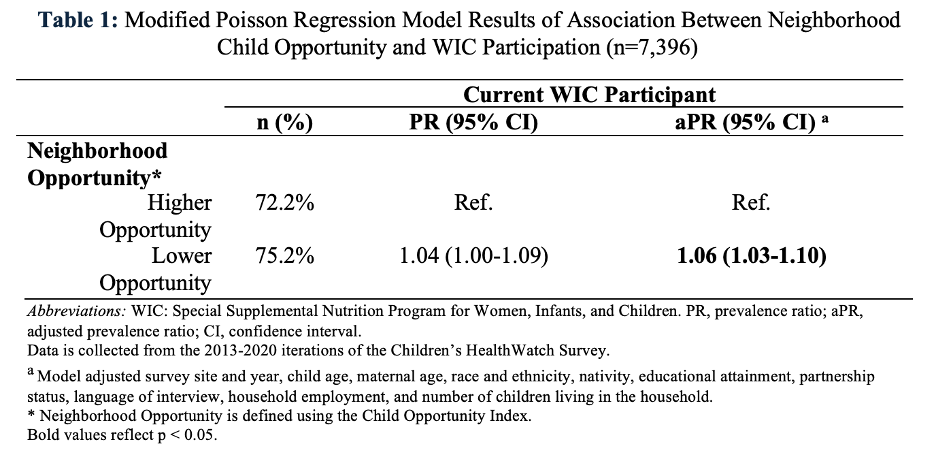
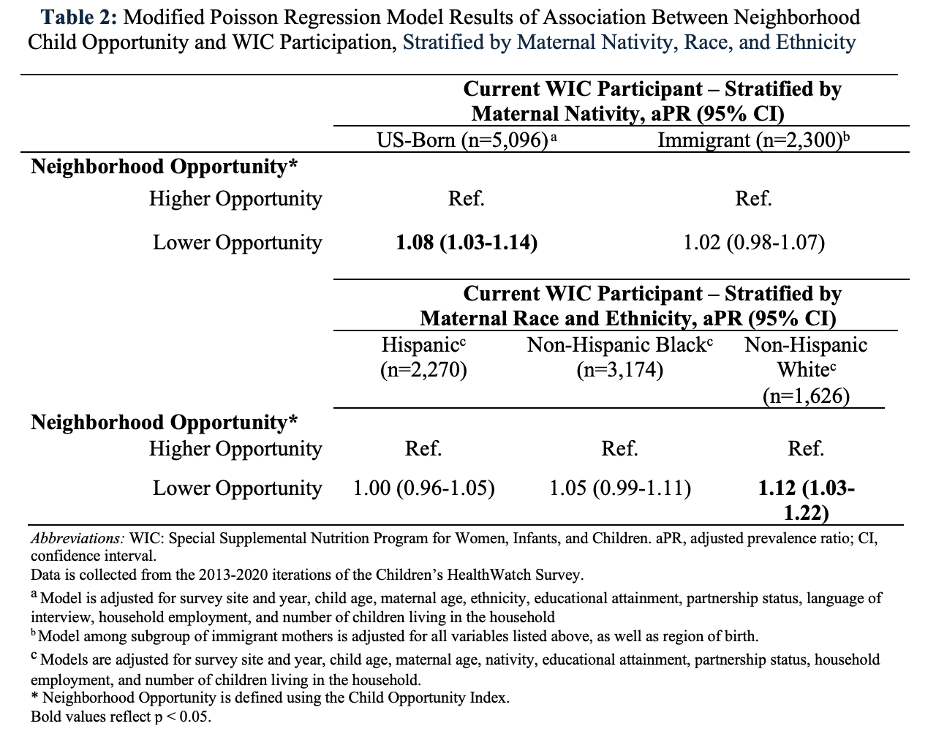
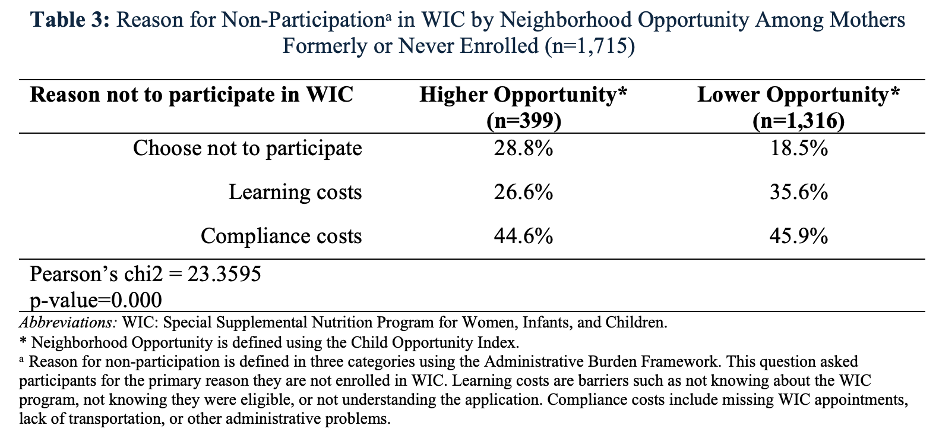
Background: Access to food assistance programs, including the Special Supplemental Nutrition Program for Women, Infants, and Children (WIC), can improve child health and wellbeing. While neighborhood-level disparities in food insecurity and healthcare access exist, little is known about whether programs such as WIC reach these neighborhoods more effectively. Objective: To determine the association between neighborhood opportunity and WIC enrollment among WIC-eligible mothers, along with reasons for WIC non-enrollment. Design/Methods: This study utilizes 2013-2020 data from Children's HealthWatch, a repeated cross-sectional survey of mothers with young children seeking care in emergency departments or health clinics in three US cities. Neighborhood opportunity, measured by the Child Opportunity Index (COI) was determined by linking survey responses of caregivers of children under 4 years (N=7,380) to their electronic health record to capture address at the time of interview, and then to the COI. Generalized estimating equations with a modified Poisson model were employed to estimate adjusted prevalence ratios of the association between COI (higher vs. lower opportunity neighborhoods) and WIC enrollment (formerly/never enrolled vs. currently enrolled). Analyses further explored these associations by race/ethnicity and nativity. Descriptively, reasons for WIC non-enrollment collapsed as Administrative Burdens (learning cost, compliance cost, chose not to participate) was described by COI. Results: Mother-child dyads in lower opportunity neighborhoods had a 6% higher prevalence (aPR 1.06, 95% CI 1.03-1.10) of WIC enrollment compared to those in higher opportunity neighborhoods, after adjusting for individual and household characteristics. In subgroup analyses, this association was significant among non-Hispanic White mothers but not mothers who were Hispanic or non-Hispanic Black; no differences were seen by mother's nativity. Those residing in lower opportunity neighborhoods who did not participate in WIC were more likely to report learning costs and less likely to report choosing not to participate.
Conclusion(s): There is variation in WIC enrollment by neighborhood opportunity in this sample. These results have implications for tailoring WIC outreach to under-enrolled areas. To maximize participation, future research should uncover whether lower WIC enrollment in high opportunity neighborhoods is due to low awareness, stigma, distance to services offered or other contributing factors.
Table 1: Modified Poisson Regression Model Results of Association Between Neighborhood Child Opportunity and WIC Participation (n=7,396) 5
Table 2: Modified Poisson Regression Model Results of Association Between Neighborhood Child Opportunity and WIC Participation, Stratified by Maternal Nativity, Race, and Ethnicity
Table 3: Reason for Non-Participationa in WIC by Neighborhood Opportunity Among Mothers Formerly or Never Enrolled (n=1,715)