692 - A New Elective for Trainees Demonstrated Sustained Well-Being Improvements 6 Months After the Elective
Saturday, April 25, 2026
3:30pm - 5:45pm ET
Publication Number: 2675.692
Jennifer Sedler, Children's Hospital Colorado, Denver, CO, United States; Rachita Gupta, Hassenfeld Children's Hospital at NYU Langone, Manhattan, NY, United States; Sonja I. Ziniel, University of Colorado Anschutz School of Medicine, Franktown, CO, United States; Jennifer Reese, University of Colorado School of Medicine, Aurora, CO, United States
Assistant Professor Children's Hospital Colorado Denver, Colorado, United States
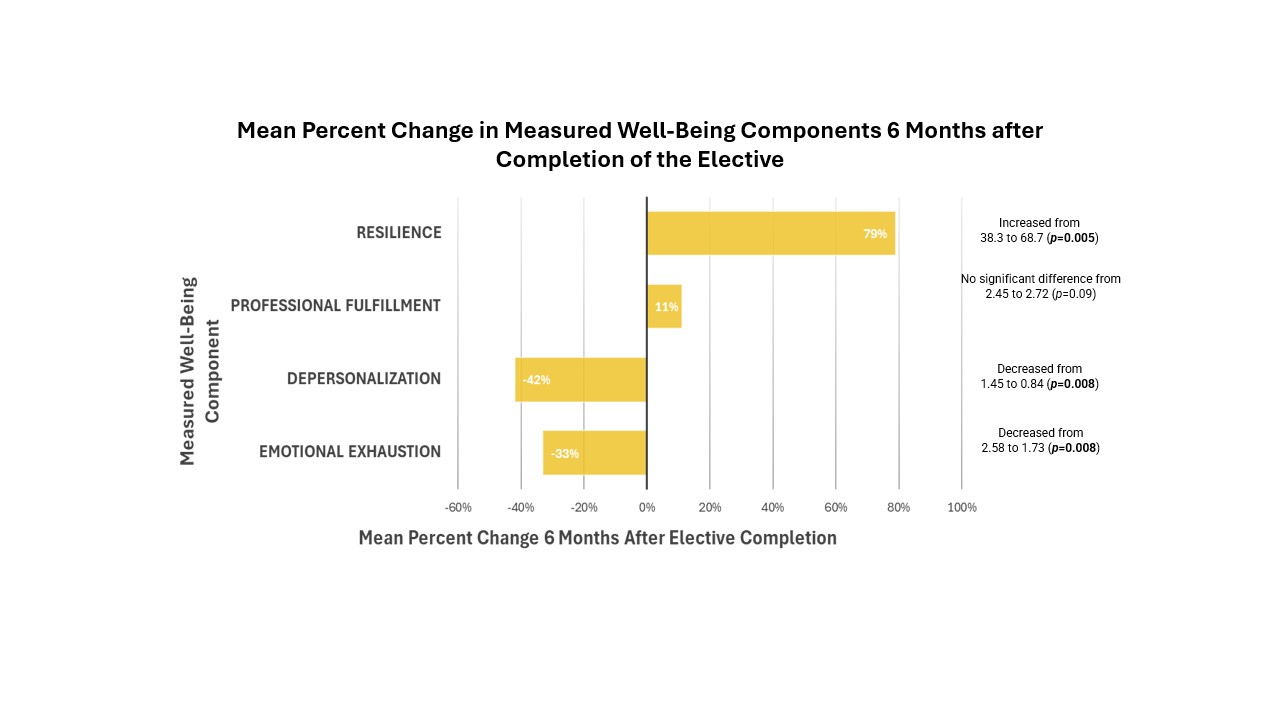
Background: Burnout, defined as chronic workplace stress leading to emotional exhaustion, depersonalization, and reduced sense of accomplishment, remains prevalent among medical trainees and faculty. Building resilience and well-being skill sets is increasingly recognized as a core defense. We developed and evaluated a structured two-week Well-Being Elective for residents and fellows designed to provide concrete strategies for sustained thriving in the face of chronic stress. Objective: To evaluate the impact of a structured two-week Well-Being Elective for medical trainees on resilience, burnout domains emotional exhaustion and depersonalization, professional fulfillment, and coping strategies over a six-month period. The secondary objective was to assess participant satisfaction. Design/Methods: This IRB-exempt pilot enrolled 11 participants (2 residents, 9 fellows) at the University of Colorado. The curriculum integrated interactive workshops, reflective practice, and creation of a personalized well-being toolkit. Outcomes were assessed at baseline, 2 weeks, and 6 months using validated instruments: Connor-Davidson Resilience Scale (CD-RISC), Professional Fulfillment Index (PFI), and Brief COPE inventory. Results: At 6 months, participants demonstrated significant improvements in resilience (mean CD-RISC 38.3 to 68.7, p=0.005), decreased emotional exhaustion (2.58 to 1.73, p=0.008), and reduced depersonalization (1.45 to .84, p=0.008). Professional fulfillment showed no significant difference (2.45 to 2.72, p=0.099). Although not significantly different, coping shifted toward more problem-focused strategies (1.93 to 2.16, p=0.09), with decreased avoidance (0.75 to .96, p=.17). All participants reported they would recommend the elective.
Conclusion(s): A structured two-week well-being elective with toolkit creation produced sustained six-month improvements in resilience and burnout measures among residents and fellows. While the concepts were not wholly novel, the delivery method (workbook-based, toolkit-focused, and longitudinal) offers a replicable model distinct from ad hoc interventions and demonstrates the potential for durable impact on trainee well-being.
Mean Percent Change in Measured Well-Being Components 6 Months After Completion of the Elective