Session: Neonatal Hematology & Transfusion Medicine 1
149 - Retrospective Audit of Transfusions in Infants: Overview and Needs (RATION) in the Australian context
Saturday, April 25, 2026
3:30pm - 5:45pm ET
Publication Number: 2143.149
Sara Chiaretti, Australian Red Cross Lifeblood, Kelvin Grove, Queensland, Australia; Meghan Boomgardt, Australian Red Cross Lifeblood, Brisbane, Queensland, Australia; Georgina Jacko, Australian Red Cross Lifeblood, Brisbane, Queensland, Australia; Peter S. Cunningham, Mater Research, Brisbane, Queensland, Australia; Helen G.. Liley, The University of Queensland, South Brisbane, Queensland, Australia; Linda McLaughlin, N/A, Brisbane, Queensland, Australia; Marijke Welvaert, Australian Red Cross Lifeblood, Sydney, New South Wales, Australia; Rebecca E. Griffiths, Australian Red Cross Lifeblood, Brisbane, Queensland, Australia
Professor The University of Queensland South Brisbane, Queensland, Australia
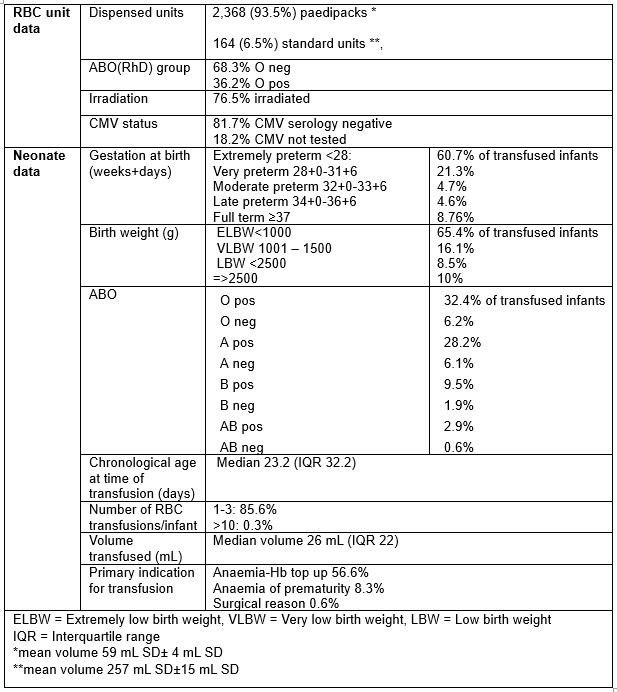
Background: Red blood cell (RBC) transfusions are common in neonatal intensive care units (NICUs) with a population-level review in one Australian state (NSW) reporting a transfusion rate of 4.8 per 1000 live births (Bowen et al., 2015). However, concerns have emerged regarding the associations between RBC transfusion exposure and adverse neonatal outcomes (Ghirardello et al., 2017). Currently in Australia, neonates requiring RBC transfusions receive adult derived components produced by dividing a standard leucocyte depleted RBC unit in 4 packs (mean haematocrit: 0.63 L/L) to minimise product wastage and reduce donor exposure. But the amount used is not monitored. Recent research is focusing on finding the best RBC products for transfusion in neonates. This includes exploring alternative options to adult derived components (which may not be optimal), such as umbilical cord or stem cell derived products. However, determining how current and novel RBC products could be optimally provided has not been addressed. Objective: To assess how RBC components are currently administered in Australia's neonatal population, with the intention of developing optimised new products which improve transfusion practices while limiting wastage Design/Methods: A 5-year (1 Jan 2019 - 31 Dec 2023) retrospective observational review has conducted linking transfusion and demographic data between Australian Red Cross Lifeblood (Lifeblood) and two tertiary Australian NICUs. 2,533 transfusions administered to 1,221 inpatient neonates were examined. Product usage percentage was determined by dividing the volume of RBCs administered by the total volume of RBCs issued during the specified period. Descriptive statistics and estimates of product usage were evaluated using Prism software Results: Results are summarised in table 1. Analyses show most neonates received 1-3 transfusions (85.6%). Infants born extremely preterm ( < 28 wks) were the most transfused (60.7%). Volume transfused ranged between 4.3 and 130 mL with a median of 26 mL, IQR 22 mL. Of RBC unit volume issued, 56.6% was administered
Conclusion(s): Our analysis highlights the need for comprehensive evaluation of RBC usage in NICU settings, including how varied NICU clinical protocols affect RBC usage, wastage and outcomes. These data will used to design new strategies to optimise RBCs currently supplied by Lifeblood (e.g. matching ABO) and to inform the development of future products for neonatal transfusion.
Table 1. Descriptive statistics of retrospective observational review