641 - The Effect on Cerebral Blood Flow Indices of Preterm Neonates During Kangaroo Care given by Father as Compared to Kangaroo Care given by Mother - A Randomized Crossover Study.
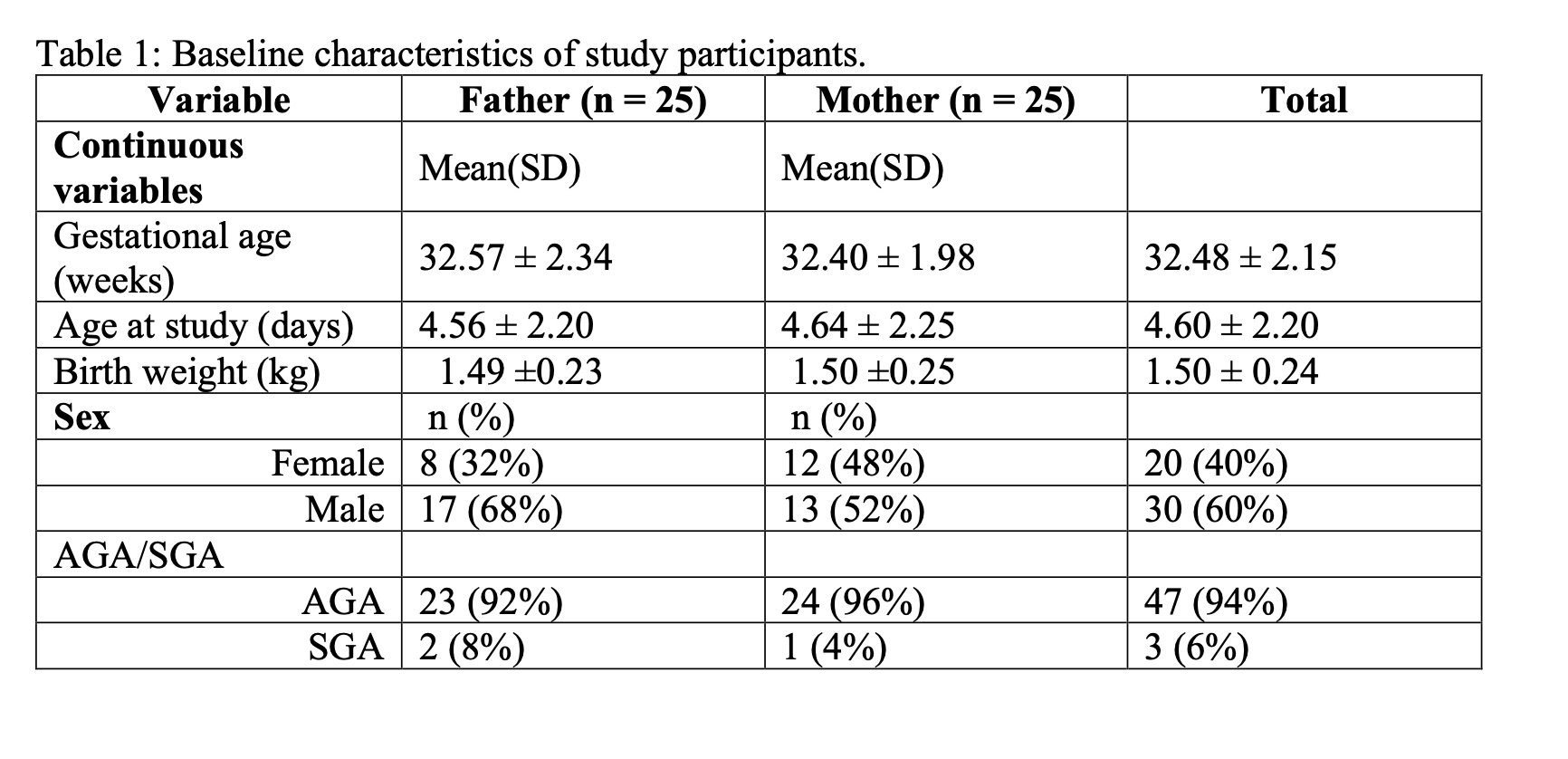
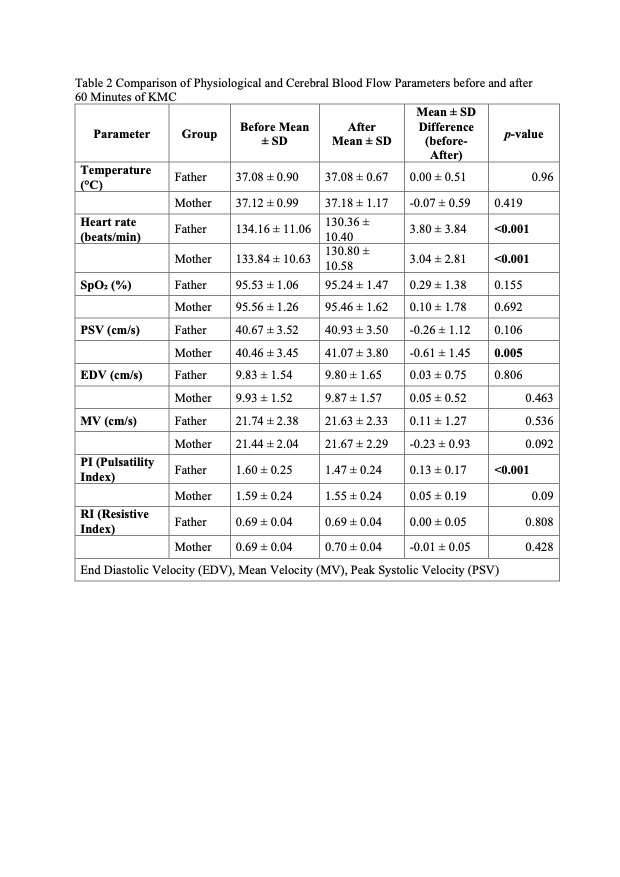
Background: Kangaroo Mother Care (KMC) is standard of care for all preterm neonates. Doppler ultrasound assessments have indicated favorable alterations in MCA flow velocities, reflecting improved cerebral perfusion during and after KMC. The equivalence of paternal KMC vis-à-vis maternal KMC regarding cerebral blood flow effects remains unexplored. Objective: To evaluate and compare the changes in cerebral blood flow (CBF) indices in the middle cerebral artery after Kangaroo Care is provided by the mother and father separately in stable preterm infants Design/Methods: Randomized Controlled Cross-Over trial. This crossover study included 50 stable preterm neonates eligible for KMC. Randomization was performed using a computer-generated sequence. After randomization, measurements of physiological parameters and cerebral blood flow parameters of the middle cerebral artery were taken before initiating KMC, and these data were collected again after 60 minutes of KMC administered by the mother. This process was repeated after a 6-12-hour washout period when the father administered KMC. The parent who administered the first KMC was the randomized event, providing for a robust crossover RCT. Results: Fifty preterm neonates were enrolled (40% female; 94% appropriate for gestational age), with a mean gestational age of 32.5 ± 2.1 weeks and birth weight of 1.50 ± 0.24 kg. (Table 1). Heart rate decreased significantly after 60 minutes of KMC in both the father and mother groups (134.16 ± 11.06 to 130.36 ± 10.40 and 133.84 ± 10.63 to 130.80 ± 10.58, respectively; p < 0.001), whereas temperature, SPO₂, End Diastolic Velocity (EDV), Mean Velocity (MV), and Resistive Index (RI) showed no significant pre-post changes (p > 0.05) in both groups. Peak Systolic Velocity (PSV) increased significantly only in the mother group, while Pulsatility Index (PI) decreased significantly only in the father group. Between-group comparisons revealed no significant differences in physiological or cerebral blood flow parameters (p > 0.05), except for PI. (Table 2).
Conclusion(s): Fathers are as effective as mothers in providing skin-to-skin care for preterm neonates, achieving comparable stabilization of physiological and cerebral blood flow parameters.
Table 1: Baseline characteristics of study participants.
Table 2 Comparison of Physiological and Cerebral Blood Flow Parameters before and after 60 Minutes of KMC