37 - Neonatal Opioid Withdrawal Syndrome Rates and the COVID-19 Pandemic
Saturday, April 25, 2026
3:30pm - 5:45pm ET
Publication Number: 2034.37
Benjamin Goldberg, Boston Children's Hospital, Boston, MA, United States; Christopher A. Cortina, Boston Children's Hospital, Boston, MA, United States; Jessica P.. Liu, Boston Children's Hospital, Boston, MA, United States; Aliza Ray, Boston Children's Hospital, Boston, MA, United States; Carter Petty, Boston Children's Hospital, Boston, MA, United States; Carly E.. Milliren, Boston Children's Hospital, Boston, MA, United States
Biostatician Boston Children's Hospital Boston, Massachusetts, United States
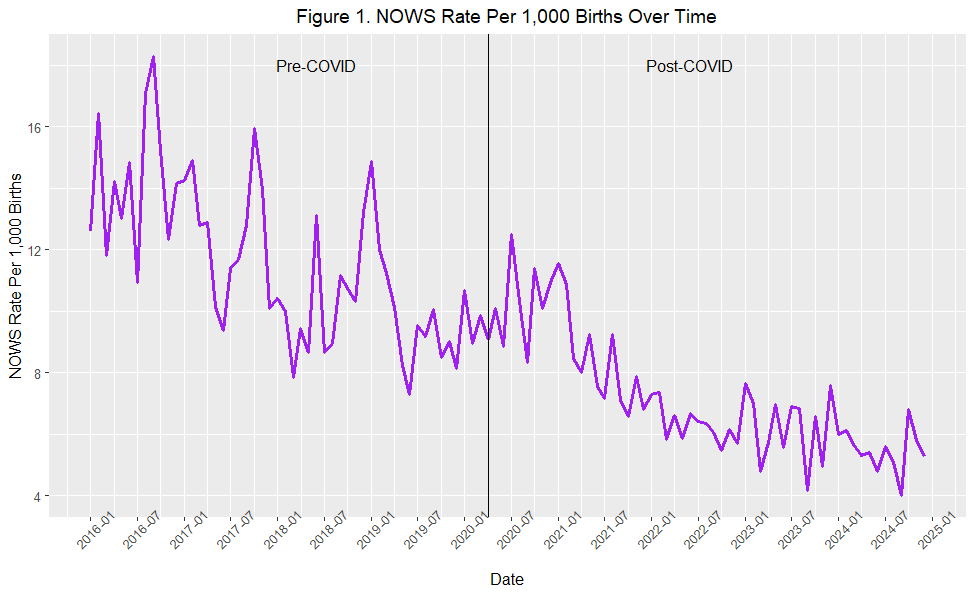
Background: After sharp increases in incidence since the early 2000s, rates of births for infants with neonatal opioid withdrawal syndrome (NOWS) began to decline in the years immediately preceding the COVID-19 pandemic. However, more recent trends during and after the pandemic have not been described. Objective: This study examined rates of NOWS births from 2016 - 2024 and explored changes after the onset of the COVID-19 pandemic. Design/Methods: Using data from the Pediatric Health Information System (PHIS), we extracted birth hospitalization discharges for infants born from January 2016 to September 2024. Infants with NOWS were identified by ICD-10 diagnosis code (P96.1). We included 45 hospitals with 10 or more NOWS births during the study period. We defined the pre-COVID period as January 2016-March 2020 and the post-COVID period as April 2020-September 2024. We examined demographic and clinical characteristics among infants with NOWS by COVID period. The monthly rate of births for infants with NOWS was calculated per 1,000 births. The aggregate monthly trend in overall NOWS rates across all sites was visualized by a line graph. In addition, we examined hospital-level counts and rates of NOWS births by COVID time periods. Results: We included N=7,028 births for infants with NOWS, 3,799 pre-COVID and 3,229 post-COVID. Demographic and clinical characteristics are presented in Table 1. Most patients were white (67% overall; 70% pre vs. 63% post; p< 0.001) and male (54% overall; 55% pre vs. 53% post; p=0.2). The median birthweight was 2,830 grams (2,830 g pre vs. 2,820 g post; p=0.9), and the median gestational age was 38 weeks (38 weeks pre vs. 37 weeks post; p< 0.001). Most patients resided in the Midwest (38%) or the South (40%). Race and ethnicity, gestational age, and census region were significantly different between the pre- and post-COVID periods. The rate of NOWS births declined from 11.5 pre-COVID to 7.0 post-COVID per 1,000 births. Overall, NOWS rates showed a decreasing trend throughout the entire time period, with no clear change in trajectory following the onset of COVID (Figure 1). Most hospitals demonstrated a decline in NOWS rates after COVID.
Conclusion(s): There was no evidence of an increase in NOWS births following the onset of the COVID-19 pandemic. Our analysis suggests that rates of NOWS births were lower in the post-COVID period, likely continuing the pre-COVID decline, suggesting pandemic-related disruptions in care and changing substance use patterns did not exacerbate NOWS incidence.
Figure 1. NOWS Rate Per 1,000 Births Over Time
Table 1. Demographic and clinical characteristics among infants with NOWS at PHIS hospitals, 2016-2024 (N=7,028) Table1.pdf