299 - Evaluating California Food Service Directors’ Knowledge and Beliefs about Ultra-Processed Foods
Sunday, April 26, 2026
9:30am - 11:30am ET
Publication Number: 3288.299
Anjali Gupta, Stanford University School of Medicine, Cary, NC, United States; Alix Zuceth Duran Gomez, Stanford University School of Medicine, Santa Clara, CA, United States; Donna Matheson, Stanford University School of Medicine, Palo Alto, CA, United States; Aditi Sharma, Stanford University School of Medicine, South San Francisco, CA, United States; Viviane Richard, Stanford University School of Medicine, Palo Alto, CA, United States; Lorrene D. Ritchie, Nutrition Policy Institute, University of California, Division of Agriculture and Natural Resources, Oakland, CA, CA, United States; Ashley De La Rosa, Dolores Huerta Foundation, Bakersfield, CA, United States; Deiglis Delgado, IUPMA, Fresno, CA, United States; Genoveva Islas, Cultiva La Salud, Fresno, CA, United States; Christina Hecht, University of California, Agriculture and Natural Resources, Oakland, CA, United States; Kenneth Hecht, UC Nutrition Policy Institute, Berkeley, CA, United States; Anisha Patel, Lucile Packard Children's Hospital Stanford, Palo Alto, CA, United States; Andrea Pedroza-Tobias, Stanford University School of Medicine, Palo Alto, CA, United States
Medical Student Stanford University School of Medicine Cary, North Carolina, United States
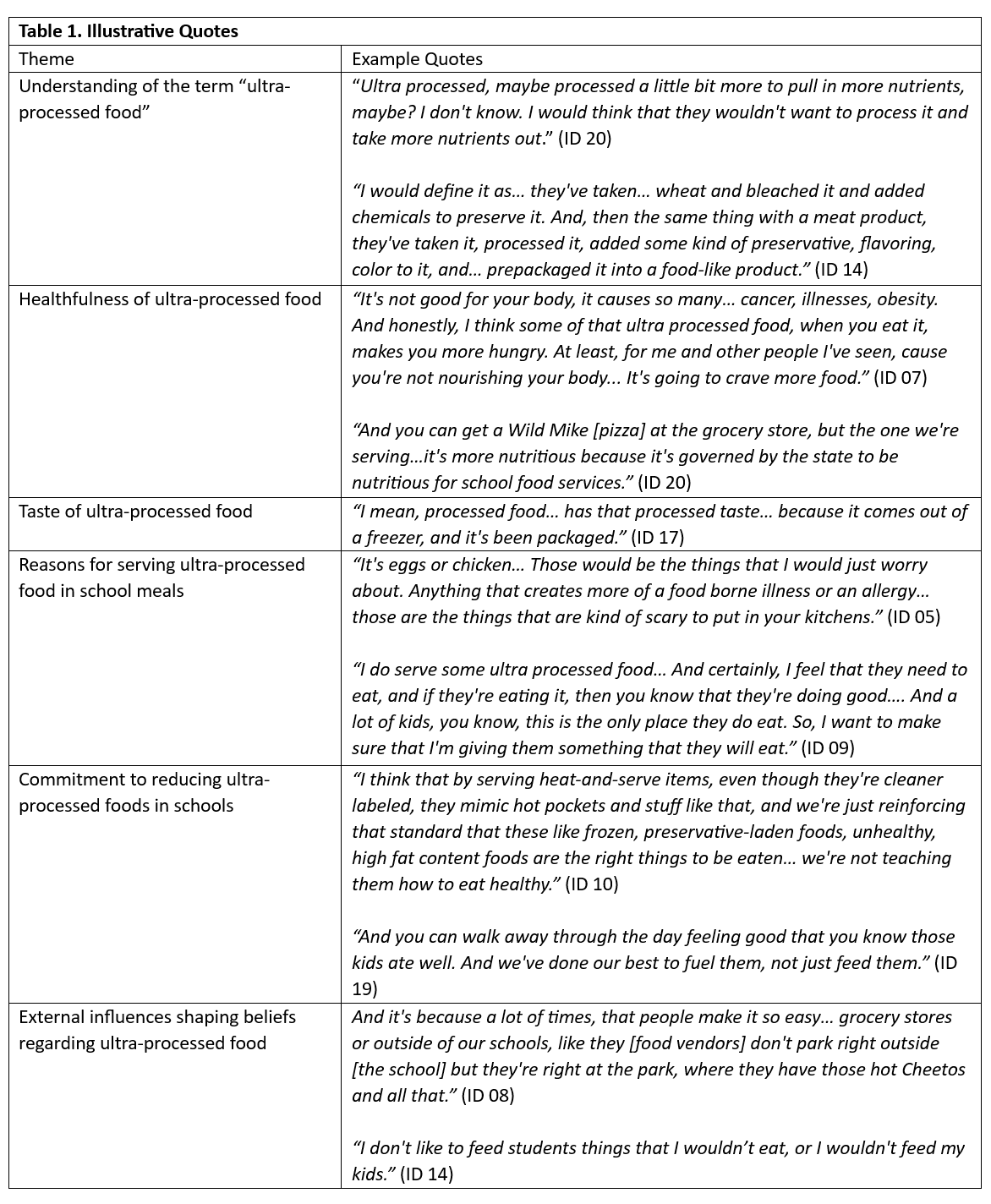
Background: Ultra-processed foods (UPFs) contain industrially formulated ingredients not typically used in home cooking and are often high in sodium, added sugars and/or fats. Consumption of these foods is associated with chronic diseases such as obesity, type 2 diabetes, and hypertension, with increasing evidence for having addictive qualities. While school meals must meet United States Department of Agriculture (USDA) nutrition standards, there are no national regulations specific to UPFs served in schools. Given that school meals can provide up to half of children's daily calories, reducing UPFs in school meals represents a priority strategy to improve children's health and has been of significant policy interest at that state and federal levels. Objective: As food service directors (FSDs) are critical stakeholders in the implementation of school meal programs, this study's purpose was to characterize their knowledge and beliefs about UPFs. Design/Methods: This qualitative study was designed via a community-based participatory research process. We conducted 20 semi-structured interviews in 2024 with FSDs in the San Joaquin Valley, California, a region with high rates of food insecurity and chronic disease. The interviews explored the barriers and facilitators to providing freshly prepared meals and reducing UPFs in school meals. Interviews were double-coded, and an inductive thematic analysis approach was used to identify key themes about FSDs' knowledge and beliefs about UPFs. Results: Of the 16 participants who responded to the demographics survey, the mean (SD) age was 50.9 (11.9), 93.8% were women, 50% identified as White, and 37.5% identified as Hispanic. One-third of FSDs reported never having heard of UPFs. After we provided a definition of UPFs, FSDs perceived that UPFs were less healthy than scratch-cooked food; however, many FSDs perceived that UPFs served in schools were healthier than UPFs available outside of schools. Some FSDs cited concerns about student food insecurity and food-borne illnesses as reasons for serving UPFs in school meals. Conversely, other FSDs expressed concerns that serving UPFs at school could reinforce unhealthy eating habits among children. Illustrative quotes are provided in Table 1.
Conclusion(s): The findings highlight a significant knowledge gap regarding UPFs among FSDs in this California region. Education and training efforts to improve understanding about UPFs among FSDs may play an important role in improving the quality and healthfulness of school meals.