1 - Pediatric Rural Interfacility Transfers by Emergency Medical Services
Sunday, April 26, 2026
9:30am - 11:30am ET
Publication Number: 3000.1
Caroline Morris, Nationwide Children's Hospital, columbus, OH, United States; Christopher E. Gaw, Nationwide Children's Hospital, Columbus, OH, United States; Christopher B. Gage, National Registry of EMTs, Columbus, OH, United States; Chelsea Kadish, Nationwide Children's Hospital, Columbus, OH, United States; Anne Runkle, Nationwide Children's Hospital, Columbus, OH, United States; Joelle Donofrio-Odmann, University of California, San Diego School of Medicine, La Jolla, CA, United States; Ashish R. Panchal, The Ohio State University, Columbus, OH, United States
Fellow Nationwide Children's Hospital columbus, Ohio, United States
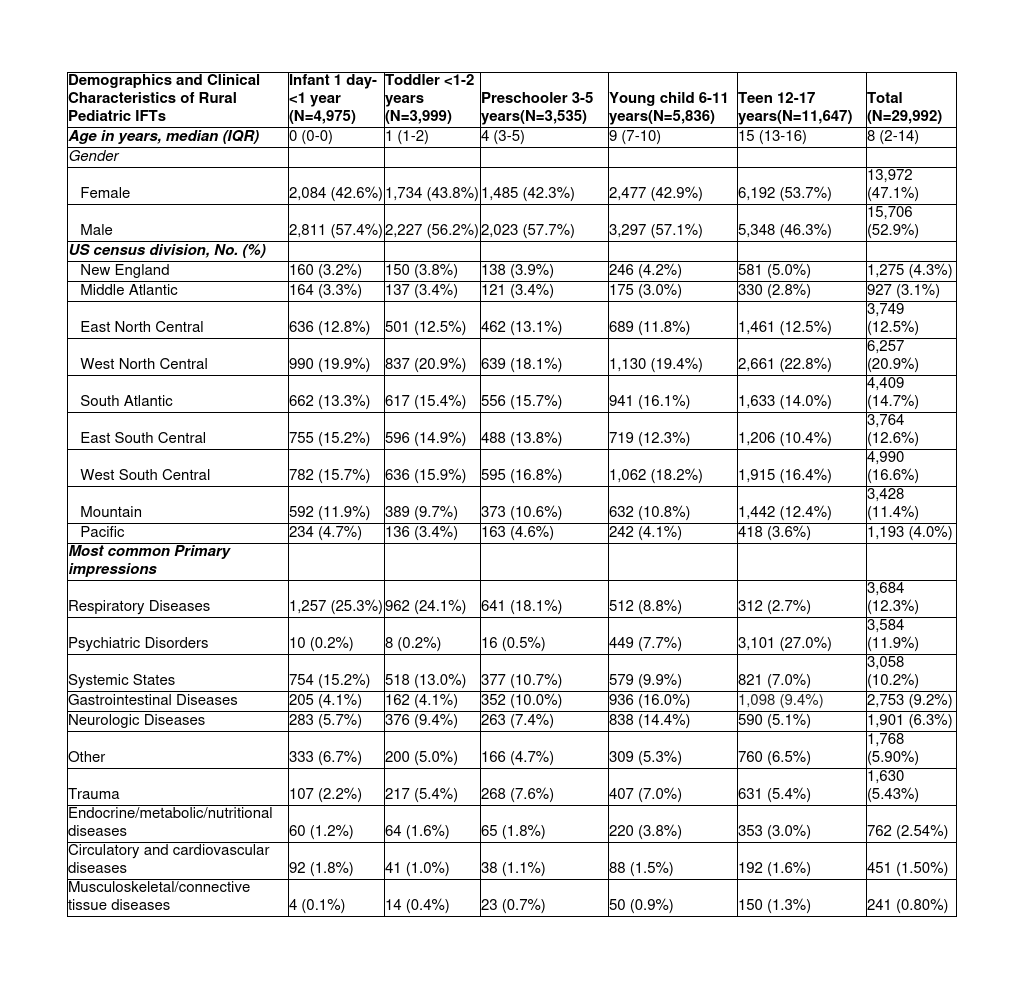
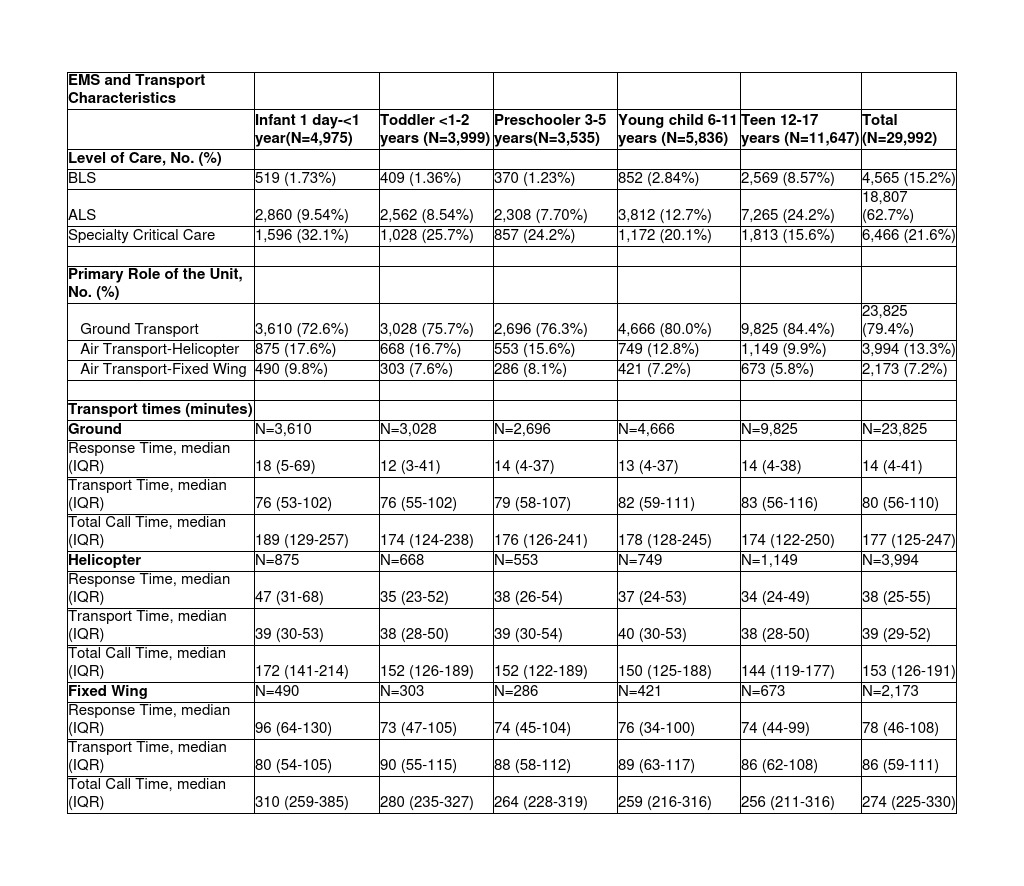
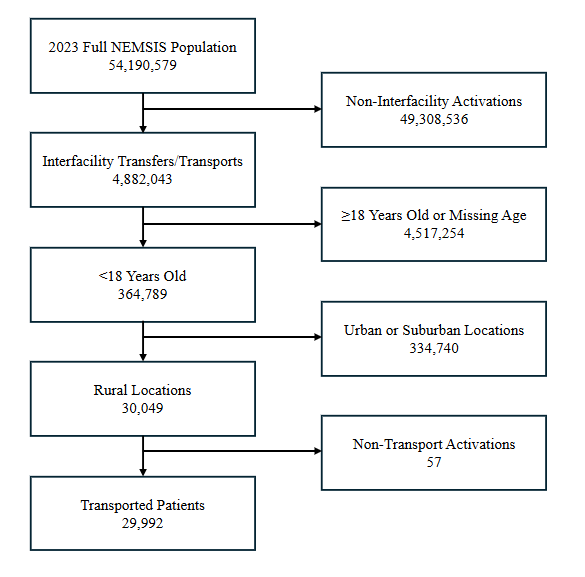
Background: Interfacility transports (IFTs) are critical for the care of pediatric patients in the United States (US), especially in rural areas that may be underserved. Objective: Given the paucity of pediatric rural IFT data, we aimed to characterize rural IFTs of pediatric patients in the US. Design/Methods: We performed a retrospective study using the 2023 National Emergency Medical Services Information System dataset. We included rural IFTs of patients 1 day to 17 years (infant [1 d- < 1 y], toddler [1-2 y], preschooler [3-5 y], young child [6-11 y], and teenager [12-17 y]). Using descriptive statistics (proportions, medians, IQRs), we analyzed patient demographics and emergency medical service (EMS) transport characteristics. Results: We identified 29,992 rural pediatric IFT encounters (median: 8 y [IQR: 2-14 y], 47.1% female) (Figure 1, Table 1). The most common age group transferred was teenagers (38.5%). The most common primary impression was respiratory diseases (12.3%), and it remained the most common primary impression for infants, toddlers, and preschoolers. The most common primary impression for young children was gastrointestinal diseases (16.0%), whereas psychiatric complaints (27.0%) was the most common for teenagers. Ground transport comprised the majority of IFTs (79.4%) (Table 2). Most transfers involved an ALS unit (62.7%), followed by specialty critical care (21.6%), and BLS units (15.2%). Within age categories, infants (32.1%) and toddlers (25.7%) had the highest proportions of specialty critical care transports, with lower proportions observed in older age groups. The median total transport times in infants for ground (76 min; [IQR: 53-102 min]), helicopter (39 min; [30-53 min]), and fixed wing transport (80 min; [54-105 min]) were slightly higher than observed in other age groups. Infant median dispatch to scene times for ground (18 min; [IQR: 5-69 min]), helicopter (47 min; [31-68 min]), and fixed wing transport (96 min; [64-130 min]) were slightly higher than in other ages.
Conclusion(s): Nearly 30,000 rural residing children required IFT in 2023. Most IFTs were transferred via ground transport. Infants and toddlers were transferred by specialty care units at higher proportions than in other ages. Infants had slightly longer median total transport and dispatch to scene times. Primary impressions differed by age. Respiratory diseases was most common for infants, toddlers, and preschoolers, while psychiatric complaints was for teenagers. These findings highlight the unique care needs of infants and toddlers, and the importance of continued efforts in national pediatric readiness and EMS training.