








Neonatal Neurology
Session: Neonatal Neurology 8: Neonatal Neurology & Neurodevelopment

Rae Dong, MD, MPH
Assistant Professor
Hassenfeld Children's Hospital at NYU Langone
New York, New York, United States
.jpg) Cytokine concentrations are indicated un pg/ml on the y axis. Time in months are indicated on the x axis. Mean is indicated by the solid line at each time point.
Cytokine concentrations are indicated un pg/ml on the y axis. Time in months are indicated on the x axis. Mean is indicated by the solid line at each time point. .jpg) Descriptive statistics indicate that our study population was about 55% male, and tended to be below average for height weight and BMI for age across all ages studied. Overall, this study population experienced a high level of febrile illness, diarrheal illness and repeated courses of antibiotics.
Descriptive statistics indicate that our study population was about 55% male, and tended to be below average for height weight and BMI for age across all ages studied. Overall, this study population experienced a high level of febrile illness, diarrheal illness and repeated courses of antibiotics.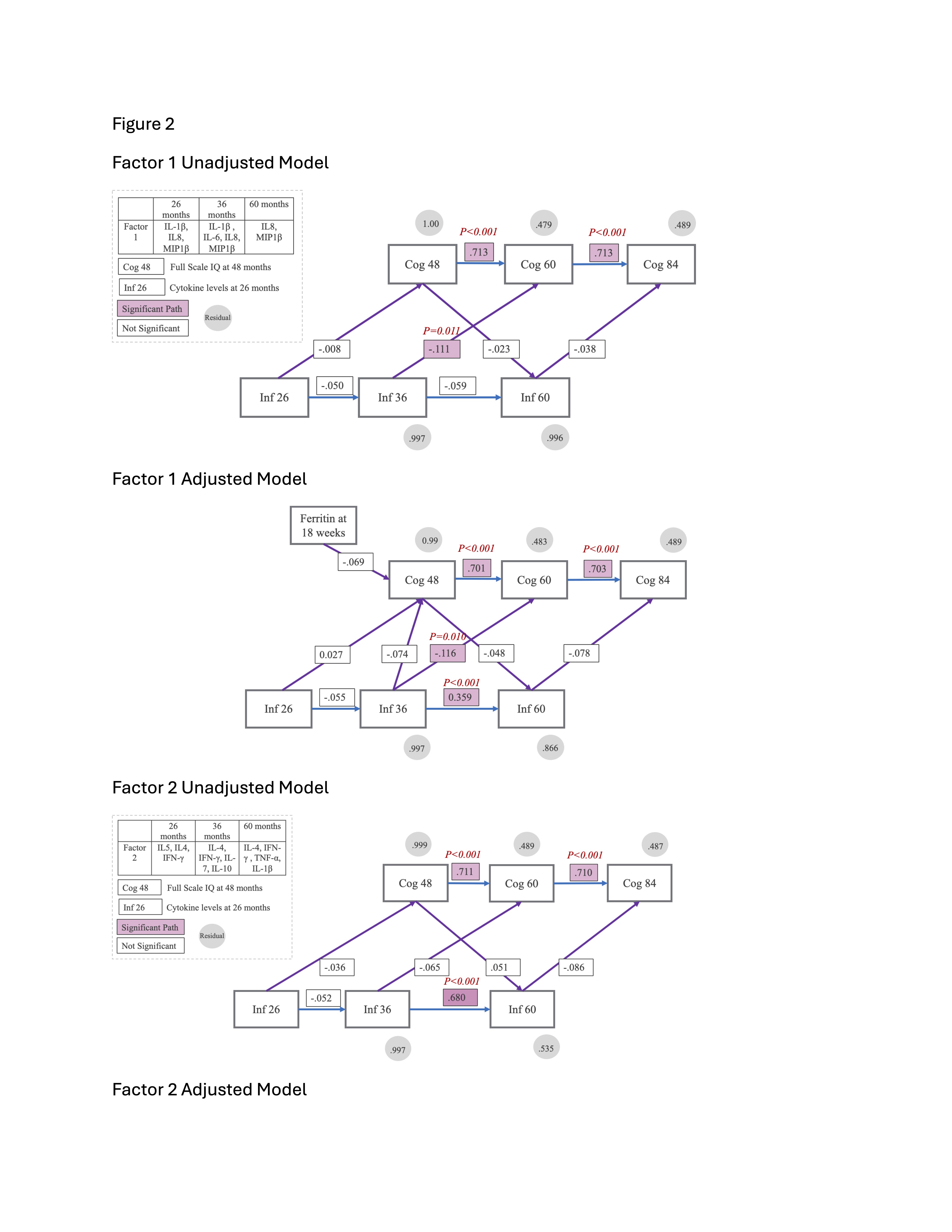 Using 2 factors defined using exploratory and confirmatory factor analysis, models of each factor of cytokines at 26 months, 36 months and 60 months were run against the full-scale IQ scores at 48 months, 60 months, and 84 months. For the factor 1 unadjusted model, the autoregressive path for cognitive scores was found to be significant and earlier cognitive scores were significantly associated with later cognitive scores. The cross lagged path for inflammation at 36 months to cognitive score at 60 months was found to be significant. For every 1 standard deviation increase in inflammation at 36 months, there was a 0.111 decrease in cognitive scores. There were no significant cross lagged paths found for the factor 2 unadjusted model. Ferritin levels at 18 weeks were included as a covariate in the adjusted factor 1 model. Ferritin was not found to be significantly associated with cognitive scores. After including all possible paths and adjusting for multiple comparisons, in factor 1 the cross lagged path for inflammation at 36 months to cognitive score at 60 months remained significant with a p-value of 0.01. For every 1 standard deviation increase in inflammation at 36 months, there was a 0.116 point decrease in cognitive scores.