687 - Association Between Primary Care Access and Emergency Department Utilization
Sunday, April 26, 2026
9:30am - 11:30am ET
Publication Number: 3664.687
Lukas Gaffney, Boston Children's Hospital, Boston, MA, United States; Todd W. Lyons, Boston Children's Hospital, Wayland, MA, United States; Michael Monuteaux, Boston Children's Hospital, Boston, MA, United States; Joel H. Hudgins, Brown Emergency Medicine, Milton, MA, United States
Clinical Fellow in Emergency Medicine Boston Children's Hospital Boston, Massachusetts, United States
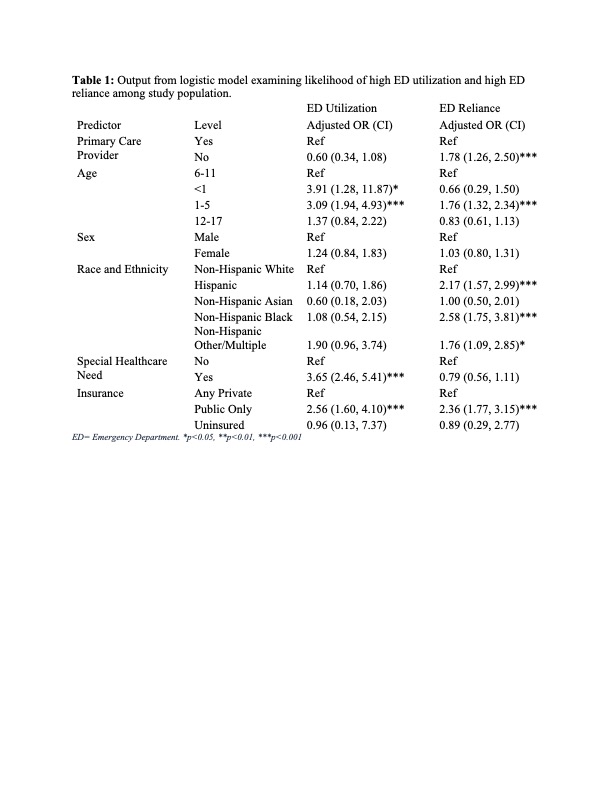
Background: Access to primary care plays a vital role in pediatric emergency department utilization. Practice characteristics such as proximity, availability, and ease of contact are also associated with emergency department utilization. The relative importance of these factors and their availability on a national scale has not been fully established. Objective: To examine the association between primary care access and emergency department utilization and reliance. We hypothesized that lack of primary care, limited after hour availability, and farther distance from care would be associated with higher emergency utilization and reliance. Design/Methods: We performed a retrospective cross-sectional study of patients < 18 years old in 2021-2022 using the Medical Expenditure Panel Survey, a nationally representative survey. Our primary outcomes were high emergency department utilization (2 or more emergency visits annually) and high emergency department reliance (one-third or more of all medical visits occurring in the emergency department). Our exposure was primary care access and individual practice characteristics including distance from patient, ease of contacting via phone, ease of contacting on nights and weekends, and office availability outside traditional business hours. Covariates included age, sex, race and ethnicity, and special healthcare needs. We assessed the relationship between outcomes, exposure, and covariates using logistic regression. Results: We included 9878 children who were representative of 72,549,476 children nationally. 60,353,592 (83.2%) children had identified primary care. Lack of primary care was associated with high emergency reliance (adjusted odds ratio 1.78, 95% confidence interval 1.26-2.50) but not high utilization (adjusted odds ratio 0.60, 95% confidence interval 0.34-1.08). Among children with primary care, no individual component of access to care was associated with either outcome.
Conclusion(s): Lack of primary care access was associated with greater reliance on the ED for medical care, but not with high ED utilization. These distinctions can help policymakers design tailored programs to improve these outcomes.