360 - Sodium Awareness in Lactation Trial (SALT): Feasibility and Acceptance of Parent-led Point-of-Care Human Milk Sodium for Lactation Support
Sunday, April 26, 2026
9:30am - 11:30am ET
Publication Number: 3347.360
Rebecca Hoban, Seattle Children's, Seattle, WA, United States; Debbie Ng, University of Washington School of Medicine, Seattle, WA, United States; Katie M.. Strobel, University of Washington School of Medicine, Seattle, WA, United States; Kendell German, University of Washington School of Medicine, Seattle, WA, United States; Samantha Anthony, The Hospital for Sick Children, Toronto, ON, Canada
Staff Neonatologist Seattle Children's Seattle, Washington, United States
Background: Data-driven interventions to improve lactation success are lacking. Parents who deliver preterm are high risk for lactation challenges. A drop in parent's own milk (POM) sodium (Na) (≤ 366ppm = ≤16mM) is a sign of secretory activation (SA), an early, vital lactation step associated with adequate POM volumes throughout lactation. Objective: In pump-dependent parents of preterm infants in the neonatal intensive care unit (NICU), to: 1) Establish feasibility and acceptance of parent-led longitudinal point-of-care POM Na testing, 2) Investigate relationships between lactation risks, daily POM Na and lactation outcomes, 3) Explore if real-time POM Na data could inform pumping behavior and influence POM volumes. Design/Methods: SALT, a non-randomized prospective interventional pilot study, taught lactating parents who delivered < 35 weeks gestation to use Na meters to trend POM Na for 14 days. Outcomes included POM Na levels achieving and sustaining SA, POM volumes, POM at NICU discharge, and intervention acceptability. Qualitative interviews are in progress. Descriptive statistics for non-normal data were performed. Results: Of 100 eligible parents, 29 enrolled. 25 had 2 POM Na measurements and were included in analysis. Of the n=4 who withdrew after 1 Na test, 50%/75% were Medicaid/WIC eligible, respectively, suggesting the need for targeted support in marginalized populations. The diverse cohort had many lactation risk factors especially overweight/obesity (Table 1). All achieved SA, albeit delayed at day 5.4 vs 3 days for typical term parents (Table 2a). Figure 1 conveys fluctuation of daily Na. After SA, only 4/24 later had high Na (>366ppm/>16mM), signaling reopening of mammary cellular pathways that risks POM supply. Unlike many high-risk cohorts, the majority of parents maintained low Na, a sign of lactation success, so pumping behavior modifications were not needed. 23/25 tested their own POM; 2 requested study team testing. Surveys (Table 2b) suggest parent-led testing in this highly motivated cohort was helpful and not stressful. 79% thought that POM Na testing should be offered to all high-risk parents.
Conclusion(s): In high-risk pump-dependent parents of preterm infants, parent-led POM Na testing was acceptable and empowering. Surprisingly, in this cohort, all achieved and most maintained SA without additional interventions. It is possible that frequent study team contact improved lactation outcomes. Longitudinal Na testing with resultant real-time interventions in the critical first 14 days needs further study in high-risk cohorts.










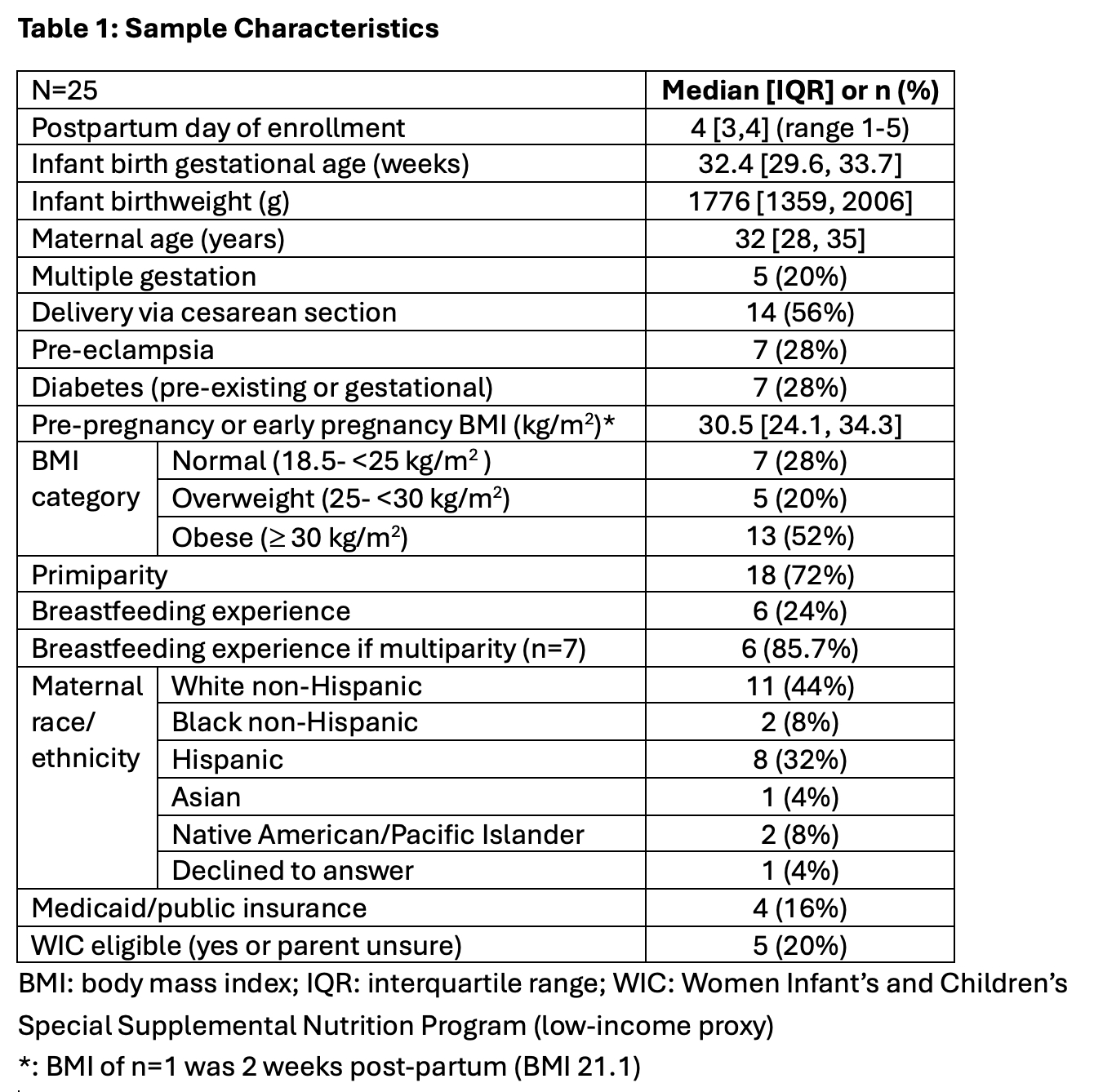 Table 1
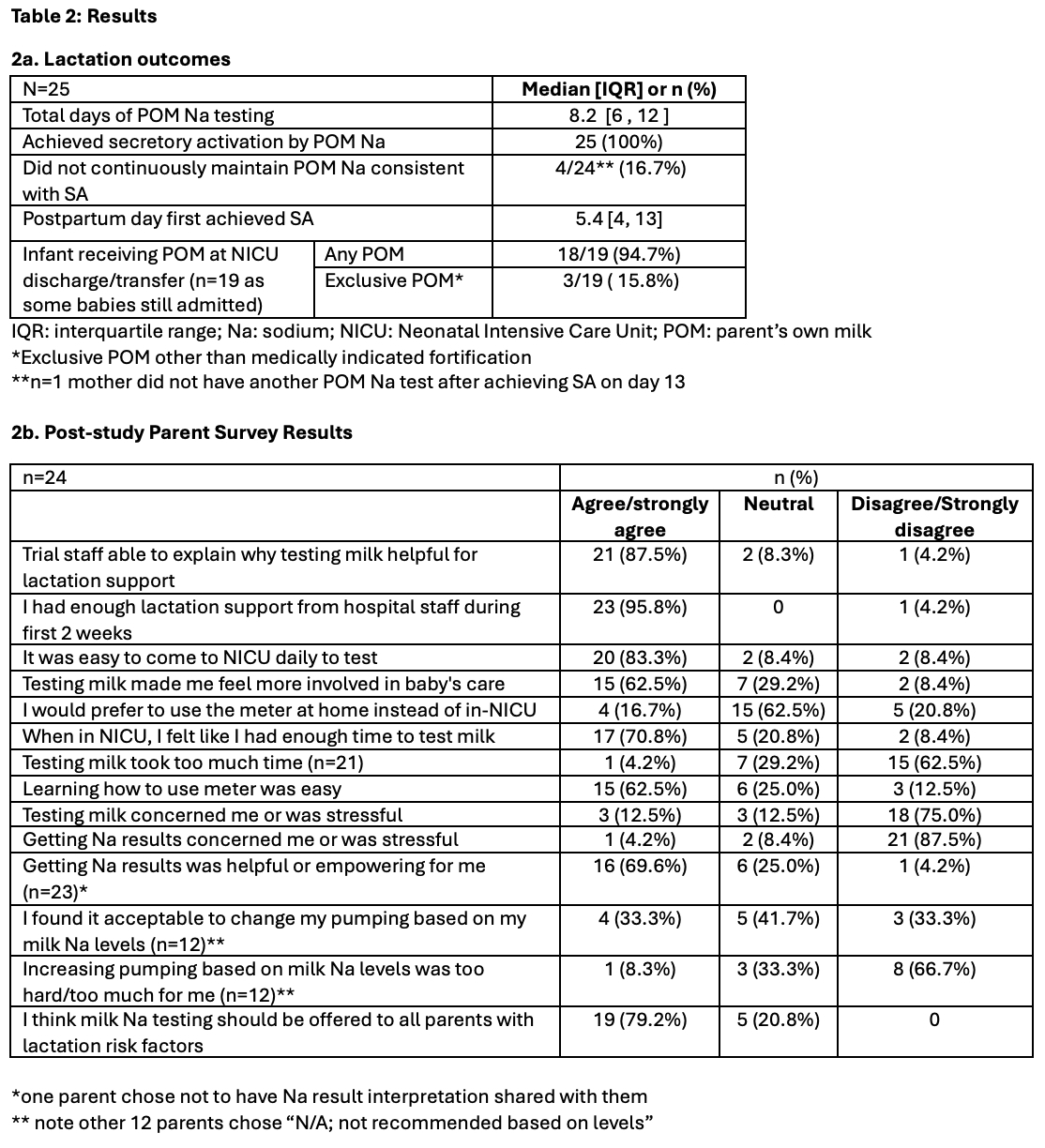 Table 2
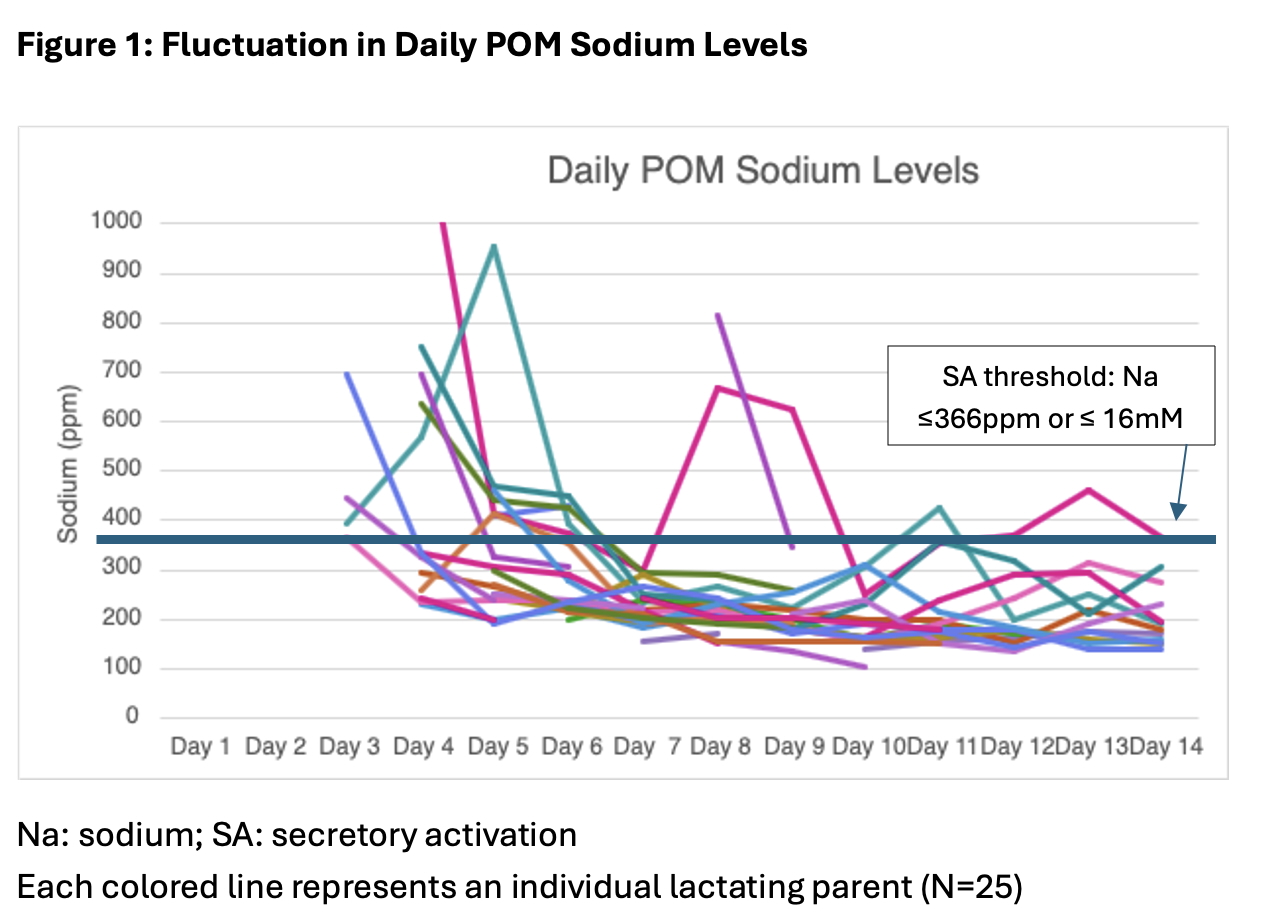 Figure 1