658 - Longitudinal growth trajectories of small vulnerable newborns in rural Ethiopia
Sunday, April 26, 2026
9:30am - 11:30am ET
Publication Number: 3637.658
Nandita Perumal, University of South Carolina, Columbia, SC, United States; Firehiwot Workneh, Addis Continental Institute of Public Health, Addis Ababa, Adis Abeba, Ethiopia; Nebiyou Fasil, Addis Continental Institute of Public Health, Addis Ababa, Adis Abeba, Ethiopia; Kalkidan OS. Yibeltal, University of South Carolina, Columbia, SC, United States; Unmesha Roy Paladhi, The Warren Alpert Medical School of Brown University, Providence, RI, United States; Yumin Kim, The Warren Alpert Medical School of Brown University, Boston, MA, United States; Krysten North, Brigham and Women's Hospital, Boston, MA, United States; Theresa I. Chin, The Warren Alpert Medical School of Brown University, 200 Chestnut St, RI, United States; Fred Van Dyk, Johns Hopkins University -- School of Public Health, baltimore, MD, United States; Parul Christian, Johns Hopkins Bloomberg School of Public Health, BALTIMORE, MD, United States; Yemane Berhane, Addis Continental Institute of Public Health, Addis Ababa, Adis Abeba, Ethiopia; Anne CC Lee, Warren Alpert Medical School of Brown University, Providence, RI, United States
Assistant Professor University of South Carolina Columbia, South Carolina, United States
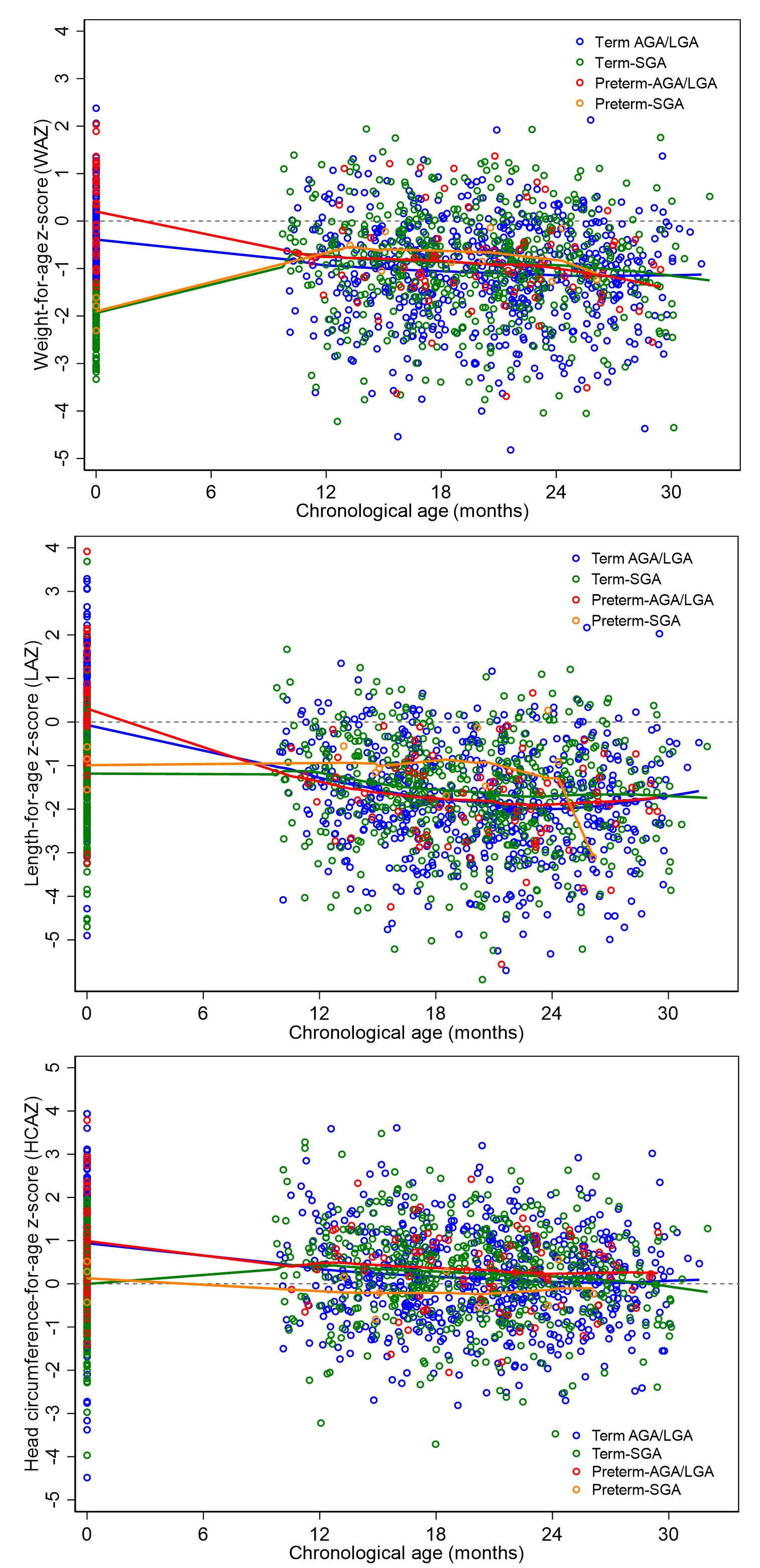
Background: Evidence on longitudinal growth trajectories of children born preterm ( < 37 weeks of gestational age [GA]) and small-for-gestational age [GA] (SGA) ( < 10th percentile of birthweight-for-GA) - collectively, small vulnerable newborns - is limited. Objective: To estimate the growth trajectories of children from birth up to 24 months of age by newborn type in rural Ethiopia. Design/Methods: We followed 462 infants from birth up to 24 months who were born to women previously enrolled in a pragmatic randomized clinical effectiveness trial testing a nutrition and infection prevention intervention in rural Amhara, Ethiopia (ISRCTN15116516). Child anthropometry was measured at birth, 12, 18, and 24 months using standardized procedures. Age- and sex-standardized anthropometric indices (weight-for-age [WAZ], length-for-age [LAZ], and head circumference-for-age [HCAZ] z-scores) were derived using the Intergrowth-21st Newborn Size Standards at birth in conjunction with the World Health Organization Child Growth Standards (WHO-GS) for postnatal growth. Postmenstrual age (i.e., corrected GA) was used for preterm-born infants when using the WHO-GS. Generalized estimating equations with piecewise linear spline terms for postnatal age were used to estimate longitudinal growth trajectories by newborn type (Term-nonSGA [reference], Term-SGA, and Preterm-nonSGA), adjusting for intervention assignment. Results: Overall, 52% (223/425) infants were term-nonSGA, 40% (169/425) were term-SGA, 7.8% (33/425) were preterm-nonSGA. Infants born term-SGA had the lowest birth size (mean SD [95%CI]: WAZ, -1.55 [-1.66, -1.43]; LAZ, -1.16 [-1.42, -0.09]; and HCAZ, -0.93 [-1.15, -0.70]). Compared to term-nonSGA infants, term-SGA infants demonstrated a rapid increase in anthropometric indices from birth to 12 months (SD change per one month [95%CI]: WAZ, 0.15 [0.12, 0.17]; LAZ, 0.11 [0.08, 0.15]; HCAZ, 0.09 [0.05, 0.12]) followed by a decreasing slope between 12 to 18 months. In contrast, compared to term-nonSGA infants, preterm-nonSGA infants had higher average birthweight, followed by a declining slope for WAZ and LAZ (for each: -0.04 SD per month, 95%CI: -0.10, 0.01) in the first 12 months, with the slopes declining further between 12-24 months, particularly for LAZ.
Conclusion(s): Preterm and SGA infants had similar z-score to term-nonSGA infants by 12 months; though term-nonSGA infants demonstrated a rapid decline in anthropometric indices in the first 12 months. Interventions to support growth of term-nonSGA infants in the first year, and preterm and term-SGA children beyond infancy are needed.
Figure 1: Longitudinal growth trajectories of small vulnerable newborns in rural Ethiopia