199 - No Results Left Behind: An Educational QI Initiative to Build Resident Accountability in Test Result Management
Sunday, April 26, 2026
9:30am - 11:30am ET
Publication Number: 3191.199
Tuana Demir, Inova Children's Hospital, McLean, VA, United States; Kenneth J. Lopez, Inova Children's Hospital, McLean, VA, United States; Anjana Bhami Shenoy, Inova Children's Hospital, Tysons, VA, United States; Ananya Sarkar, Inova Children's Hospital, Herndon, VA, United States; Andrew McManus, Inova Children's Hospital, McLean, VA, United States; Maria Cheema, Inova Children's Hospital, Alexandria, VA, United States; Jahnvi Jani, Inova Children's Hospital, Falls Church, VA, United States; Sarah A.. Mohammad, Inova Children's Hospital, Falls Church, VA, United States; Erica H. Yi, Inova Children's Hospital, Reston, VA, United States; Claire M. Saunders, Inova Children's Hospital, Falls Church, VA, United States; Swathi Deo V. Sambatha, Inova Children's Hospital, Fairfax, VA, United States; Tin Nguyen-Phan, Inova Children's Hospital, Fairfax, VA, United States; Ahmed Nabila, Inova Children's Hospital, Herndon, VA, United States; Meredith Carter, Inova Children's Hospital, Fairfax, VA, United States; Courtney Port, Inova Children's Hospital, Falls Church, VA, United States
Resident Physician Inova Children's Hospital McLean, Virginia, United States
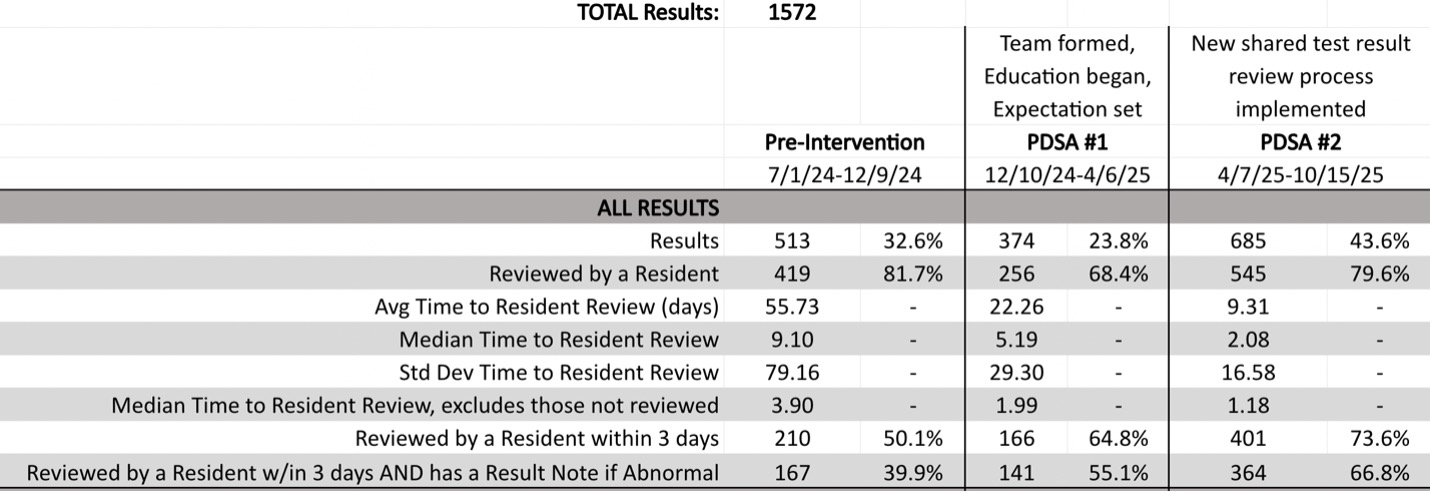
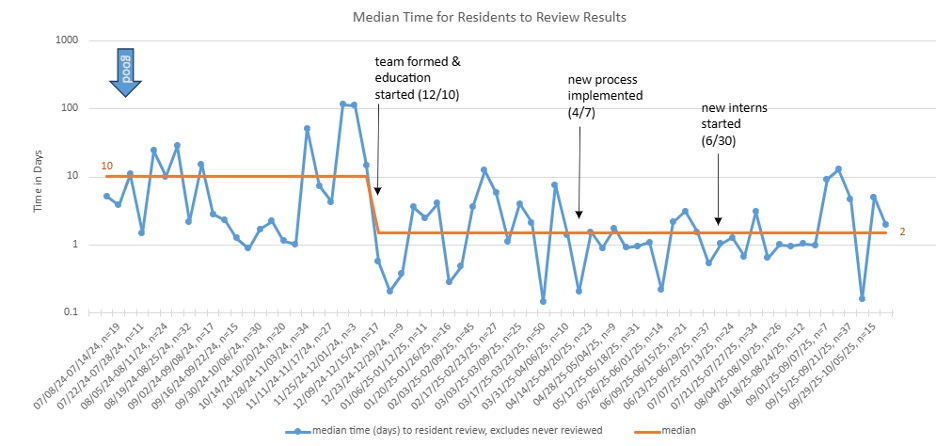
Background: Managing tests resulted via electronic health records following patient encounters is an important responsibility in most physician specialties. Failure to address these results in a timely manner has been identified as a major patient safety concern by several organizations, but research shows that the time involved in this review process contributes to the risk of burnout. Therefore, it is crucial that physicians learn this skill during residency training. On a local needs assessment, resident self-reported confidence for managing results outside of the outpatient encounter prior to the intervention was 10% (n=10) of all and 30% (n=3) of 3rd-year residents. Objective: We aim to improve resident preparedness for managing outpatient results through an iterative educational process which increases the proportion of timely and appropriately managed results of all resident-ordered clinic tests from 32% to 80% within 12 months. Design/Methods: This single-center QI project was conducted in an academic pediatric outpatient safety net clinic. All in-basket results from testing ordered by residents were included (baseline: 7/2024-12/2024 and post-intervention: 12/2024-11/2025). The Model for Improvement and PDSA cycles were utilized. Residents were educated on the burnout and safety risks of delayed in-basket management. A parallel process was developed to prioritize resident result management that included clinic residents linking in-baskets, assigning residents to review results daily, and managing abnormal results with attending supervision. Process and outcome measures were analyzed using run charts. Results: We reviewed 1572 results (Table 1). The median time for residents to review results decreased from 10 days to 2 days (Fig 1). The percentage of results reviewed within 3 days increased from 50% to 74%. The percentage of results managed timely (within 3 days) and appropriately (plans documented for abnormal results with attending supervision) increased from 40% to 55% after the first PDSA cycle and then to 67% after the second PDSA cycle. The median percentage of results reviewed by a resident remained stable at around 80%.
Conclusion(s): Incorporating residents into a structured workflow supported by attending oversight enhances resident experience in safe, timely, and accurate result management. Next steps include creating a recurring orientation process for clinic residents on test result management in order to reach our aim. This model may serve as a sustainable approach to improving test result management in residency training programs.
Table 1: Metrics for Resident Review of Test Results Pre- and Post-Intervention
Figure 1: Run Chart of Median Time to Resident Review of Test Results Over Time