659 - Average Cost of Trauma Care for Emergency Patients in Northwest Tanzania
Sunday, April 26, 2026
9:30am - 11:30am ET
Publication Number: 3638.659
Arthi S. Kozhumam, Northwestern University The Feinberg School of Medicine, Chicago, IL, United States; Shahzmah A.. Suleman, Bugando Medical Centre, Mwanza, Mwanza, Tanzania; Colleen Fant, Ann & Robert H. Lurie Children's Hospital of Chicago, Chicago, IL, United States
MD-PhD Candidate Northwestern University The Feinberg School of Medicine Chicago, Illinois, United States
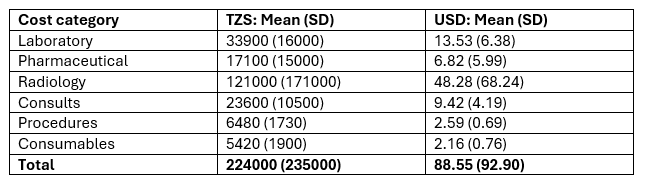
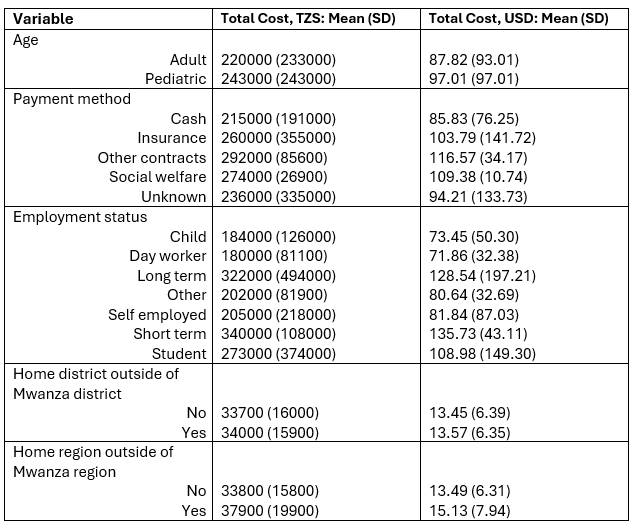
Background: In Tanzania, road traffic collisions account for 60% of injury fatalities. Little is known in Tanzania about cost of trauma care to patients. Our team created a standard process for evaluation and documentation of trauma patients at Bugando Medical Center (BMC), a tertiary referral hospital in northwest Tanzania, to describe trauma characteristics and risk factors. Objective: To identify the average and distribution of cost of care for BMC trauma patients; and evaluate differences across age, payment method, employment status, and district/region of residence. Design/Methods: We conducted a cross-sectional analysis of adult and pediatric patients enrolled in a trauma registry from March-August 2023 via the emergency department (ED) of BMC. Overall (PMID:39716057) and pediatric (PMID:41035771) trauma patient characteristics have been previously described. Data were collected using the WHO trauma form. Demographic variables including average monthly income and cost of care (laboratory, pharmaceutical, radiology, consults, procedures, consumables; and total cost) were assessed. Data were entered into REDCap and descriptive statistics were created in RStudio. Costs are presented in Tanzanian shilling (TZS) and USD. Results: For the 570 patients enrolled in the registry, the average total cost of care was $88.55 (SD: $92.90). 44 (7.7%) were missing costs related to laboratory testing, 122 (21.4) to pharmaceuticals, 110 (19.3%) radiological evaluation, 69 (12.1%) consults, 229 (40.2%) procedures, and 216 (37.9%) to consumables. Of 348 (61.1%) with listed monthly income in TZS, 94 (27.0%) earned < 100,000 ( <$39.92), 183 (52.6%) earned between 100,001-300,000 ($39.92-119.76), 59 (17.0%) earned between 300,001-500,000 ($119.77-199.60), and the remaining 12 (3.4%) earned >500,000 (>$199.60). Procedures and consumables were cheapest, and radiology costs were most expensive (Table 1). Average total pediatric care cost (n=119) was not significantly more expensive than adult care (n=451) (X2 p=0.2397), while total cost of care was most expensive for those paying via social welfare (n=8), insurance (n=83), and other contracts (n=7). Total costs of care for patients at BMC coming from out of district or region, compared to those from Mwanza, were not significantly different (district X2 p=0.362, region X2 p=0.346) (Table 2).
Conclusion(s): While insurance subsidized costs, the average total cost of care was >75% of the monthly salary for more than half of the patients in the registry. More effort is needed to collect and support the cost of care for patients traveling to BMC from both within and outside of the region.
Cost of care overall and per category, mean and standard deviation
Cost of care across demographic variables, mean and standard deviation