648 - Associations between maternal dietary diversity and infant birth outcomes in Ethiopia
Sunday, April 26, 2026
9:30am - 11:30am ET
Publication Number: 3628.648
Unmesha Roy Paladhi, The Warren Alpert Medical School of Brown University, Providence, RI, United States; Firehiwot Workneh, Addis Continental Institute of Public Health, Addis Ababa, Adis Abeba, Ethiopia; Parul Christian, Johns Hopkins Bloomberg School of Public Health, BALTIMORE, MD, United States; Krysten North, Brigham and Women's Hospital, Boston, MA, United States; Nandita Perumal, University of South Carolina, Columbia, SC, United States; Nebiyou Fasil, Addis Continental Institute of Public Health, Addis Ababa, Adis Abeba, Ethiopia; Yemane Berhane, Addis Continental Institute of Public Health, Addis Ababa, Adis Abeba, Ethiopia; Anne CC Lee, Warren Alpert Medical School of Brown University, Providence, RI, United States
Postdoctoral Research Associate The Warren Alpert Medical School of Brown University Seattle, Washington, United States
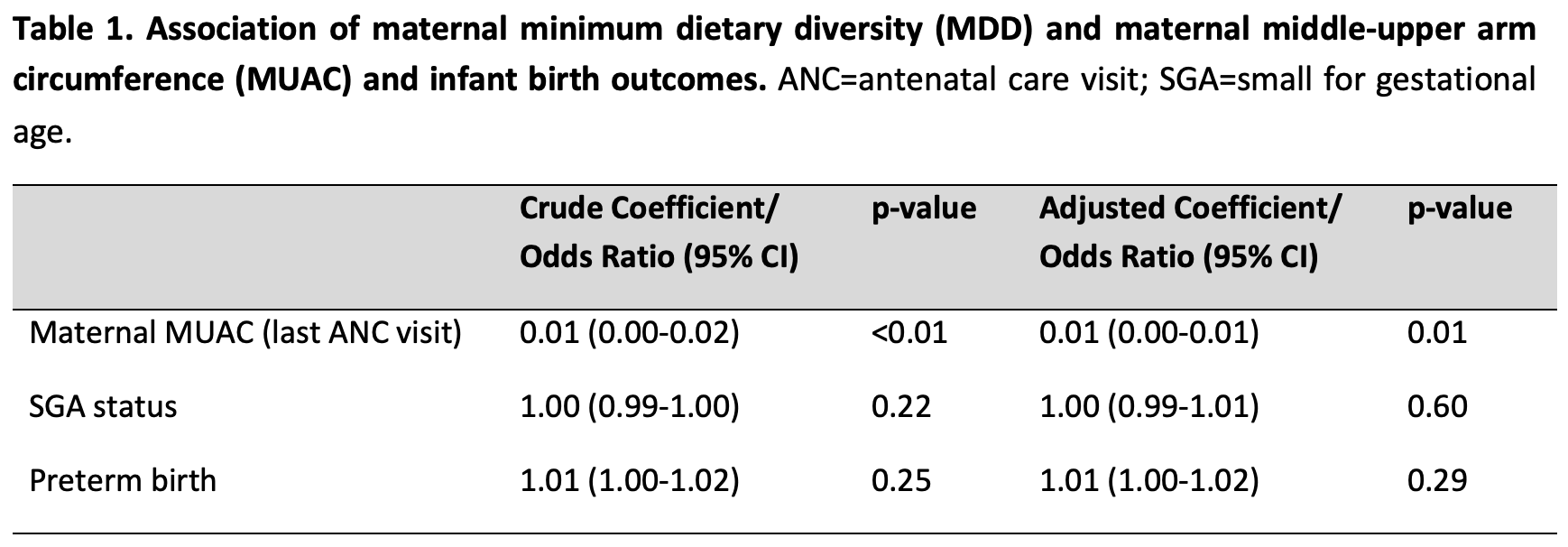
Background: Consuming a diverse diet during pregnancy may improve maternal nutritional status and birth outcomes, but these relationships are understudied in low-income settings. Objective: To determine the association between maternal minimum dietary diversity during pregnancy and 1) maternal mid-upper arm circumference (MUAC) and 2) birth outcomes, including small-for-gestational age (SGA, < 10th percentile for age by INTERGROWTH standards) and preterm birth ( < 37 weeks' gestational age). Design/Methods: The parent study enrolled pregnant women (≤24 weeks gestation) in a cluster-randomized effectiveness study of prenatal nutrition and infection control packages in rural Amhara, Ethiopia. Pregnancies were ultrasound dated, and maternal 7-day dietary recall and MUAC were collected during antenatal care (ANC) visits. Newborns were weighed within 72 hours of life with high-quality digital scales. Minimum dietary diversity for women (MDDW) was calculated as a binary where women reported consuming ≥5 of the following food groups: 1) grains, roots, and tubers, 2) pulses, 3) nuts and seeds, 4) dairy, 5) meat, poultry, and fish, 6) eggs, 7) dark leafy greens and vegetables, 8) other vitamin A-rich fruits and vegetables, 9) other vegetables, and 10) other fruits in the past 7 days. We then calculated the percentage of antenatal care visits women met MDDW. We conducted linear and logistic regression analyses to determine the association between percent of ANC visits meeting MDDW and 1) maternal MUAC at the last ANC visit and 2) newborn SGA status and preterm birth, adjusting for health center (cluster), maternal education, parity, and food insecurity a priori across all models. Results: Of the 2392 enrolled pregnant women in the study between 2020-2021 in the rural region of Amhara, Ethiopia, 2376 were included in this secondary data analysis. Half the participants had no formal education, 71% had parity >1, and 90% were food secure. Only 4.35% participants met MDDW at 50% or more ANC visits. Mean MUAC at the last ANC visit was 24.0cm (SD=1.96). Percent of ANC visits meeting MDDW during pregnancy was significantly associated with increased maternal MUAC at last ANC visit (adjusted coefficient: 0.01, 95% CI: 0.00-0.01, p=0.01). Maternal MDD was not significantly associated with SGA status (aOR: 1.00, 95% CI: 0.99-1.01) or preterm birth (aOR: 1.005, 95% CI: 0.996-1.015).
Conclusion(s): MDDW was associated with maternal undernutrition via MUAC measurement, but may not be a sufficiently sensitive indicator to detect very small effect sizes on birth outcomes.
Table 1. Association of maternal minimum dietary diversity (MDD) and maternal middle-upper arm circumference (MUAC) and infant birth outcomes. ANC=antenatal care visit; SGA=small for gestational age.