649 - Detecting Hidden Wasting in Infants with Severe Hydrocephalus: A Machine Learning Model Using Standard Anthropometric Measures
Sunday, April 26, 2026
9:30am - 11:30am ET
Publication Number: 3629.649
Julia Tatz, Boston Children's Hospital, Brookline, MA, United States; Davis Natukwatsa, Cure Children's Hospital of Uganda, Mbale, Mbale, Uganda; Rutvi Vyas, Boston Children's Hospital, Boston, MA, United States; Miriah Kemigisha, CURE CHILDREN'S HOSPITAL OF UGANDA, mbale, Mbale, Uganda; Marvin Seruwu, Cure children's hospital of Uganda, Mbale, Mbale, Uganda; Starlin Tindimwebwa, CURE CHILDRENS HOSPITAL MBALE, JINJA, Jinja, Uganda; Moses Wabukoma, CURE Children's Hospital of Uganda, Mbale, Mbale, Uganda; Joshua Jayz. Magombe, NeuroKids.org, Kampala, Kampala, Uganda; Brian K. Nsubuga, Neurokids, Mbale, Mbale, Uganda; Collins Akugizibwe, CURE Children's Hospital of Uganda, Mbale, Mbale, Uganda; Simeo Ochieng, CURE Hospital, GOMA, Mukono, Uganda; yasmin Cerqueira, University of Sao Paulo, São Paulo, Sao Paulo, Brazil; Astrid G. Zazueta, Boston Children's Hospital, Boston, MA, United States; Alissar Dalloul, Boston Children's Hospital, Cambridge, MA, United States; Marcia H. Yoshikawa, Boston Children's Hospital, Boston, MA, United States; Enock Kainja, Cure children's hospital of Uganda, mbale, Mbale, Uganda; Esther Nalule, Cure Children's Hospital of Uganda, Mbale, Mbale, Uganda; Ronald Mulondo, Yale School of Medicine, New haven, CT, United States; Edith Mbabazi-Kabachelor, Yale School of Medicine, New Haven, CT, United States; Steven J. Schiff, Yale School of Medicine, New Haven, CT, United States; Jennifer T. Queally, Boston Children's Hospital, Boston, MA, United States; P. Ellen grant, Boston Children's Hospital, Boston, MA, United States; Emmanuel Wegoye, CURE children's Hospital Uganda., Mbale, Mbale, Uganda; Sutin Jason, Boston Children's Hospital, Boston, MA, United States; Pei-Yi Lin, Boston Children's Hospital, Cambridge, MA, United States; Humphrey Okechi, CURE Children's Hospital of Uganda, Mbale, Mbale, Uganda
Assistant Professor Boston Children's Hospital Harvard Medical School Cambridge, Massachusetts, United States
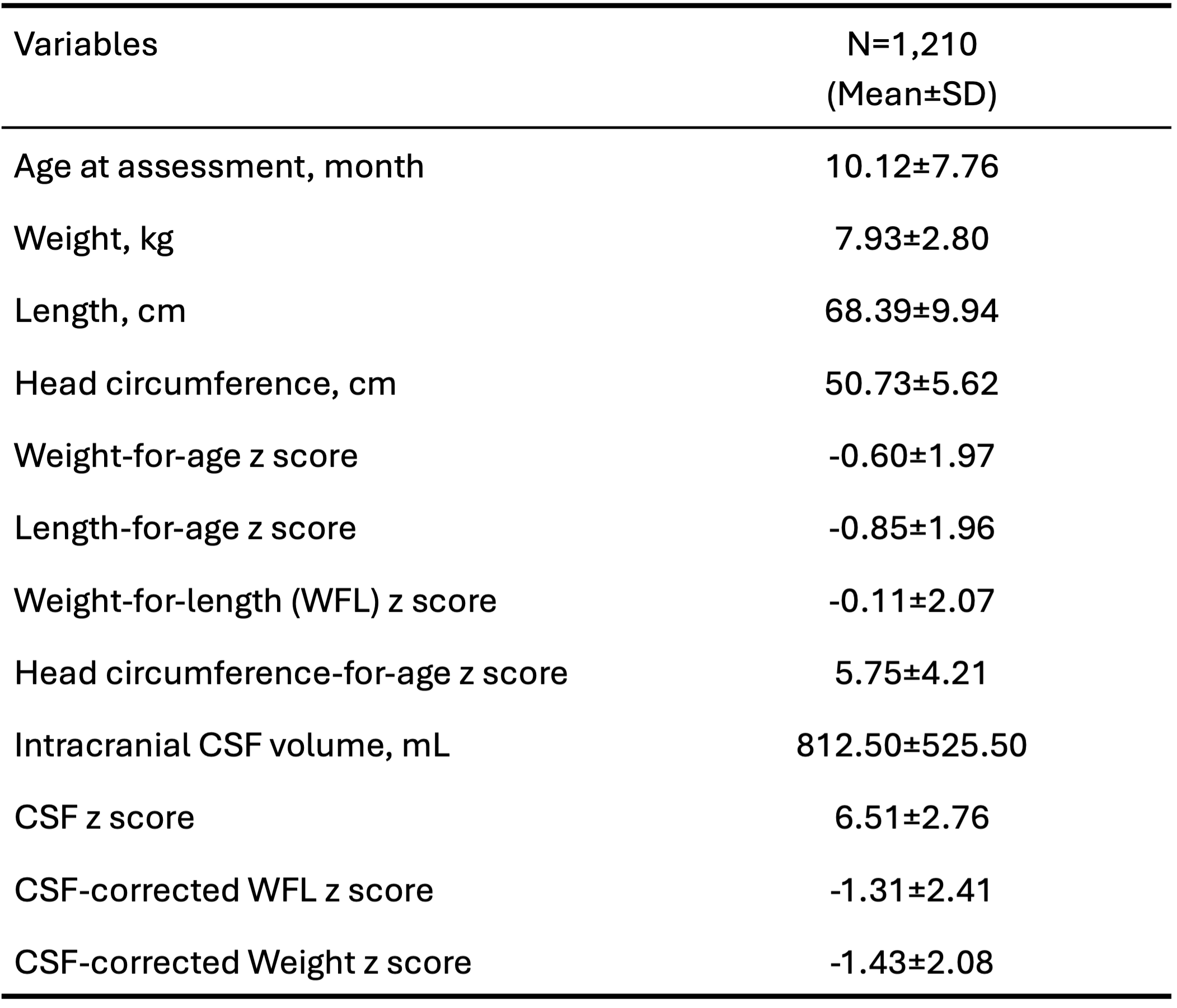
Background: The prevalence of malnutrition in children under five is high in low- and middle- income countries, with suspected greater risk in those with neurological disorders. Infant hydrocephalus affects about 250,000 newborns in sub-Saharan Africa annually, yet nutritional status is poorly reported. Excess cerebrospinal fluid hinders traditional anthropometric assessment, and accurate diagnosis requires subtracting CSF weight from body weight, but imaging tools are often unavailable in resource-limited settings. Objective: To determine the prevalence of malnutrition in Ugandan infants with severe hydrocephalus using CSF-corrected weight, and to develop a machine learning (ML) model to predict wasting using standard anthropometric measures alone. Design/Methods: This analysis included 296 infants with hydrocephalus at Cure Children's Hospital of Uganda (NCT03650101) with longitudinal CT scans and anthropometric assessments. CSF-corrected weight was calculated by subtracting excess intracranial CSFV from body weight and age-sex-matched z-scores were calculated. Wasting was defined as weight-for-length z-score <-2. A Support Vector Classification model was trained using the stratified 5-fold cross-validation method with repetition. Results: A total of 1,210 visits (mean [SD] age, 10.1 [7.8] months) were analyzed. The cohort demonstrated severe hydrocephalus with median [IQR] excess CSF volume of 542.0 [312.6-885.3] mL and CSF z-score of 6.5 [4.9-8.3]. Median [IQR] weight-for-length z-score changed from -0.023 [-1.22 to 1.15] (uncorrected) to -1.1 [-2.5 to 0.22] (CSF-corrected). Critically, 45.3% (N=134) had at least one missed diagnosis using standard measurements. The optimal model using weight, weight-for-age z-score, weight-for-length z-score, head circumference-for-age z-score, and head circumference-for-length z-score achieved 94.6% accuracy, 91.3% recall, 93.0% precision, and AUC 0.99.
Conclusion(s): Nearly half of patients experienced at least one missed diagnosis when using standard anthropometric criteria. Using only age, weight, length, and head circumference, our machine learning model accurately predicts wasting without requiring CSF volume measurement or CT imaging. Our model enables identification of a previously hidden population of malnourished infants who may be at higher risk for poor outcomes. Implementation of this model could potentially improve longitudinal monitoring of nutritional status in resource-limited settings where hydrocephalus is endemic.