11 - Impacts of school-based health centers in Oregon on student health care use, need, and health outcomes
Sunday, April 26, 2026
9:30am - 11:30am ET
Publication Number: 3010.11
Ashley M. Kranz, RAND, Arlington, VA, United States; Katherine M.. Rancaño, RAND, Boston, MA, United States; Laura J. Faherty, MaineHealth, Portland, ME, United States; Catria Gadwah-Meaden, RAND, Boston, MA, United States; Christine Mulhern, RAND, Santa Monica, CA, United States
Senior Policy Researcher RAND Arlington, Virginia, United States
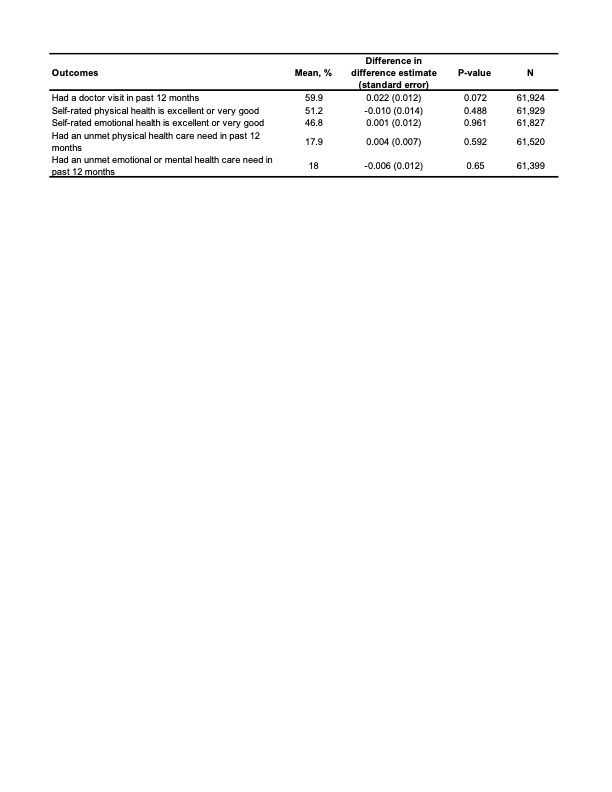
Background: School-based health centers (SBHCs) are located at schools and provide comprehensive primary medical care at low or no cost to students and community members. SBHCs are well-positioned to reduce disparities in health outcomes and health care use by eliminating transportation and cost barriers and primarily serving communities with low household incomes and high health care needs. Objective: To determine the impact of SBHCs on the health care use, need, and health outcomes for high school students in Oregon. Design/Methods: We linked 8 years of biannual student-level survey data for 11th grade students in Oregon to information about the locations and opening dates of SBHCs in high schools from 2007 to 2019. We used a stacked difference-in-differences regression approach which accounts for differences in outcomes over time and across schools. We estimate the effect of a SBHC opening on student-level outcomes. We examined the following outcomes: having a doctor visit in the past 12 months, any unmet physical health care need in past 12 months, any unmet emotional or mental health care need in past 12 months, if self-rated physical health was excellent or very good, and if self-rated emotional health was excellent or very good. Results: Depending on the outcome, we examined 61,520 to 61,929 student-year observations. These students attended 181 schools, of which 33 (18.2%) had a SBHC that opened during our study period. The Table shows the share of students with each outcome of interest. In our sample, 59.9% of 11th grade students had a doctor visit in the past 12 months. The results of our difference-in-differences regression approach show that a SBHC opening was associated with a 2.2 percentage point increase in the likelihood of a student reporting having visited a doctor in the past 12 months (standard error = 1.20, P=0.072). No other outcomes were statistically significantly associated with a SBHC opening.
Conclusion(s): Analysis of student-level survey data for 11th grade students in Oregon found that the opening of a SBHC increased the share of students that reported having a doctor visit in the past 12 months but was not associated with a change in reported emotional or physical health unmet need or outcomes. Further research is needed to determine the impacts of SBHCs in other communities and on additional outcomes.
Table Means and regression adjusted difference-in-differences estimates









 Means and regression adjusted difference-in-differences estimates