Session: Medical Education 7: Resident - Curriculum II
749 - Walking in Their Shoes: teaching access to care using a hands-on approach to understand health access barriers
Sunday, April 26, 2026
9:30am - 11:30am ET
Publication Number: 3725.749
Aditi Gupta, Baylor College of Medicine, Houston, TX, United States; Ana C. Monterrey, Baylor College of Medicine, Houston, TX, United States; Shelley Kumar, Baylor College of Medicine, Sugar Land, TX, United States
Associate Professor of Pediatrics Baylor College of Medicine Houston, Texas, United States
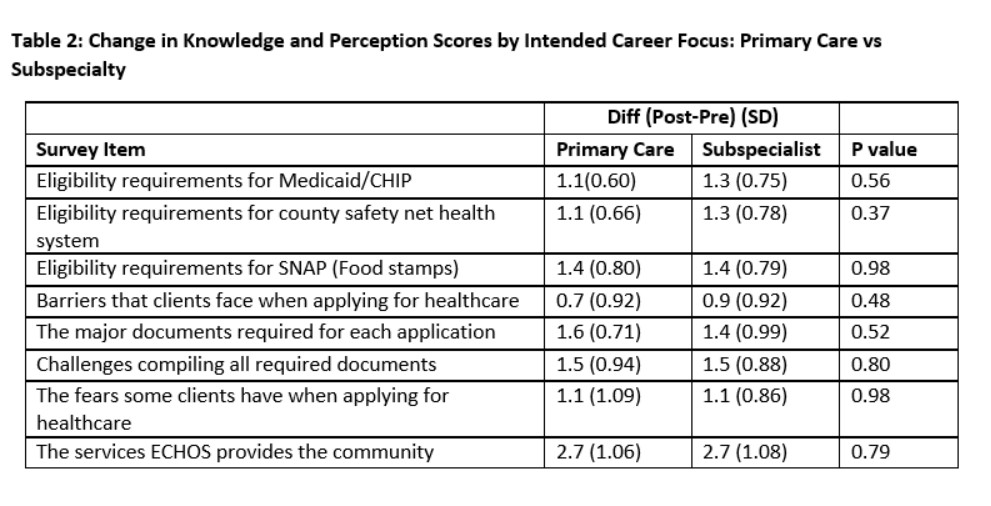
Background: Social determinants of health (SDOH) education is ACGME required for pediatrics. Access to health care is a vital educational component. Didactic knowledge alone does not provide residents with adequate understanding of complexities and barriers to accessing care. Experiential learning activities help residents gain empathy and reflect on situations their patients face. We partnered with a local community organization and together created an experiential curriculum where residents shadow a community health worker (CHW) helping families enroll in health benefits. Objective: Evaluate an experiential curriculum teaching residents about access to care eligibility and barriers. Design/Methods: During their community and advocacy rotation, pediatric residents spent a half day at a community organization. Residents completed pre- and post-surveys assessing knowledge of eligibility for governmental assistance programs. Each resident shadowed a CHW assisting clients with benefit applications and was encouraged to ask questions and engage in discussion. Data were analyzed using the Wilcoxon signed-rank test for pre-post comparisons and the Wilcoxon rank-sum test to compare change in scores between residents pursuing primary care versus subspecialty careers. Results: Of 53 residents enrolled, 46 (87%) consented and completed both surveys (September 2024-October 2025). Most were PGY-2 (74%) or PGY-3 (24%). Post-session responses showed statistically significant improvement in knowledge across all domains, particularly in understanding eligibility for Medicaid/CHIP and the county safety net health system, SNAP, understanding required documentation needed to apply, and understanding of services provided by the partner organization (Table 1). Residents strongly agreed that the experience enhanced their ability to address non-medical drivers of health [Median (IQR) = 5 (4-5)] and improved their understanding of access to care [Median (IQR) = 5 (4-5)]. No significant difference was observed in score changes between residents planning careers in primary care versus subspecialties (Table 2).
Conclusion(s): An experiential curriculum on access to care improved residents' knowledge about both eligibility requirements and barriers families encounter when accessing health benefits. This increased knowledge enhanced their perceived ability to address social drivers of health. Future work will include focus groups and/or individual interviews to learn more about knowledge gained.
Table 1: Knowledge of access to care eligibility requirements and barriers
Change in Knowledge and Perception Scores by Intended Career Focus: Primary Care vs Subspecialty










.jpg)