347 - Feeding Practices and Growth Outcomes among SGA and Non-SGA Extremely Preterm Infants in the Chinese Neonatal Network
Sunday, April 26, 2026
9:30am - 11:30am ET
Publication Number: 3334.347
Xing yu YANG, The University of Hong Kong-Shenzhen Hospital, Shenzhen, Guangdong, China (People's Republic); Jie yang, Fudan Children's Hospital, Shanghai, Shanghai, China (People's Republic); Qianshen Zhang, The University of Hongkong, Shenzhen Hospital, SHENZHEN, Guangdong, China (People's Republic)
The University of Hong Kong-Shenzhen Hospital Shenzhen, Guangdong, China (People's Republic)
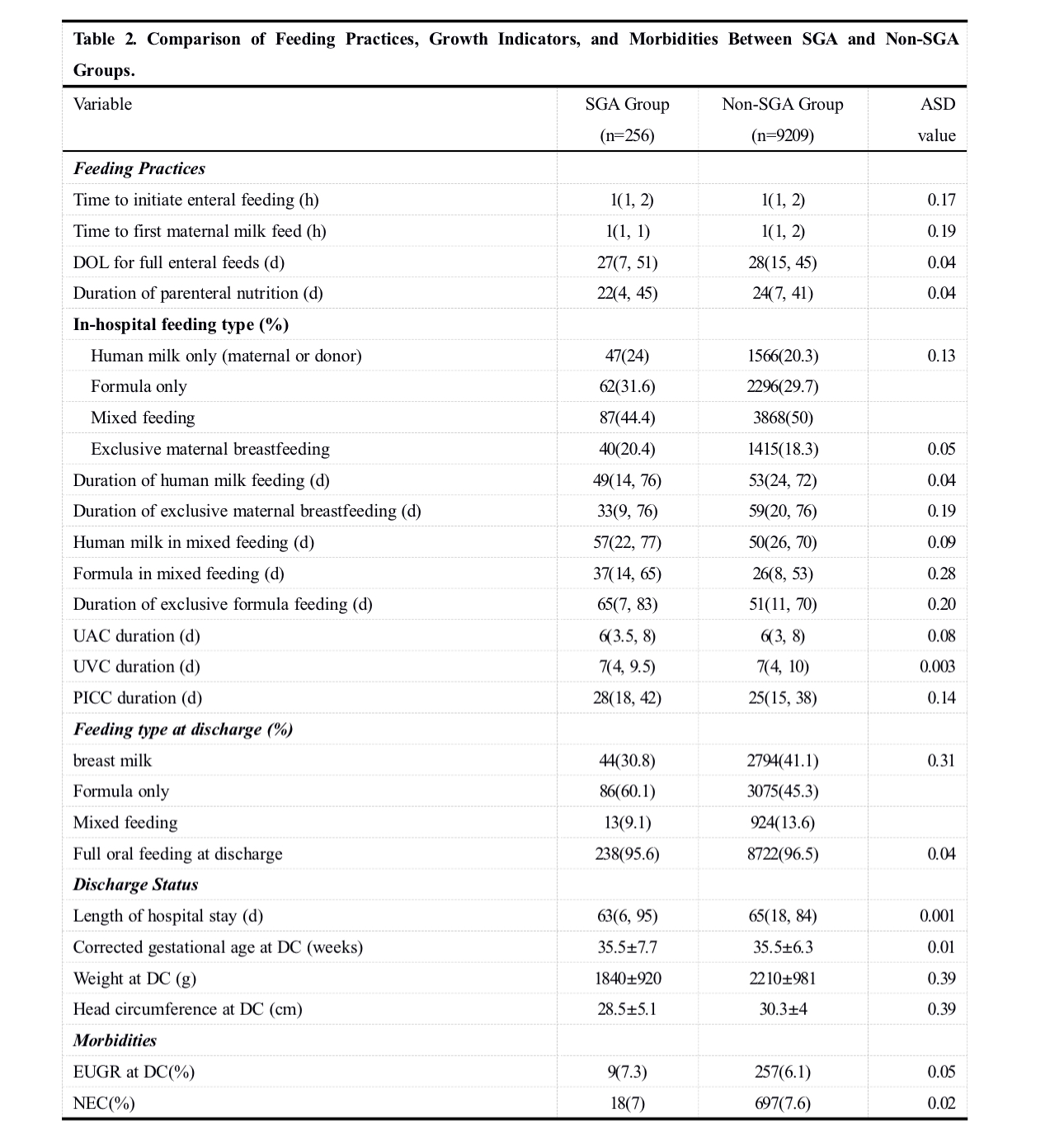
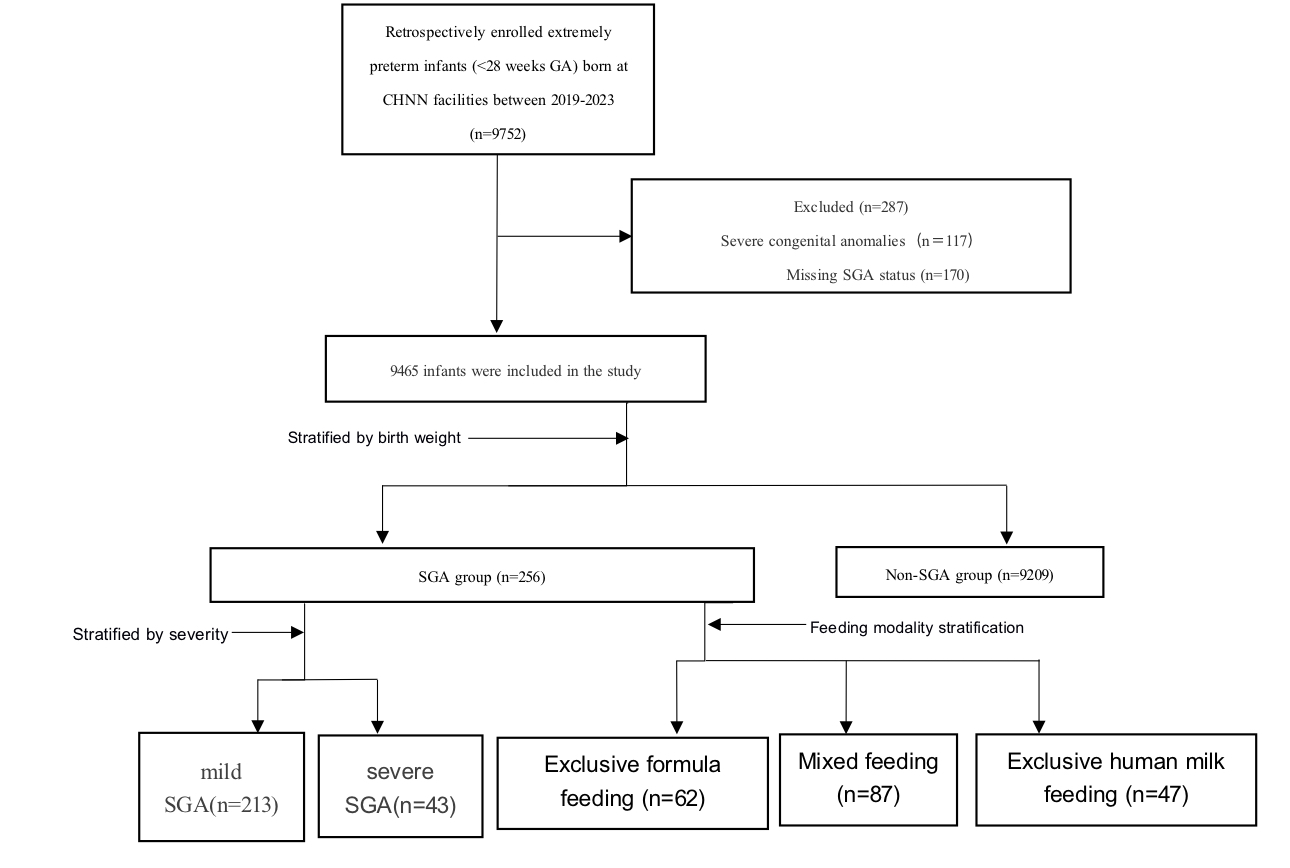
Background: Research on extremely preterm infants (EPI, gestational age < 28 weeks) who are also small-for-gestational-age (SGA) is limited. Investigating this high-risk subgroup is critical due to their combined challenges of prematurity and impaired intrauterine growth. Objective: To compare feeding practices and growth outcomes between SGA and non-SGA EPI within the Chinese Neonatal Network (CHNN). Design/Methods: This retrospective multicenter cohort study analyzed data from 9,465 EPI born between January 1, 2019, and December 31, 2023, across 112 CHNN neonatal intensive care units (NICUs). Infants with major congenital anomalies, chromosomal abnormalities, inherited metabolic diseases, or missing data were excluded. Participants were stratified into SGA (n=256) and non-SGA (n=9,209) groups based on birth weight. Feeding practices and growth outcomes were compared. Subgroup analyses within the SGA cohort were performed based on feeding type and SGA severity. Group comparisons utilized Pearson's chi-square, Student's t-test, or Mann-Whitney U test, with differences expressed using standardized differences or p-values. Results: The SGA group had a significantly lower mean birth weight (615±116 g vs. 942±193 g; standardized difference=2.06). Cesarean delivery rates and maternal hypertensive disorders were higher in the SGA group (standardized difference>0.5). SGA infants received less maternal human milk and had lower rates of exclusive human milk feeding at discharge (standardized difference>0.1). Time to achieve full enteral feeding, incidence of necrotizing enterocolitis (NEC), and rates of extrauterine growth restriction (EUGR) at discharge did not differ significantly between groups (standardized difference < 0.1). Within SGA subgroups, the exclusive human milk group achieved full enteral feeding faster (median 27 days) and had a shorter median hospital stay (36 days) compared to the exclusive formula (36 & 72 days) and mixed feeding groups (41 & 91 days) (p < 0.01). NEC and EUGR rates did not differ among these subgroups (p>0.05). Mortality was significantly higher in severe SGA (birth weight ≤3rd percentile) infants (65.1% vs. 36.6%; standardized difference=0.59). Surviving severe SGA infants took longer to achieve full enteral feeding (median 58 days) compared to mild SGA infants (39 days; standardized difference=0.5).
Conclusion(s): High mortality in severe SGA EPI and feeding difficulties in survivors necessitate targeted interventions. Promoting human milk feeding is essential to reduce prolonged hospitalization and improve outcomes.
Patient Selection and Study Flow Diagram
Baseline Characteristics of the Study Population. Values are number (percentage) unless stated otherwise.









.jpg)