710 - Assessing and Identifying Key Procedural Steps to Improve Pediatric Intraosseous Placement for Prehospital Providers Using a Novel Training Model
Sunday, April 26, 2026
9:30am - 11:30am ET
Publication Number: 3687.710
Anne Adema, Children's Hospital Colorado, Littleton, CO, United States; Kathleen Adelgais, University of Colorado School of Medicine, Aurora, CO, United States; Mairead Dillon, University of Colorado School of Medicine, Denver, CO, United States; Katherine Galloway, University of Colorado School of Medicine, Aurora, CO, United States; Madison Philbin, Palm Beach County Fire Rescue, Port Saint Lucie, FL, United States; Laura Rochford, Children's Hospital Colorado, Denver, CO, United States; Claire Gahm, Children's Hospital Colorado, Denver, CO, United States; Stephen Rineer, University of Colorado School of Medicine, Aurora, CO, United States; Molly Ray, Children's Hospital Colorado, Denver, CO, United States; Charles Coyle, Palm Beach County Fire Rescue, West Palm Beach, FL, United States; Peter Antevy, Palm Beach County Fire Rescue, Davie, FL, United States; Tony Zitek, The Permanente Medical Group, Tracy, CA, United States
Assistant Professor Pediatrics, Director Acute Care Education University of Colorado / Children's Hospital Colorado Littleton, Colorado, United States
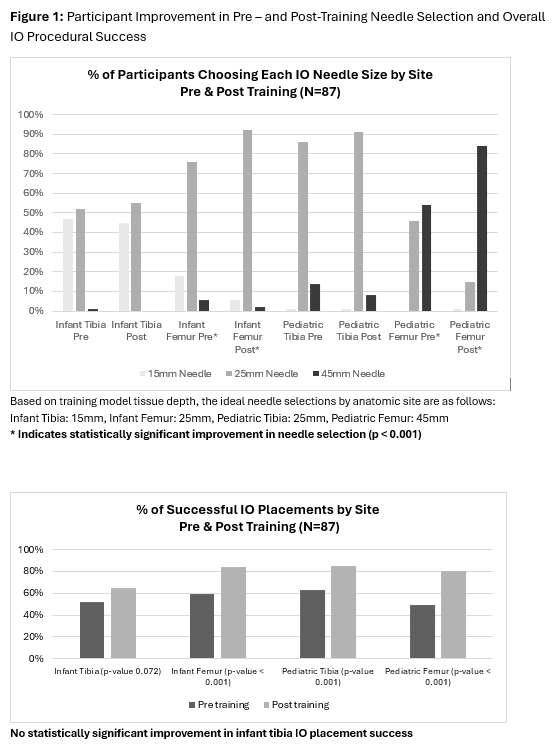
Background: Pediatric intraosseous (IO) access is a critical skill for Emergency Medical Services clinicians, yet prehospital studies show frequent malposition, placement delay, and short IO lifespan in children. Procedural success may be multifactorial, yet training gaps persist as current methods lack realistic visual, tactile, and spatial feedback. COMPLETE-IO, an anatomically realistic model of the infant and pediatric tibia-femur, enables full procedural practice with palpable landmarks and tactile feedback. It is unclear which procedural steps most influence successful tibia and femur IO placement. Objective: To assess key procedural steps affecting IO placement success before and after a brief educational intervention using COMPLETE-IO trainers Design/Methods: This prospective study video-recorded EMS clinicians from a single agency performing IO placement on COMPLETE-IO models before and after brief education and hands-on training. The models simulate accurate tissue depth, cortical thickness, and palpable landmarks, allowing reviewer assessment of landmark accuracy and appropriate needle selection at each anatomic site. Five independent pediatric emergency medicine experts reviewed pre-post procedural videos to assess accuracy of each Pediatric Advanced Life Support IO step, needle selection, and overall procedural success. McNemar's Chi-squared test with continuity correction compared pre- and post-training needle selection and overall procedural success for each site. P-values < 0.05 were considered statistically significant.. Results: A total of 105 EMS clinicians completed the training session of which 87 had complete pre-post procedural videos for review (Table 1). The steps with the lowest pre-training accuracy per site include landmark identification (correctly performed by 61-71% of participants), needle selection (47-86%), and stopping drilling upon loss of resistance (70-75%), reflect procedural challenges influenced by the unique anatomic features of pediatric patients (Table 2). Needle selection improved at the infant femur, pediatric tibia and femur, but worsened at the infant tibia. IO placement success improved for the infant femur, and pediatric tibia and femur (p, 0.001) (Figure 1).
Conclusion(s): A brief training intervention with COMPLETE-IO demonstrated statistically significant improvement in IO placement success at the infant femur and pediatric tibia and femur, though not at the infant tibia. Video review provides insight to current prehospital pediatric IO procedural competency and identifies factors to target for future improvement in procedural competency.
Table 1: Participant Characteristics
Table 2: Pre-and Post-Training Accuracy of the PAL Procedural Steps with Lowest Pre-Training Accuracy
Figure 1: Participant Improvement in Pre - and Post-Training Needle Selection and Overall IO Procedural Success by Site









.png)
.png)