349 - Cross-sectional associations of maternal dietary quality and human milk oligosaccharide (HMO) concentrations in a cohort of exclusively breastfeeding mother-infant dyads
Sunday, April 26, 2026
9:30am - 11:30am ET
Publication Number: 3336.349
Meghan Crimmins, University of Minnesota School of Public Health, Minneapolis, MN, United States; Annalee Furst, UC San Diego, San Diego, CA, United States; Emily M. Nagel, University of Minnesota Department of Pediatrics, Minneapolis, MN, United States; Chang Lu, Boston Children’s Hospital, Boston, MA, United States; Kelsey Johnson, Keck School of Medicine of the University of Southern California, Los Angeles, CA, United States; Arti Uniyal, Boston Children's Hospital, Brookline, MA, United States; Tiffany Gallagher, University of Minnesota, New Ulm, MN, United States; Elvira Isganaitis, Joslin Diabetes Center and Harvard Medical School, Boston, MA, United States; David A. Fields, University of Oklahoma College of Medicine, Oklahoma City, OK, United States; Lars Bode, University of California, San Diego, La Jolla, CA, United States; Ellen W. Demerath, University of Minnesota School of Public Health, Minneapolis, MN, United States
University of Minnesota School of Public Health Minneapolis, Minnesota, United States
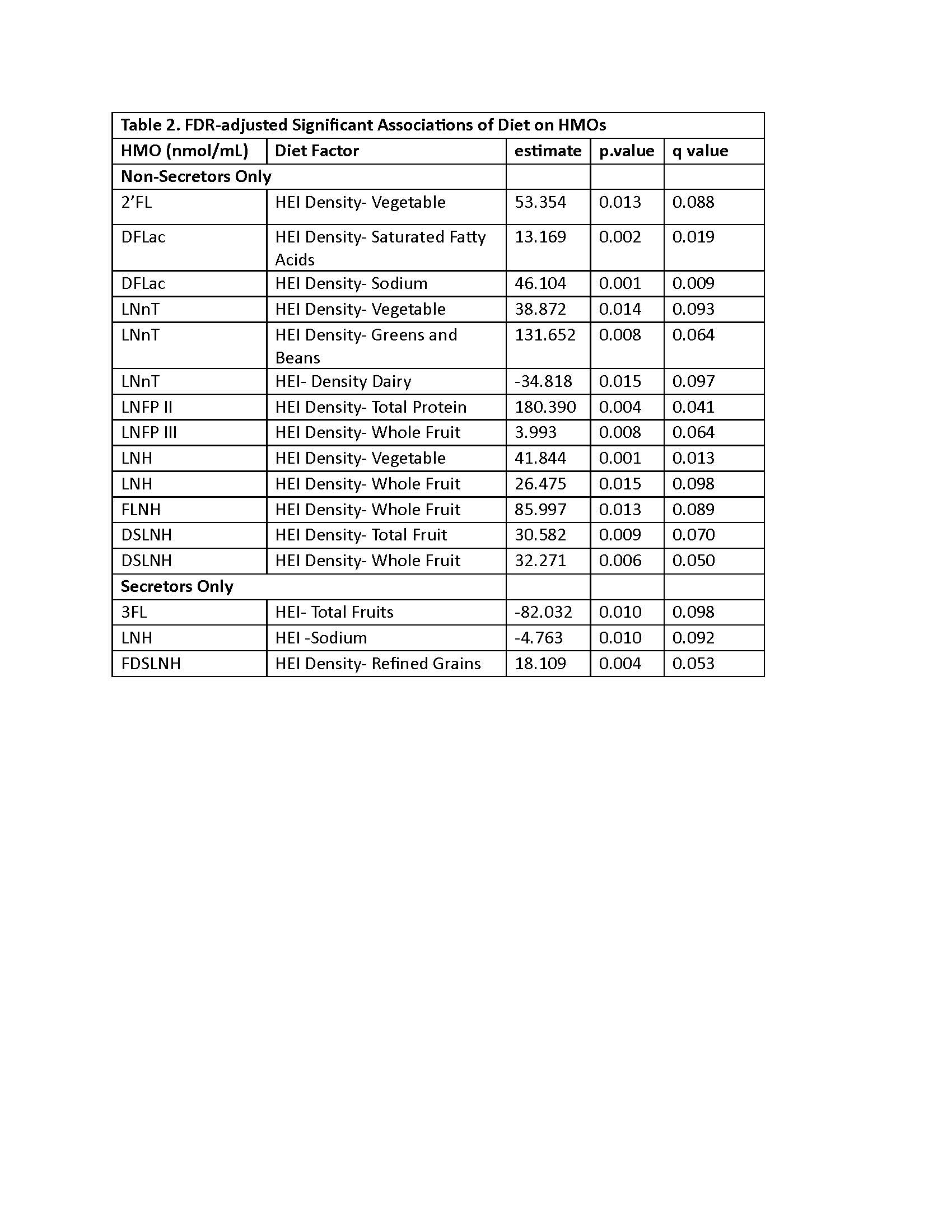
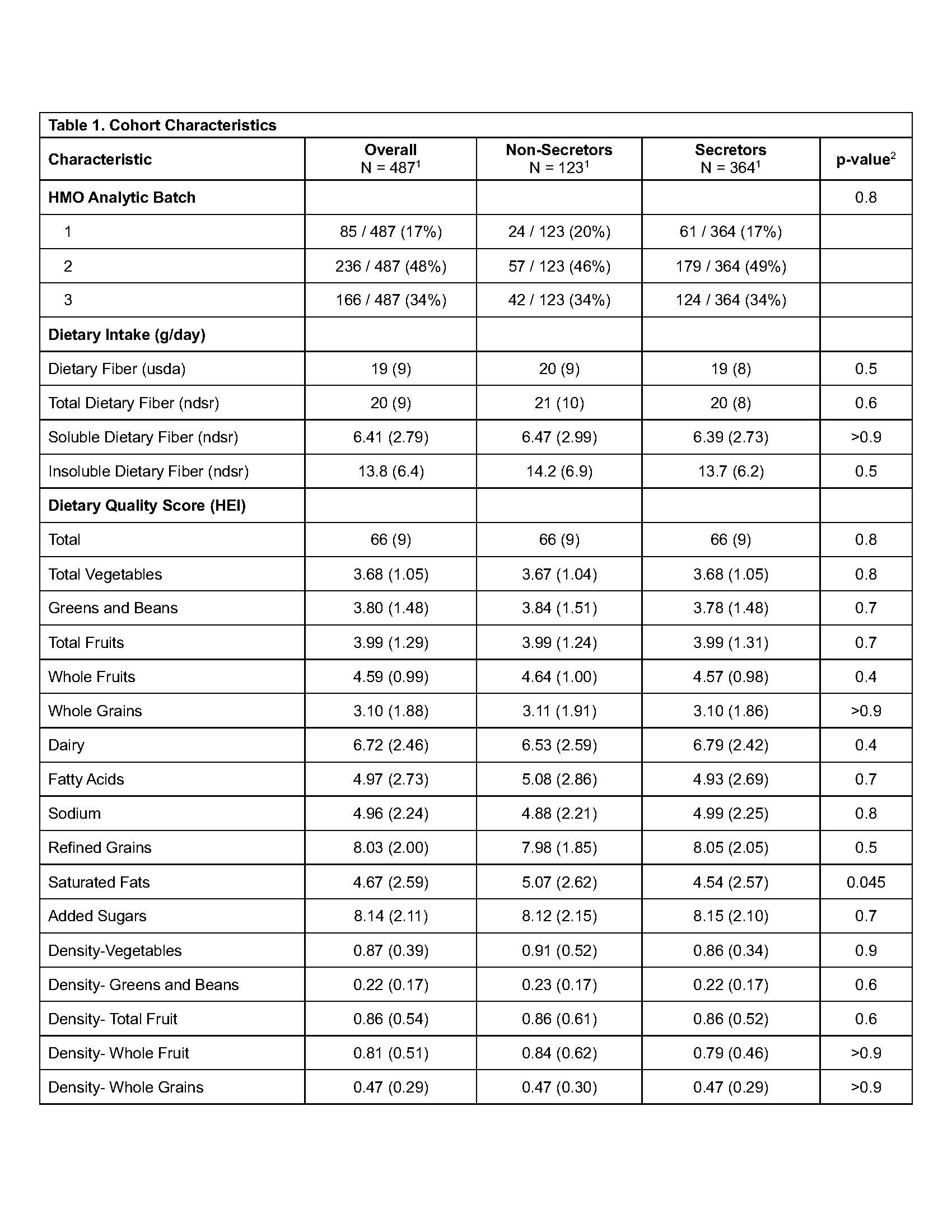
Background: Human Milk Oligosaccharides (HMOs) are unique to human milk and play important roles in shaping the infant gut microbiome and immune system. Maternal factors, including diet, influence HMO profiles, which can in turn affect infant growth and development. Objective: The aim of this analysis was to test cross-sectional associations of maternal dietary quality measures and HMO concentrations. Design/Methods: Maternal dietary information and human milk samples were collected at 1 month postpartum using Dietary History Questionnaires (DHQ) II and III in 487 exclusively breastfeeding members of the Mothers and Infants LinKed for Healthy Growth (MILk Study) from which Healthy Eating Index (HEI)-2015 scores and soluble and insoluble fiber intake (g/day) were calculated. The 19 most abundant HMO concentrations were measured by HPLC. Linear regression models stratified by secretor status tested the associations between total and HEI sub-scores and daily fiber intake with each HMO. Covariates included laboratory batch, infant gestational age at birth, exact age at study visit, sex, delivery mode, maternal pre-gravid BMI, age, and parity. Results: Non-secretors comprised 25% of the study sample, and as expected there were significant differences in HMO concentrations between the secretor and non-secretor groups, but maternal diet quality varied little between secretors and non-secretors (Table 1). Significant associations (FDR q < 0.10) were observed between a number of diet quality scores and individual HMO species (Table 2). When stratified by secretor status, there were more significant associations observed among non-secretors with seven HMOs compared to secretors with three HMOS. Fruit and vegetable intake measures were responsible for most of the associations and were predominantly positively associated with HMO concentrations. Fewer associations were detected for sodium, dairy, saturated fat, and refined grains with a mix of both positive and negative effects. There were no diet-HMO associations that were significant for both secretors and non-secretors.
Conclusion(s): In a large observational cohort of exclusively breastfeeding mother-infant dyads , variety of maternal dietary quality measures were associated with the concentrations of 10 HMO at 1 month postpartum in a secretor-dependent manner. Although reverse causation is unlikely, nonetheless randomized intervention trials and more precise dietary exposure assessment is needed to confirm the degree to which differences in maternal diet shape HMO abundance.
Table 1. Cohort Characteristics (page 1)
Table 1. Cohort Characteristics (page 2)
Table 2. FDR-adjusted Significant Associations of Diet on HMOs









.jpg)