366 - Effects of the Lifestyle Intervention in Preparation for Pregnancy (LIPP) on Breastfeeding Outcomes and Human Milk Composition
Sunday, April 26, 2026
9:30am - 11:30am ET
Publication Number: 3353.366
Sarbattama Sen, Women & Infants Hospital of Rhode Island, providence, RI, United States; Chloe Andrews, Women & Infants Hospital of Rhode Island, Wrentham, MA, United States; Isabella Lawandy, Brigham and Women's Hospital, Boston, MA, United States; Laurie P. Foster, 0100, Boston, MA, MA, United States; Li Yin Cheok, St. John's University, New York, NY, United States; Camilia R. Martin, Weill Cornell Medicine, New York, NY, United States; Patrick Catalano, MGH, Boston, MA, United States
Vice Chair, Pediatric Research Women & Infants Hospital of Rhode Island providence, Rhode Island, United States
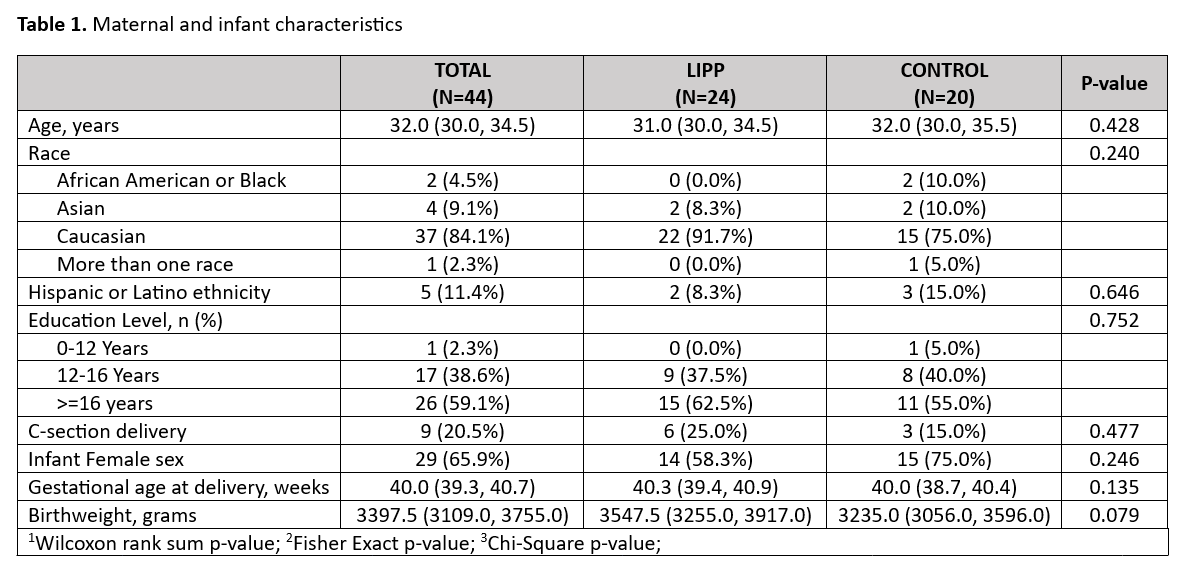
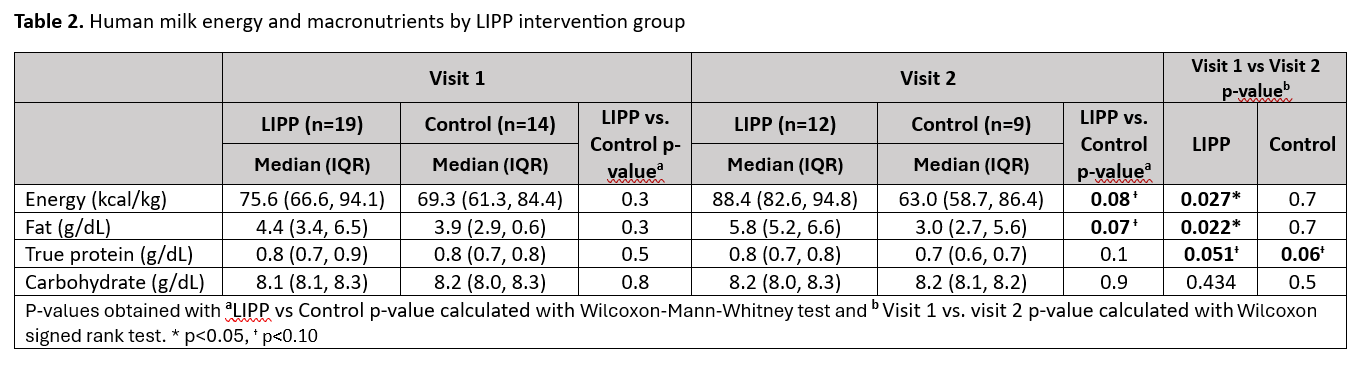
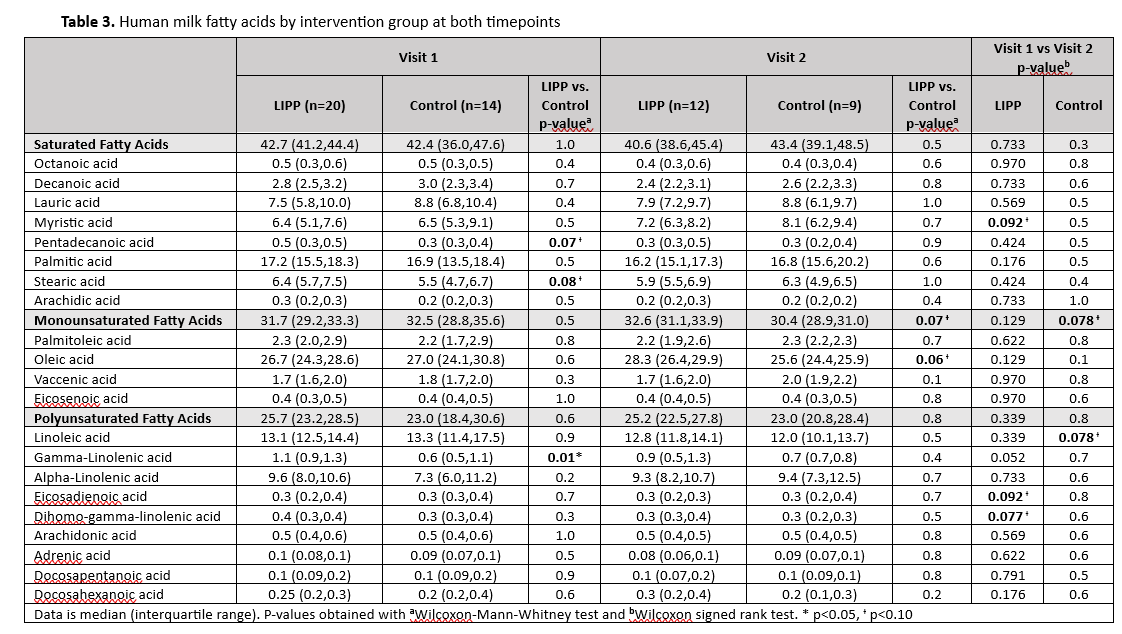
Background: Human milk (HM) is the recommended infant nutrition for the first six months of life. Maternal health is a key driver of milk composition, yet few studies have determined the impact of postpartum lifestyle (diet/exercise) interventions on lactation duration or milk composition. Objective: To determine the effect of a lifestyle intervention during lactation on 1) duration of breastfeeding and 2) HM composition, including energy, macronutrient, and fatty acid composition, in women with overweight or obesity. Design/Methods: The LIPP trial randomized postpartum participants to either a Mediterranean diet (with provision of olive oil) and supervised exercise for six months, or usual care. Women with BMI ≥25kg/m2 were enrolled at three months postpartum and a subset of LIPP participants opted to participate in a lactation sub-study. HM samples were collected at baseline (V1; 3 mo postpartum) and visit 2 (V2; 6 mo postpartum) as an aliquot of an early morning full breast expression. We assessed breastfeeding duration with the Infant Feeding Practices Survey II. We measured HM macronutrients using mid-infrared spectroscopy and fatty acids with gas chromatography/mass spectrometry. HM energy was calculated using the Atwater equation. In this intention to treat analysis, we used the Wilcoxon-Mann-Whitney test to assess differences in breastfeeding duration and HM composition between arms, and the Wilcoxon rank sum test to detect changes across time between V1 and V2. Results: Among the 44 participants, the median age was 32 years, 84% were White, and 59% had at least a college degree. There were no significant differences in baseline characteristics between groups (Table 1). The duration of breastfeeding did not differ by randomization arm (LIPP 39.1 vs. Control 43.5 weeks, p=0.7). At V2, the intervention arm had higher HM energy (88.4 vs. 63.0 kcal/kg; p=0.08) and fat (5.8 vs. 3.0 g/dL; p=0.07) vs. the control arm (Table 2), although this did not achieve statistical significance. Between V1 and V2, the intervention arm experienced a significant increase in HM energy and fat (p < 0.05) while the control arm experienced a non-significant decrease. At V2, there was a trend towards higher HM monounsaturated fatty acids (32.6 vs. 30.4 nm%; p=0.07) in the intervention vs. control arm, which was mainly driven by higher oleic acid, a key component of olive oil (28.3 vs. 26.6 nm%; p=0.07) (Table 3).
Conclusion(s): Interventions during lactation modulate critical components of HM. Future studies should test the impact of maternal interventions during lactation on child health in well-powered, generalizable trials.
Table 1. Maternal and infant characteristics
Table 2. Human milk energy and macronutrients by LIPP intervention group
Table 3. Human milk fatty acids by intervention group at both timepoints