351 - Comparative Analysis of Stem Cell Composition in Preterm and Term Human Breastmilk
Sunday, April 26, 2026
9:30am - 11:30am ET
Publication Number: 3338.351
Mohammed Malik, University of California, Irvine, School of Medicine, Anaheim, CA, United States; Cherry Uy, University of California, Irvine, School of Medicine, Orange, CA, United States; Fayez Bany-Mohammed, University of California, Irvine, Irvine, CA, United States; Muhammad Aslam, UC Irvine, Orange, CA, United States
Fellow University of California, Irvine, School of Medicine Anaheim, California, United States
Background: The benefits of human breastmilk for newborns have been recognized for centuries. Human breastmilk is a complex and dynamic biofluid, rich in macronutrients and micronutrients essential for optimal growth and development. Its composition changes over time and is influenced by gestational age (GA) at delivery, duration of lactation, maternal health, and environmental factors. In addition to its nutritional and immunological components, recent studies have identified the presence of stem cells in human breastmilk. These cells are believed to play a role in neonatal immune system development, tissue regeneration, and overall growth. Objective: We hypothesized that breastmilk from mothers delivering preterm infants (23-28 weeks' GA) contains more stem cells than milk from term deliveries (37-42 weeks' GA). The study aimed to quantify total stem cells as well as comparison of stem cell lineages in preterm and term breastmilk. Design/Methods: Human breastmilk samples were collected from six preterm and six term lactating mothers. Samples were collected between 7-14 days postpartum to exclude colostrum. Milk processing and cell isolation were performed according to established protocols. Briefly, samples were centrifuged to obtain the cellular pellet, washed, and resuspended for analysis. Total stem cell counts were determined, and cells were subsequently analyzed by fluorescence-activated cell sorting (FACS) to identify specific stem cell populations based on characteristic surface markers. Results: Quantification demonstrated a higher yield of total stem cells in preterm breastmilk (6.7 × 10⁴ cells/mL) compared to term breastmilk (5.3 × 10⁴ cells/mL). FACS analysis revealed the presence of multiple stem cell lineages, including mesenchymal stem cells (MSCs), epithelial progenitor cells (EPCs), hematopoietic/immune stem cells (HSCs), and pluripotent/embryonic-like stem cells (PSCs). Among these, MSCs represented the largest population of cells in both preterm and term breastmilk. Statistically significant differences were observed in the relative proportions of these lineages between preterm and term milk (Fig. 1).
Conclusion(s): Preterm milk contains more stem cells than term milk, suggesting gestational age influences their content and composition. These differences may impact neonatal development, especially in preterm infants. Further research will clarify their biological and therapeutic significance.
Figure 1 Stem Cell Profile of Preterm and Term Breastmilk









.jpg "Mohammed Malik, MD photo")
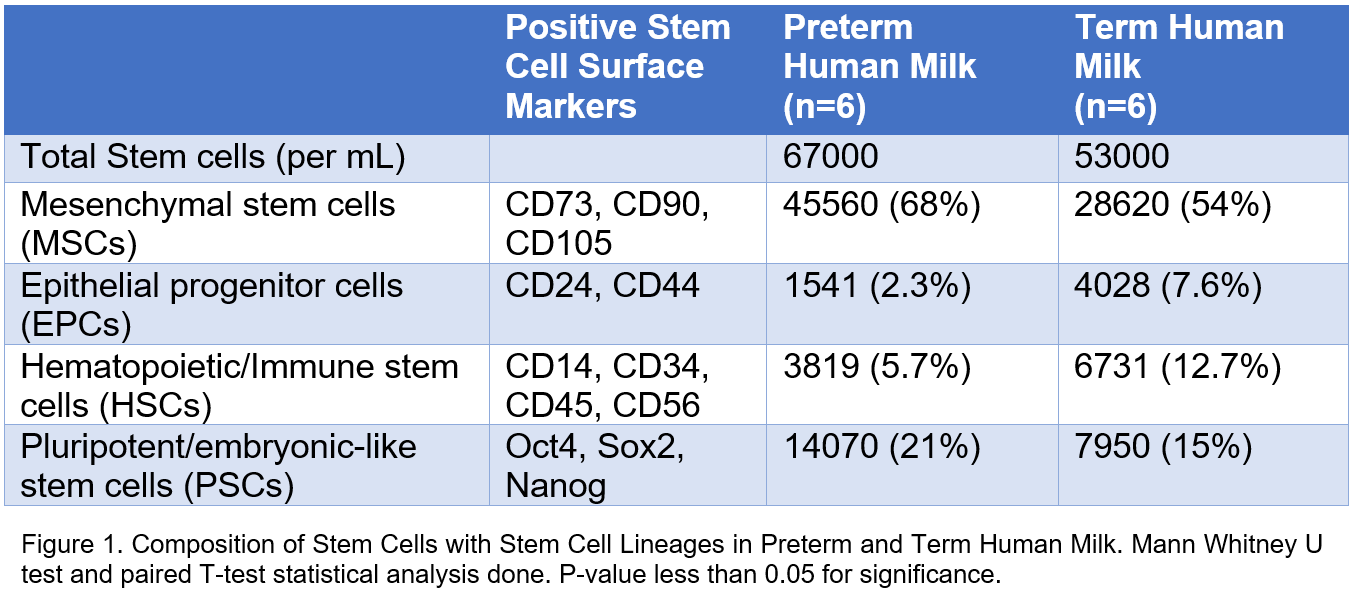 Stem Cell Profile of Preterm and Term Breastmilk