127 - Improving the Workflow of the Newborn Nursery
Sunday, April 26, 2026
9:30am - 11:30am ET
Publication Number: 3121.127
Miral Mehyar, University of Texas Medical Branch School of Medicine, Texas City, TX, United States; Neel Patel, University of Texas Medical Branch at Galveston, League City, TX, United States; Nancy Trinh, University of Texas Medical Branch School of Medicine, Galveston, TX, United States; Anoop Chandran, University of Texas Medical Branch School of Medicine, GALVESTON, TX, United States; Aimee Lopez, University of Texas Medical Branch School of Medicine, Pearland, TX, United States; Saher Fatima, University of Texas Medical Branch, sugar land, TX, United States; Sara Sadiq, University of Texas Medical Branch School of Medicine, Galveston, TX, United States; Sofia Jares Baglivo, UTMB, Galveston, TX, United States; Abdulrahman Alhanbali, University of Texas Medical Branch School of Medicine, Galveston, TX, United States; Mariam Siddiqi, University of Texas Medical Branch School of Medicine, League City, TX, United States; Amir N. Mubarak, University of Texas Medical Branch School of Medicine, Galveston, TX, United States; Muhammad Zaid H. Hussain, University of Texas Medical Branch School of Medicine, Houston, TX, United States; Abdallah Alkhaldi, University of Texas Medical Branch School of Medicine, Galveston, TX, United States; Elizabeth Rodriguez Lien, University of Texas Medical Branch School of Medicine, Galveston, TX, United States; Maria E.. Franco Fuenmayor, University of Texas Medical Branch School of Medicine, Galveston, TX, United States
Pediatric Resident University of Texas Medical Branch School of Medicine Texas City, Texas, United States
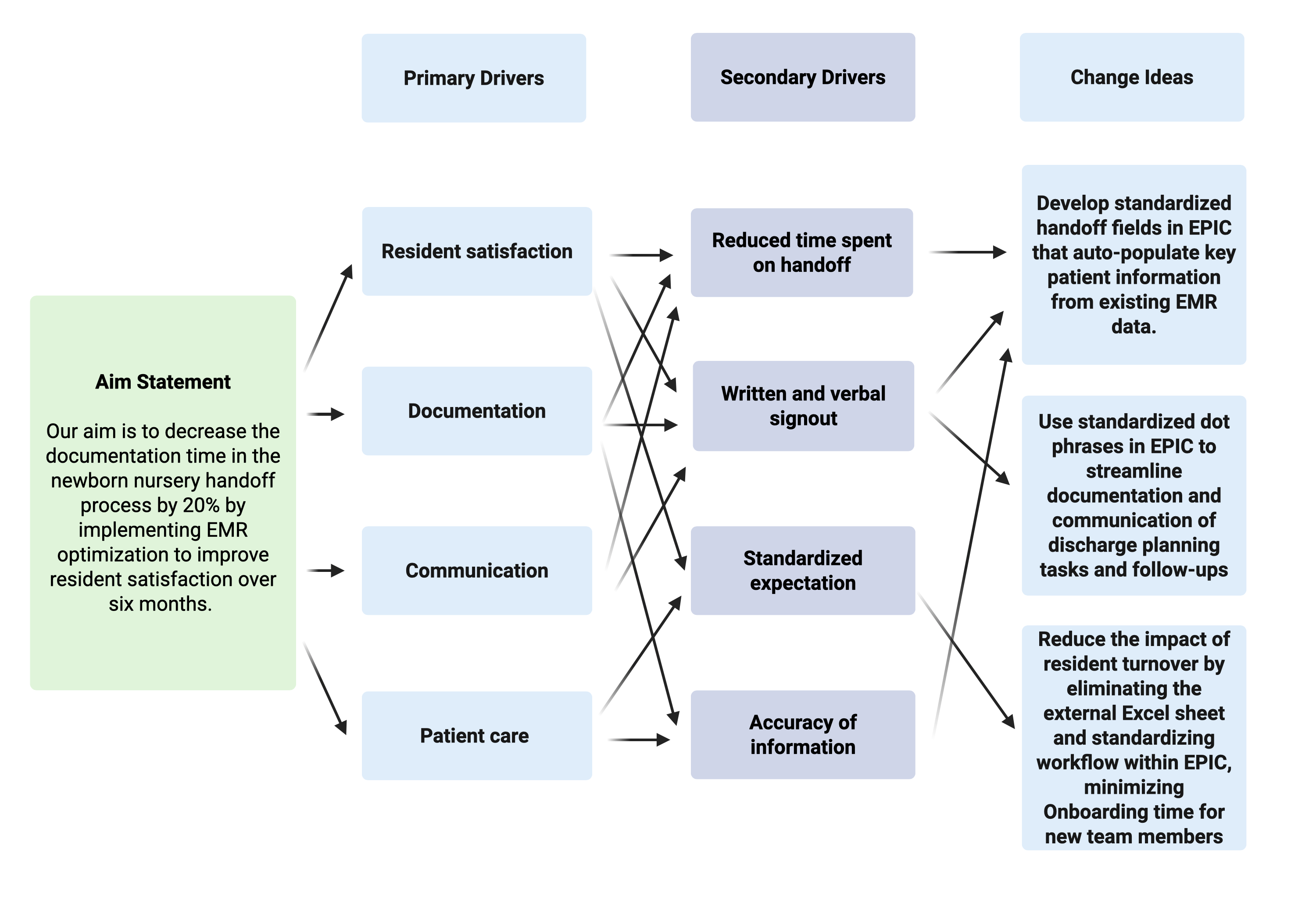
Background: Workflow efficiency plays a critical role in ensuring safe, effective patient care and in supporting residents' well-being. Redundancies and inefficiency in daily tasks can cause resident frustration, which can ultimately lead to communication errors during handoffs. In our newborn nursery, we have been using a shared Excel sheet outside the electronic medical record (EMR) to keep track of our patients. Objective: To decrease the documentation time in the newborn nursery handoff process by 20% by implementing EMR optimization to improve resident satisfaction over six months. Design/Methods: This quality improvement project took place in a robust newborn nursery in a large academic center. Using the Plan-Do-Study-Act (PDSA) model, we developed and implemented a standardized EPIC-based handoff tool to replace a shared Excel spreadsheet. A key driver diagram guided the intervention, with baseline data collected. The PDSA cycles included: 1) information gathering on current workflow and handoff utilization, 2) launching a pre-intervention survey to assess resident satisfaction and perceived workflow challenges, 3) designing and refining the standardized EPIC-based handoff tool with input from residents, 4) education tools to prepare for intervention, 5) implementation and 6) post-intervention survey to evaluate changes in satisfaction and perceived workflow efficiency compared to baseline. Results: Comparisons of our preintervention and postintervention surveys reveal significant improvements across nearly every metric following the implementation of the EMR-based handoff tool. In particular, communication clarity rose from 10% to 67%, and accuracy from 0% to 78% respectively. Ease of use improved from 7% to 81%, along with workflow and time efficiency from 10% to 74%. Importantly, negative perceptions of wellbeing and feelings of being overwhelmed both decreased from 65% to 30%. Time to complete written handoff decreased significantly from 87 seconds ± 23.2 to 9.1 seconds ± 9.2 (p < 0.001). Overall, these findings show that transitioning to an EMR-integrated handoff tool significantly enhanced clarity, accuracy, usability, and satisfaction while reducing workload burden and inefficiency.
Conclusion(s): Transitioning to a structured EMR-based handoff tool has the potential to improve communication, efficiency, and resident experience in the newborn nursery. Over a series of 6 PDSA cycles, significant improvement was noted. Future efforts will focus on long-term sustainability and potential adaptation across other pediatric units.
Driver Diagram
Pre- and Post-Intervention Survey Results
Comparison of Resident Satisfaction Before and After EMR Handoff Tool Implementation Using Wilcoxon Rank-Sum Test










.png)
.png)
