587 - The Efficacy and Safety of Triptans in Pediatric Migraine: A Systematic Review, Pairwise and Network Meta-Analysis
Sunday, April 26, 2026
9:30am - 11:30am ET
Publication Number: 3568.587
Zaid Bazbaz, An-Najah National University, Jerusalem, Yerushalayim, Israel; Ahmad Hamza, University of Pittsburgh School of Medicine, Pittsburgh, PA, United States; Ahmed Harb, Faculty of Medicine, Al-Azhar University, Cairo, Egypt, Zagazig, Ash Sharqiyah, Egypt; Dalia Atef Abouda, Faculty of medicine Alexandria University Egypt, Beheria, Abu Matamir, Al Buhayrah, Egypt; Nada Mosad, Faculty of medicine, Al-Azhar University, Damietta, Egypt, Elmansoura, Ad Daqahliyah, Egypt; Asmaa Nasreldin. Ali, Qena Faculty of Medicine Qena university, Qina, Qina, Egypt
Graduate An-Najah National University Jerusalem, Yerushalayim, Israel
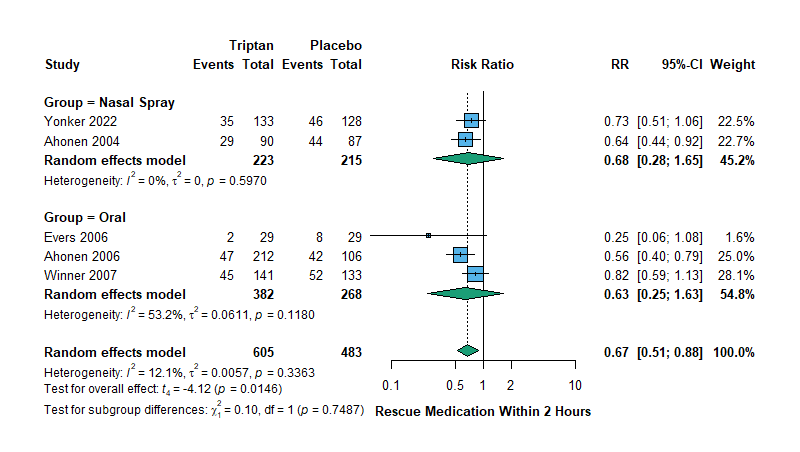
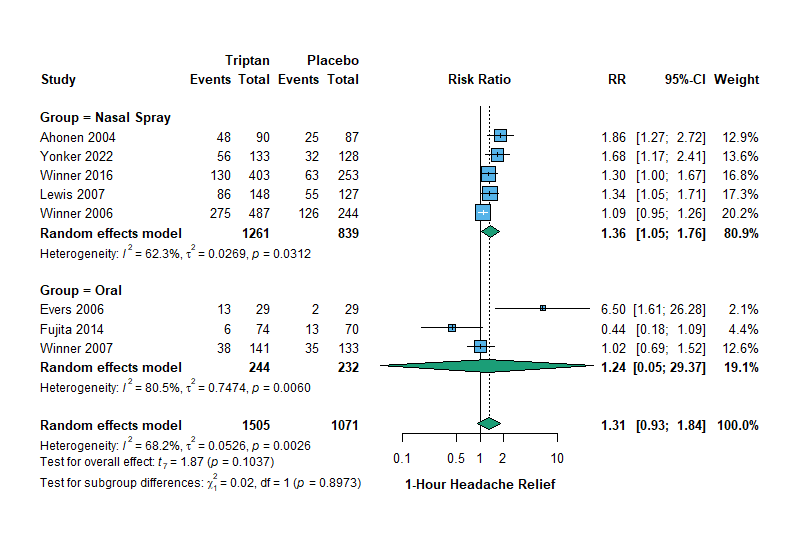
Background: Despite strong evidence supporting triptan use in adults, evidence regarding their effectiveness and safety in children and adolescents remains insufficiently defined. They inhibit cortical spreading depression, heterogeneously influence migraine pathophysiology and reduce neuronal excitability. Objective: It is important to conduct a systematic review and meta-analysis of triptans to assess their possible efficacy in children with migraine, complemented by a network meta-analysis comparing individual triptan agents. Design/Methods: All randomized controlled trials (RCTs) measuring the effect of triptans on acute pain associated with pediatric migraines were systematically reviewed. Pairwise meta-analyses were performed using a random-effects model, with results expressed as risk ratios (RRs) with 95% confidence intervals (CIs). A frequentist network meta-analysis ranked treatments using the surface under the cumulative ranking curve (SUCRA). All statistical analyses were conducted in R software. Outcomes included 30-minute, 1-hour, and 2-hour headache relief; 24-hour sustained pain relief; and 2-hour rescue medications. Subgroup analysis was conducted on nasal and oral forms. We also analyzed the adverse events, such as dizziness, nausea, fatigue, photophobia, and headache recurrence. Results: Fifteen RCTs, comprising 5903 patients, matched the inclusion criteria. Triptans significantly improved 24-hour sustained pain relief (RR = 1.36, 95% CI 1.04-1.79, P = 0.034), 30-minute (RR = 1.4, 95% CI 1.07-1.85, P = 0.027), and 2-hour headache relief (RR = 1.32, 95% CI 1.05-1.66, P = 0.02) compared with placebo. Additionally, triptans significantly reduced the need to use additional painkillers in the first two hours (RR=0.67, p=0.015). No significant difference was observed regarding 1-hour headache relief (RR = 1.31, 95% CI 0.93-1.84, P = 0.1). Route-based subgroup analyses revealed no significant variation in treatment efficacy. Network meta-analysis ranked eletriptan 40 mg best for 24-hour sustained pain relief (SUCRA = 0.98), sumatriptan 50 mg for 30-minute (SUCRA = 0.84), and zolmitriptan 2.5 mg for both 1-hour (SUCRA = 0.83) and 2-hour headache relief (SUCRA = 0.82). Triptans showed a significantly higher risk of dizziness, fatigue, and nausea compared to placebo. In contrast, a non-significant lower risk of headache recurrence and phonophobia was observed.
Conclusion(s): Triptans are effective and safe for pediatric migraines in the acute course. Additional investigations are needed to explore the long-term effects of triptans on brain network dynamics.










.png)