Session: Neo-Perinatal Health Care Delivery: Epidemiology/Health Services Research 2
97 - Complications Among Newborns With Maternal Exposure to Cannabis: Insights From the 2018–2021 National Inpatient Sample
Sunday, April 26, 2026
9:30am - 11:30am ET
Publication Number: 3093.97
Shruti Aggarwal, The Brooklyn Hospital Center, Brooklyn, NY, United States; Rahul Arora, Central Michigan University College of Medicine, SAGINAW, MI, United States; Sayera Muqarram, Central Michigan University College of Medicine, SAGINAW, MI, United States; Rigved V. Jeurkar, BJ Government Medical College, Pune, Pune, Maharashtra, India; Kamleshun Ramphul, Independent Researcher, Triolet, Pamplemousses, Mauritius; Noah P. Kondamudi, The Brooklyn, Brooklyn, NY, United States; Rahul Singla, Guru Gobind Singh Medical College, Bathinda, Punjab, India
Resident The Brooklyn Hospital Center Brooklyn, New York, United States
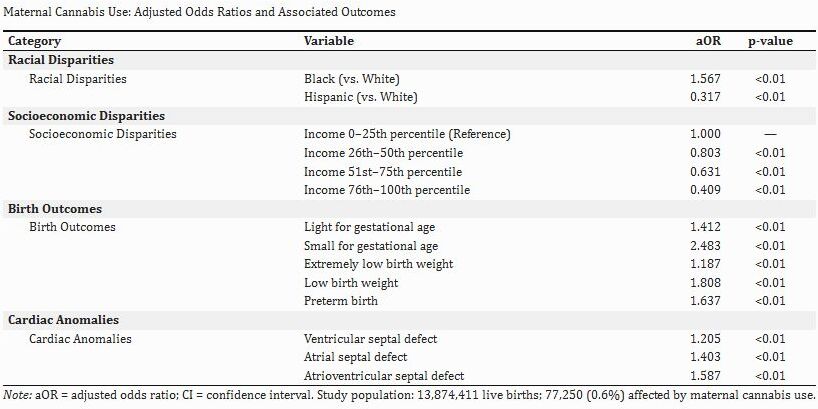
Background: Maternal exposure to harmful substances during pregnancy can significantly impact fetal growth and development. While cannabis use is increasingly prevalent, data on its effects during pregnancy remain limited. Objective: To determine the prevalence of maternal cannabis exposure among hospitalized live-born neonates in the United States (2018-2021), racial and socioeconomic disparities associated with maternal cannabis use and neonatal outcomes. Design/Methods: We conducted a retrospective analysis of hospitalized live-born neonates in the United States from 2018 to 2021 using the National Inpatient Sample (NIS). Neonates with documented maternal cannabis exposure were identified. To reduce confounding, we excluded cases involving maternal use of other substances from the control group. Multivariable regression models were employed to analyze associations between cannabis exposure and neonatal complications. Results: Of 13,874,411 live births, 77,250 (0.6%) neonates were affected by maternal cannabis use. Racial disparities were evident, with higher odds among Black neonates and lower odds among Hispanic neonates, compared to White neonates. Socioeconomic disparities were also noted, with decreasing odds of maternal cannabis exposure as household income increased, relative to the 0-25th percentile. Neonates exposed to cannabis had higher odds of being light for gestational age, small for gestational age, extremely low birth weight, low birth weight, and preterm. Increased odds of congenital cardiac anomalies were also observed, including ventricular septal defect, atrial septal defect, and atrioventricular septal defects(Table 1).
Conclusion(s): Our findings show that maternal cannabis use is linked to adverse neonatal outcomes, particularly involving fetal growth restriction, prematurity, and congenital heart defects and potential placental dysfunction. Racial and socioeconomic disparities in exposure further highlight the need for equity-focused public health strategies. As perceptions of cannabis safety evolve, it is essential to strengthen targeted education, early prenatal screening, and policy efforts to raise awareness about the risks of cannabis use during pregnancy. Such measures can help reduce exposure, improve maternal decision-making, and ultimately lead to healthier outcomes for newborns across diverse populations.
Maternal Cannabis Use: Adjusted Odds Ratios and Associated Outcomes