Session: Neo-Perinatal Health Care Delivery: Epidemiology/Health Services Research 1
80 - Rates, characteristics and causes of readmission within 7 days of discharge from the maternity hospital among singleton term newborns in France: a nationwide study from 2014 to 2024
Sunday, April 26, 2026
9:30am - 11:30am ET
Publication Number: 3076.80
Mathilde P. LETOUZEY, Inserm, pARIS, Ile-de-France, France; Luc Gaulard, Inserm, Paris, Ile-de-France, France; Marine Wojciechowski, INSERM, Bures sur Yvette, Ile-de-France, France; Jennifer Zeitlin, Inserm, Paris, Ile-de-France, France
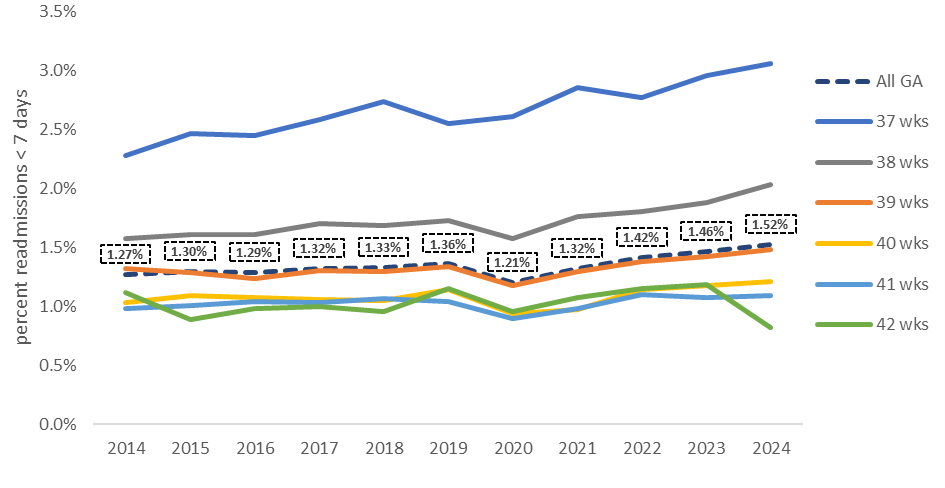
Background: Unplanned readmission of a newborn after discharge from the birth hospitalization is an indicator of the quality of healthcare services and contributes to neonatal morbidity and healthcare costs. In France, nationwide data on readmission rates and the characteristics of readmitted infants have not been reported, yet this information is critical for improving discharge protocols and evaluating early discharge policies Objective: To assess readmission rates among low-risk newborns in France in relation to their sex, gestational age (GA) and area-based deprivation quintile Design/Methods: We linked delivery and birth hospitalizations to all postnatal hospitalizations in the French National System of Health Data for the years 2014 to 2024. Our study sample included singleton liveborn infants without congenital anomalies, ≥37 weeks' GA, who were not admitted to a neonatal unit and were discharged with their mothers (7,000,431; 84.7% of all births). We computed the proportion of infants rehospitalized within 7 days after discharge home from the maternity unit and average length of stay (LOS) for selected risk factors. We used a modified Poisson model to derive adjusted relative risks (aRR) of readmission, taking into consideration clustering within hospitals Results: Average length of stay (LOS) was 3.69 days and 93,845 (1.34%) newborns were readmitted within 7 days of discharge. Eating difficulties, infectious diseases and jaundice were most frequent causes of readmission (25.64%, 21.92%, 17.56%, respectively). 7-day readmission rates were higher for boys (1.43% vs. 1.24% for girls), neighborhood deprivation (1.42% for the 5th quintile vs 1.24% for the 1st quintile) and at 37-, 38- and 39-weeks' GA compared to 40 weeks (Figure 1). Low GA was associated with longer LOS (4.17 days at 37, 3.81 at 38 and 3.66 at 39 weeks, vs. 3.56 at 40 weeks). Boys and girls (3.71 vs. 3.67) and deprivation Q1 and Q5 (3.67 vs. 3.69) had similar LOS. After adjustment, aRR were 2.50 (95%CI 2.41-2.60) at 37 weeks, 1.60 (95%CI 1.56-1.64) at 38 weeks and 1.22, 95%CI 1.20-1.25) at 39 weeks compared to 40 weeks. Rates were lower in 2014 than 2024, with a dip during COVID19; changes time were most pronounced at 37 and 38 weeks
Conclusion(s): Newborn readmission in the first 7 days after discharge is low in France, but some infants face higher risks associated with their sex, SGA status and neighborhood deprivation score. Our findings also raise questions about the increased risks for births at 37, 38 and 39 weeks' GA within a context of a growing number of inductions in France and worldwide
Figure 1: Rate of 7-day readmission overall (dotted line) and by gestational age at birth (colored lines) by year in France