Session: Medical Education 7: Resident - Curriculum II
758 - From Charts to Smiles: Empowering Pediatric Residents in Oral Health Promotion
Sunday, April 26, 2026
9:30am - 11:30am ET
Publication Number: 3734.758
NIHARIKA BHEEMISETTY, Charleston Area Medical Center, Charleston, WV, United States; Allison Holstein, Charleston Area Medical Center Vandalia Health, Charleston, WV, United States; Christine A.. Welch, Charleston Area Medical Center, Scott Depot, WV, United States
Resident Physician Charleston Area Medical Center Charleston, West Virginia, United States
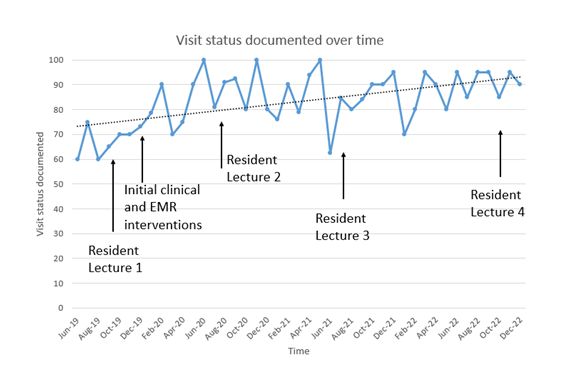
Background: Dental caries remains one of the most prevalent, chronic conditions in children. Despite being preventable, many children miss routine dental care due to access, cost, and awareness barriers. Pediatricians, who see children frequently early in life, are ideally placed for guidance, screening, and prevention. However, limited training in pediatric oral health during medical education can lead to knowledge gaps and inconsistent practices. Objective: To assess the impact of educational and practice-based interventions on pediatric residents' knowledge and counseling practices regarding pediatric oral health. Design/Methods: This retrospective study examined wellness visit notes for documentation of a dental home for patients 15 to 47 months of age from June 1, 2019, through December 31, 2022. Baseline data was collected before implementing a series of educational and practice-based interventions, including repeated, interactive sessions on best pediatric oral health practices for resident physicians. The frequency of dental visit discussions by pediatric resident physicians was documented for each study period and evaluated using chi-square analyses. Results: A total of 781 charts were reviewed during the study period, which was divided into three time periods. During pre-intervention time period 1 (n=60) (June 2019-August 2019), dental home documentation was n=39 (65.0%). During time period 2 (n=351) (September 2019- April 2021), documentation increased to 83.5% (n=293), and during time period 3 (n=370) (May 2021-December 2022), documentation was 87.3% (n=323). There was a significant improvement between time periods 1 and 2, OR=2.72 (95% CI:1.5,5.0), p=0.0008 and from time periods 1 and 3, OR=3.7(95% CI: 2.0,6.8), p< 0.0001. Time periods 2 and 3 were not significantly different OR=1.4 (95% CI: 0.90,2.1), p=0.15.
Conclusion(s): Sustained improvement in dental visit discussion documentation was achieved through repeated, interactive resident education, electronic medical records (EMR) modifications, and full practice collaboration. Providing resources such as local dental provider lists, state oral health program pamphlets, and information about community services like 211 further enhanced oral health guidance. Continued, team-based education across all residency levels fosters lasting culture change and supports sustained improvements in pediatric oral health practices.