Clinical Research Fellow Cleveland Clinic Children’s Cleveland, Ohio, United States
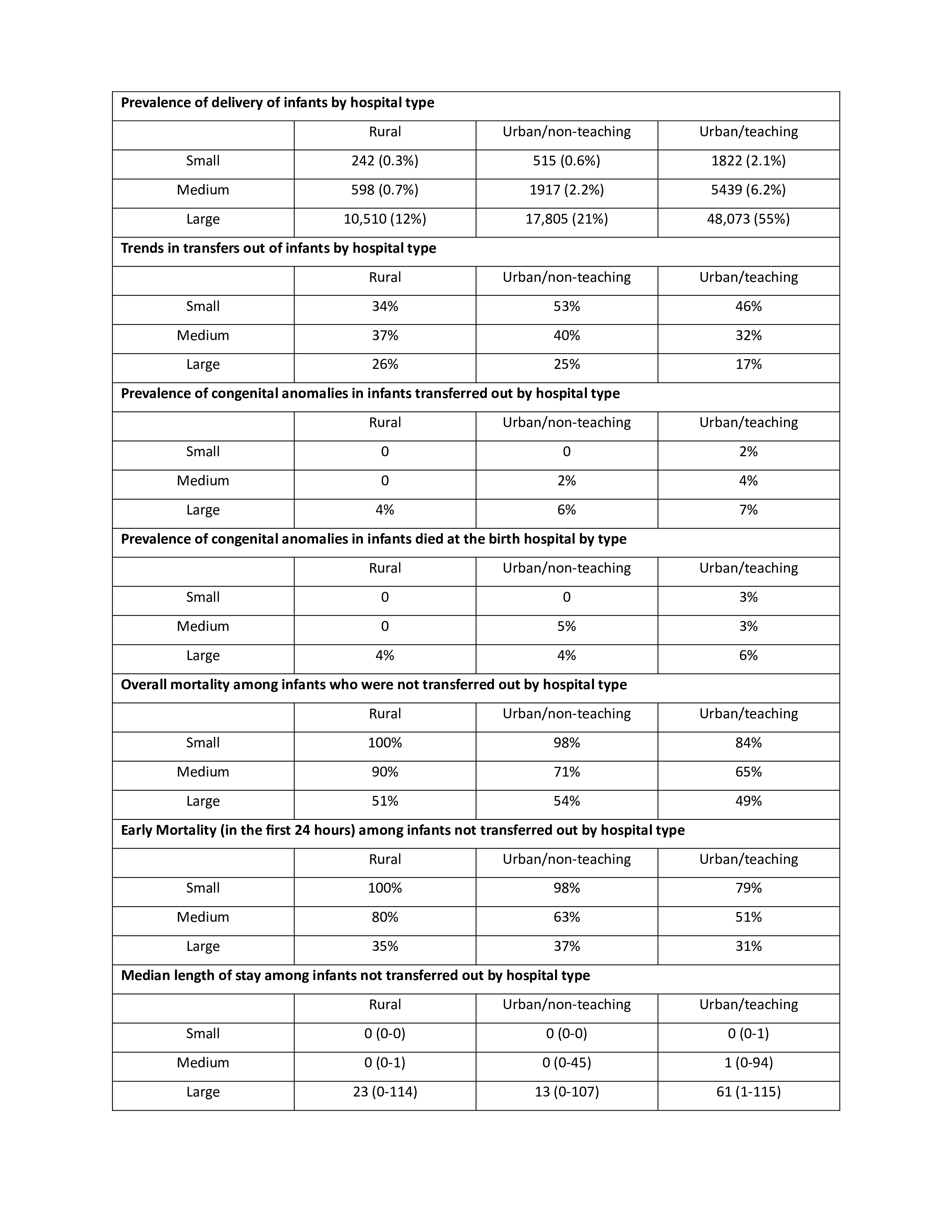
Background: There is inconsistency in reports describing the mortality among infants with gestational age (GA) < 26 weeks. Objective: To examine trends in hospital practices in resuscitating infants at the edge of viability based on hospital bed size, rural/urban location, and teaching versus non-teaching designation. Design/Methods: The datasets produced by the Healthcare Costs and Utilization Project (HCUP) were analyzed for the years 2016-2022. Infants < 26 weeks GA and < 1000g birthweight (BW) were included. Birth hospitals are categorized in the datasets based on rural vs. urban location and academic or teaching vs. non-teaching into 3 categories: rural, urban non-teaching, and urban teaching hospitals. Further, birth hospitals are classified according to bed-size into small, medium, or large hospitals. A matrix that combines both classification was created and was used to examine hospital practices. Results: Sample included 86,921 infants. Of them, infants < 23wk were 23.9%, 23wk were 19.6%, 24wk were 27.5%, and 25wk were 29%. Infants transferred out were 22.4%, those who expired at the birthing hospitals were 41%. Almost 2/3 of the deliveries occurred at urban teaching hospitals, while about 12% occur at large rural hospitals. Between 25-50% of the infants were transferred from the birth hospital. However, only 3-6% of infants transferred out have one or more severe congenital anomaly. The in-hospital mortality was 89.3%, 42.2%, 24.9%, and 15.6% in the < 23wk, 23wk, 24wk, and 25wk, respectively. More than 80% of infants were delivered at small or medium rural hospitals or small urban non-teaching or teaching hospitals who were not transferred out, expired. Similarly, the prevalence of congenital anomalies among them ranged from 3-6%. Most of them expired within the first 24 hours of life.
Conclusion(s): About 90% of infants at the edge of viability delivered at large hospitals. Between 30-50% of infants delivered at small to medium size hospitals were transferred out with no significant impact of the presence of congenital anomalies. Almost 90-100% of infants who were not transferred out in small to medium size rural hospitals and small urban non-teaching hospitals expired and mostly in the first 24 hours. It is not clear if the death is associated with failure of resuscitation attempts or a conscious decision made not to resuscitate. These findings highlight the importance of considering the hospital designation and size when calculating and comparing mortality in infants at the edge of viability.