Session: Medical Education 10: Simulation and Technology I
165 - Shaking Off Uncertainty: Pediatric Seizure Simulation Case for Residents
Monday, April 27, 2026
8:00am - 10:00am ET
Publication Number: 4162.165
Gabriela Ocampo, University of Texas Southwestern Medical School, North Richland Hills, TX, United States; Ngoc Van Horn, University of Texas-Southwestern Medical Center, Dallas, TX, United States; Sonal Sian, University of Texas at Southwestern, Dallas, TX, United States; Kimberly Laird, University of Texas at Southwestern, Dallas, TX, United States
Fellow University of Texas Southwestern Medical School Dallas, Texas, United States
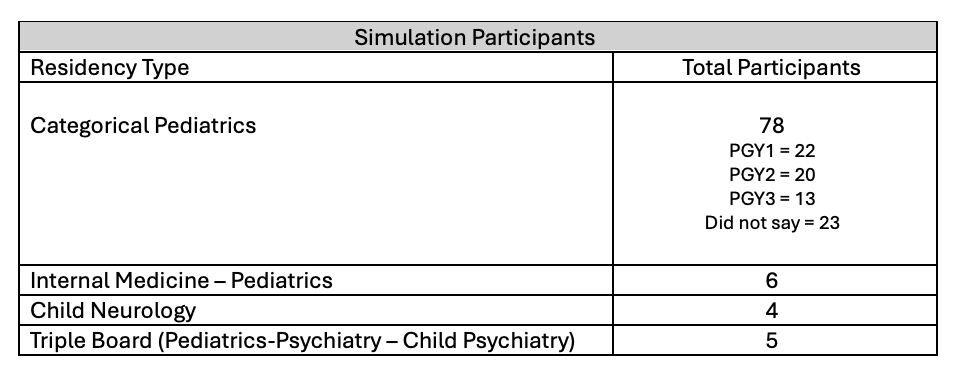
Background: Pediatric status epilepticus (SE) is a neurological emergency requiring rapid recognition and escalation of medication therapy if no initial response. Objective: This simulation was developed to train residents in SE recognition, guideline based pharmacologic escalation, appropriate diagnostic workup and team communication. Design/Methods: An infant SE scenario using high-fidelity simulation was presented to pediatric trainees including categorical, combined (Internal Medicine-Pediatrics), and accelerated (Child Neurology and Triple Board Pediatrics-Psychiatry-Child Psychiatry) residents. Pharmacy residents participated in scenarios as team members and drew up requested medications in real time. Learners managed a case of a 9 month old infant with persistent seizure activity despite pre-hospital lorazepam. Confidence in five objectives was rated on a 3 point Likert scale and compared between years of training (categorical pediatrics residents only) and type of residency program. Results: Ninety-six residents participated. Among categorical pediatrics residents who reported their PGY (n=55), significant differences were found in medical management and patient care. PGY1 residents rated their confidence significantly lower than PGY2 and PGY3 residents (p ≤ 0.0012); no differences were seen in confidence ratings between PGY2 and PGY3 residents. Leadership and communication scores did not differ by PGY level (p=0.12). No significant differences were observed between program types.
Conclusion(s): Comparable performance across residency types demonstrates skills are gained in PGY1 year despite varying rotations between the different residency programs. This case addresses gaps in pediatric SE curriculum by emphasizing timely escalation of treatment, recognition of nonconvulsive seizures, diagnostic ambiguity, and interdisciplinary teamwork.









.png)
.png)