Session: Medical Education 11: Simulation and Technology II
171 - Video-Assisted Laryngoscopy for Improving Intubation Success in Neonates
Monday, April 27, 2026
8:00am - 10:00am ET
Publication Number: 4168.171
Priyanka Patel, TJUH / Christiana Care / Nemours Children's Hospital, Philadelphia, PA, United States; Rula Nassar, Christiana care Health system, Glen Mills, PA, PA, United States; Christine Y. Yankowski, ChristianaCare, Newark, DE, United States; Keshab Subedi, Christiana Care Health System, Wilmington, DE, United States; Kelley Kovatis, ChristianaCare, Newark, DE, United States
Neonatology Fellow, PGY-6 TJUH / Christiana Care / Nemours Children's Hospital Philadelphia, Pennsylvania, United States
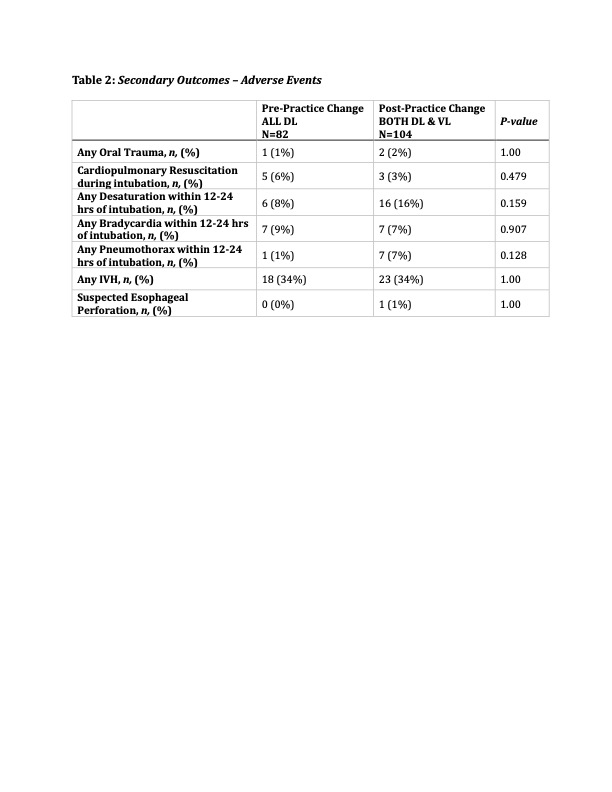
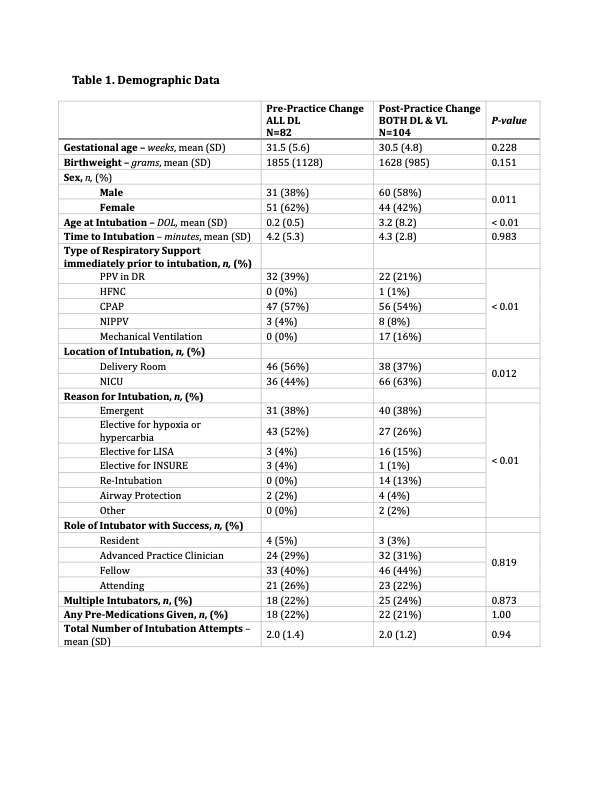
Background: Endotracheal intubation is essential in neonatal care but reduced procedural opportunities have challenged traditional training methods. While direct laryngoscopy (DL) remains the standard of care, it has limitations as a teaching tool due to lack of real-time feedback to a learner. Video laryngoscopy (VL), which enables anatomical visualization on a screen, has been shown to improve intubation success rates but its use as an education tool has not been well established. Objective: The aim of this study is to evaluate the impact of VL implementation on intubation success rates and its perceived value in enhancing procedural education. Design/Methods: This is a prospective cohort single-institution study of all infants intubated in the NICU or DR after the implementation of VL (December 2024-September 2025) compared to a historical cohort (May 2024-October 2024) after a month-long washout period. The primary outcome was successful intubation on first attempt. Secondary outcomes were adverse events including oral trauma, cardiopulmonary resuscitation, desaturation/bradycardia events, pneumothorax, any intraventricular hemorrhage, and suspected esophageal perforation. Experience of supervisors during intubation attempt was also assessed. Paired sample T-test and Chi-Square analysis were used to compare all primary and secondary outcomes. Results: Of the 186 infants included in our study, 82 were intubated using DL prior to the implementation of VL and 104 were intubated after the implementation of VL. Of those infants post-VL implementation, 54 were intubated using VL (52%). There were no differences between the groups in average gestational age or birth weight. Prior to the introduction of VL, the rate of successful intubation on the first attempt was 50% (DL only) compared with 47% after the practice change (VL & DL), p = 0.808. There were no significant differences in adverse events between the two groups. Intubators and supervising providers were less confident intubating with VL, 69% and 50%, respectively, compared with DL, 78% and 62%, respectively, p = 0.104.
Conclusion(s): Our results suggest that there is no significant difference between video and direct laryngoscopy for success on the first attempt during neonatal endotracheal intubation. Intubators and supervisors felt less confident about intubation success with the use of VL compared to DL. This is likely most reflective of the introduction of a new educational tool which may take more time to adopt and establish in practice.
Table 1. Demographic Data
Figure 1: Primary Outcome - Successful Intubation on First Attempt









.jpeg.jpg "Priyanka Patel, D.O. (she/her/hers) photo")
.jpg)