426 - Caregiver Feedback for an Infant Supply Insecurity Screening and Distribution Program in a Pediatric Emergency Department
Monday, April 27, 2026
8:00am - 10:00am ET
Publication Number: 4417.426
Elena Chen, UPMC Childrens Hospital of Pittsburgh, Pittsburgh, PA, United States; Megan Barrera Lessinger, Ann & Robert H. Lurie Children's Hospital of Chicago, Chicago, IL, United States; Lindsey Arenberg, Ann & Robert H. Lurie Children's Hospital of Chicago, Chicago, IL, United States; Hannah King, Ann & Robert H. Lurie Children's Hospital of Chicago, Chicago, IL, United States; Ashlyn McRae, Ann & Robert H. Lurie Children's Hospital of Chicago, Chicago, IL, United States; Selina Varma, Ann & Robert H. Lurie Children's Hospital of Chicago, Wheaton, IL, United States; Karen Mangold, Ann & Robert H. Lurie Children's Hospital of Chicago, Chicago, IL, United States; Megan M. Attridge, Ann & Robert H. Lurie Children's Hospital of Chicago, Chicago, IL, United States
Assistant Professor UPMC Childrens Hospital of Pittsburgh Pittsburgh, Pennsylvania, United States
Background: Providers in pediatric emergency departments (PED) are likely to interface with caregivers experiencing infant supply (IS), or formula and diaper, insecurity. IS screening and intervention in the clinical setting has become more commonplace; however, caregiver experience with these programs and drivers of IS insecurity have not been well researched. Objective: We aimed to (1) evaluate caregiver experience with a PED IS insecurity screening and intervention program and (2) identify drivers of IS insecurity. Design/Methods: We developed an IS insecurity screening and intervention initiative in August 2023 in the PED. Nurses screen caregivers of patients ≤ 36 months for diaper insecurity and patients ≤ 12 months for formula insecurity. If caregivers screen positive, social work provides supplies (diapers and/or formula) and resources (WIC information and/or a list of local diaper banks). Caregivers connected with supplies and resources between 08/01/2023-10/21/2025 received a survey regarding their satisfaction with the distributed supplies, perceived usefulness of resources and answered questions pertaining to drivers of IS insecurity. Surveys in English and Spanish were distributed by email. Results: Of the 110 caregivers who received surveys, 21(19.1%) completed the survey. Of responding caregivers, 11(52.4%) were Spanish speaking. 15(71.4%) received diapers only and 6(28.6%) received both formula and diapers.
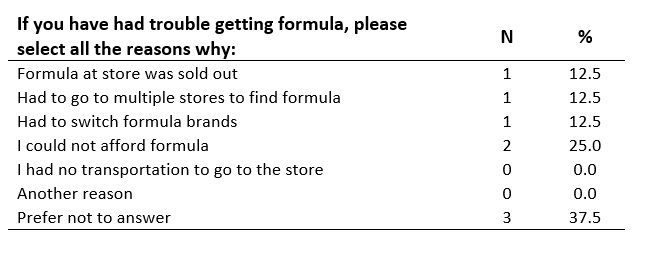
All 6 caregivers who received formula were very satisfied and used all of it. Of the 4 caregivers who recalled receiving information about WIC, all found it very helpful. 2(50%) of these caregivers, signed up for the first time. 2(25%) caregivers reported affordability as a driver of formula insecurity.
Most responding caregivers who received diapers (19, 95%) were very satisfied with the diapers. Of families who received information about diaper banks, all found the information very helpful (14, 70%) or somewhat helpful (6, 30%). 10(50%) caregivers utilized diaper banks after the PED visit, and of these, 9(90%) caregivers reported using a diaper bank for the first time. 12(54.5%) caregivers reported affordability as a driver of diaper insecurity.
Conclusion(s): IS insecurity screening and intervention may become an important part of social care in the PED and caregiver satisfaction is crucial. Most caregivers were satisfied with the diapers and formula provided and found the resources helpful. Several caregivers utilized WIC and diaper banks for the first time after receiving resources. Affordability was a commonly named driver of IS insecurity.










.png)
