Session: Developmental and Behavioral Pediatrics 7: Screening
226 - Development and Testing of the Project STANDARD (Structured Approach to Neurodevelopmental Care and Clinical Research Data) Approach to Documenting Developmental, Behavioral, and Functional Status
Monday, April 27, 2026
8:00am - 10:00am ET
Publication Number: 4223.226
William Barbaresi, Harvard Medical School; Boston Children's Hospital, Boston, MA, United States; Ramkumar Aishworiya, National University Hospital, Singapore, N/A, Singapore; Yair Bannett, Stanford University School of Medicine, Stanford, CA, United States; Julia Berg, Boston Children's Hospital, Boston, MA, United States; Nathan Blum, Children's Hospital of Philadelphia, Narberth, PA, United States; Shang Chee Chong, National University Hospital Singapore, Singapore, N/A, Singapore; Magdalena Dall, Johannes Kepler University, Linz, Oberosterreich, Austria; Jeffery Epstein, Cincinnati Children's Hospital Medical Center, Cincinnati, OH, United States; Johannes Fellinger, Klinisches Forschungsinstitut für Entwicklungsmedizin, Johannes Kepler Universität, Linz, Oberosterreich, Austria; Tanya Froehlich, Cincinnati Children's Hospital Medical Center, Cincinnati, OH, United States; Johannes Hofer, Institute of Neurology of Senses and Language, Hospital of St. John of God, Linz, Oberosterreich, Austria; Daniel Holzinger, Clinical Research Institute for Developmental Medicine, Johannes Kepler University Linz, Linz, Oberosterreich, Austria; Patty Huang, Childrens Hospital of Philadelphia, Philadelphia, PA, United States; YingQi Kang, National University Hospital Singapore, Singapore, N/A, Singapore; Marie A. Reilly, Boston Children's Hospital, Boston, MA, United States; Ann Reynolds, University of Colorado School of Medicine, Aurora, CO, United States; Gehan Roberts, The Royal Children's Hospital, Parkville, Victoria, Australia; Georgios Sideridis, Boston Children's Hospital, Weymouth, MA, United States; Deanna Swain, University of Colorado School of Medicine, Aurora, CO, United States; Sarah Weas, Boston Children's Hospital, Boston, MA, United States; Carol Weitzman, Boston Children's Hospital, Boston, MA, United States; Justice Clark, Boston Children's Hospital, Newton, MA, United States
Project Manager Boston Children's Hospital Newton, Massachusetts, United States
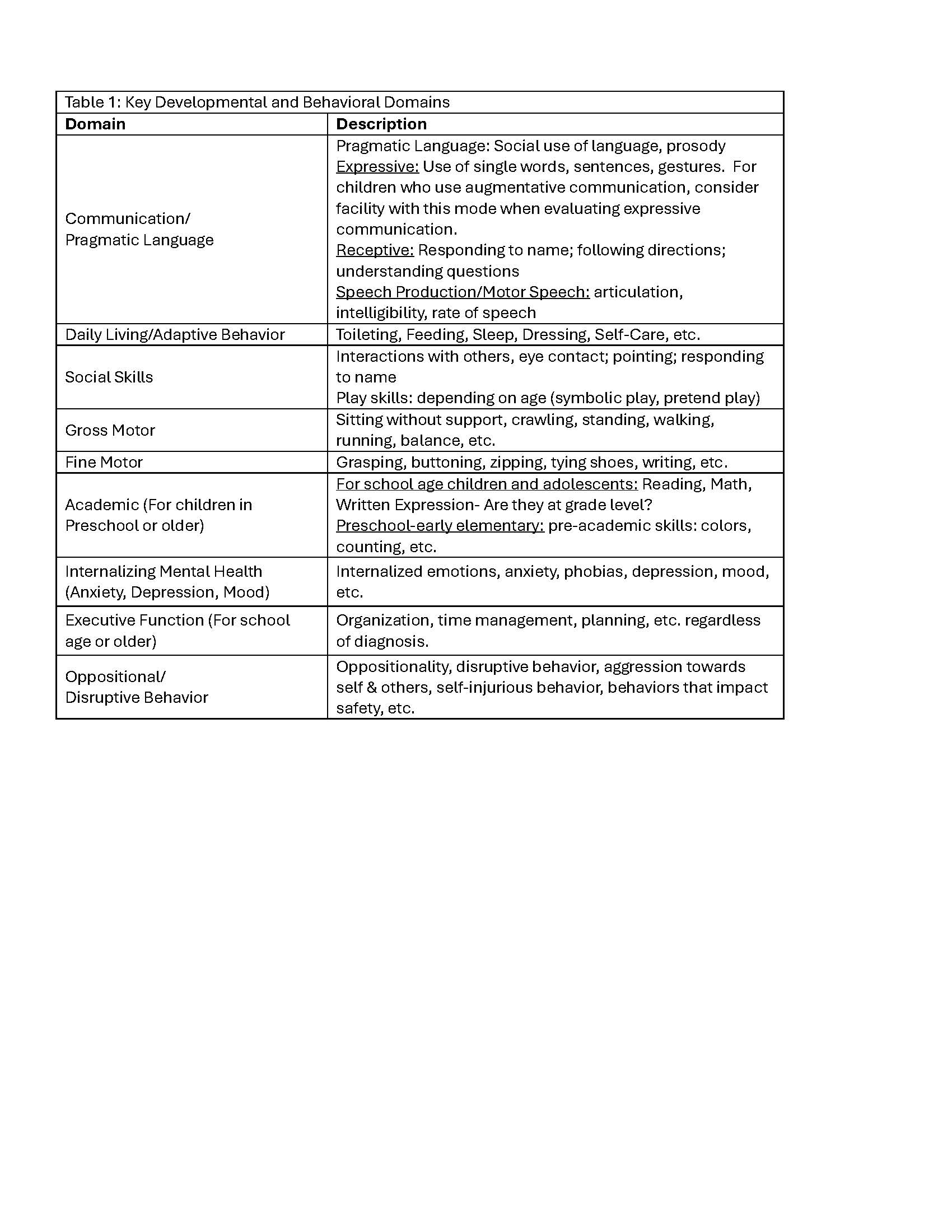
Background: Clinical documentation for children with neurodevelopmental and behavioral problems such as attention-deficit/hyperactivity disorder (ADHD) and autism spectrum disorder can be lengthy, lacks standardization, consists of free text without easily extractable discrete information, and often does not include precise details about developmental and behavioral status and overall function, limiting the utility of clinical documentation to support research and quality improvement efforts. Objective: 1. To describe the Project STANDARD (Structured Approach to Neurodevelopmental Care Clinical Research Data) development process and 2. To present the results of feasibility testing of tools to document developmental and behavioral status in key domains, overall function, and change in function. Design/Methods: Investigators from Project STANDARD's eight US and international sites developed structured elements for documenting ADHD follow-up care through an iterative process after reviewing content from current clinic notes. Feasibility testing of these tools was conducted with clinicians at each site. Volunteer clinicians were provided with training, peer support, and provided feedback after using the structured elements for 5-10 visits. Results: We developed structured data elements to record information such as current therapies, school services, and health information (e.g., sleep, diet). We also developed face-valid, Likert-scale ratings of 1 (normal/no concern) to 5 (severe-to-profound delay/impairment) for nine key developmental and behavioral domains (DBD; Table 1). The clinical global impression (CGI) severity (CGI-S) and improvement (CGI-I) scales were adapted to document overall severity of impairment and improvement since the last visit (Table 2). Clinicians found the structured elements, DBD ratings, and CGI easy to use (12/18, 12/19, and 16/19, respectively). 11/19 of respondents completed data elements during the course of the visit.
Conclusion(s): Initial Project STANDARD tools to document developmental and behavioral status, overall function, and change in function were rated as easy to use by clinicians, and could often be completed during the course of a clinical visit.
Table 1: Key Developmental and Behavioral Domains
Table 2: Clinical global impression (CGI) of severity of impairment and improvement since last visit









.jpg)
