367 - Socioecological factors influencing food and nutrition security of hospitalized families
Monday, April 27, 2026
8:00am - 10:00am ET
Publication Number: 4360.367
Michael Lugo, Cincinnati Children's Hospital Medical Center, Cincinnati, OH, United States; Sarah J.. Kopp, Cincinnati Children's Hospital Medical Center, Cincinnati, OH, United States; Jonelle Prideaux, Cincinnati Children's Hospital Medical Center, Cincinnati, OH, United States; Katherine Auger, Cincinnati Children's Hospital Medical Center, Cincinnati, OH, United States; Amanda Schondelmeyer, Cincinnati Children's Hospital Medical Center, Cincinnati, OH, United States; Meghan Fanta, Cincinnati Children's Hospital Medical Center, Cincinnati, OH, United States
Pediatric Hospital Medicine Fellow Cincinnati Children's Hospital Medical Center Cincinnati, Ohio, United States
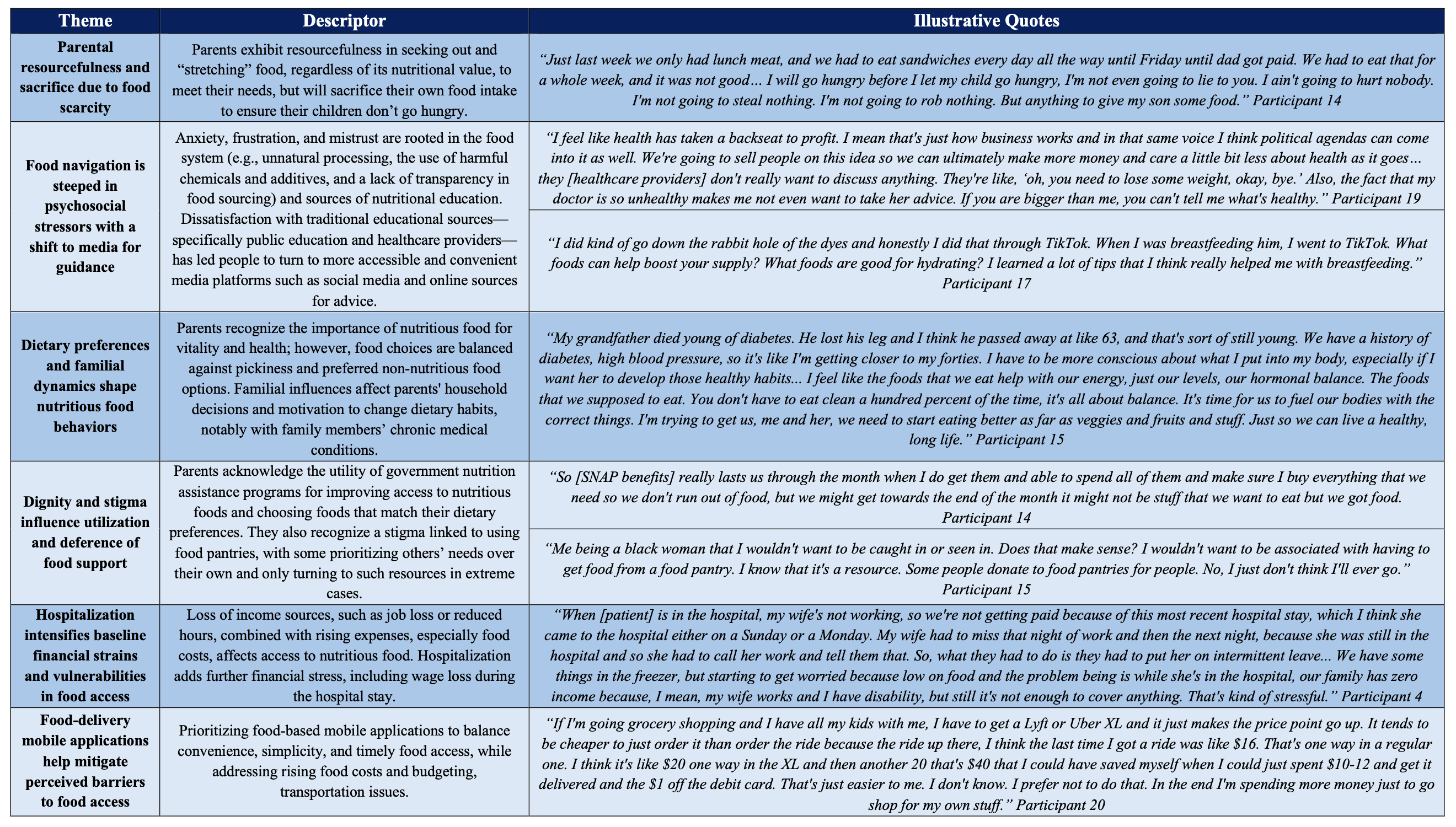
Background: Nutrition security (NS) is a concept that expands beyond food security (FS) by emphasizing consistent access, availability, and affordability of foods that promote health. The socioecological factors at the individual, household, and community levels contributing to NS are not well understood, particularly for those vulnerable to poor baseline food access, such as families with hospitalized children. Objective: Explore hospitalized families' perceptions, behaviors, and strategies regarding household nutrition and food choice, use of community-based supports, and engagement with public assistance programs. Design/Methods: We conducted semi-structured interviews in English with caregivers during hospitalization from September 2024 to July 2025. We sampled caregivers based on household FS/NS status, identified through the U.S. Department of Agriculture 6-item FS survey and the Center for Nutrition and Health Impact Household NS survey. Our interview guide explored caregiver perspectives on food and health, dietary and healthfulness choice, household food dynamics, and the determinants of community-based food support, including nutrition assistance programs. Using a hybrid thematic analysis that employed deductive and inductive methods, each interview was independently coded by two team members, with disagreements resolved through group discussion. Our team iteratively reviewed interviews and codes to finalize themes and identify illustrative quotes. Results: We interviewed 23 caregivers, with 13 identified as FS/NS, 8 as food insecure (FI)/NS, and 2 as FI/nutrition insecure (NI). Six primary themes emerged: 1) parental resourcefulness and sacrifice due to food scarcity, 2) food navigation is steeped in psychosocial stressors with a shift to media for guidance, 3) dietary preferences and familial dynamics shape nutritious food behaviors, 4) dignity and stigma influence utilization and deference of food support, 5) hospitalization intensifies baseline financial strains and vulnerabilities in food access, and 6) food-delivery mobile applications help mitigate perceived barriers to food access (Table 1).
Conclusion(s): Our findings build on an existing conceptual framework by emphasizing the dynamic interplay of socioecological factors in food perceptions, choice, and behaviors. We also introduce influential sociocultural elements - such as technology use and uncertainty about the food system - that were previously absent. While nutritious food is vital for health, dietary choices are shaped by habits, preferences, and external factors (e.g., food scarcity and financial hardship).
Table 1: Primary themes, descriptors, and illustrative quotes of hospitalized caregivers on socioecological contributors to food and nutrition security.