Session: Health Equity/Social Determinants of Health 6
4 - Empowerment, collaboration, and community connectedness among immigrant-origin adolescents serving on a youth advisory board in pediatric primary care: A multi-method study of surveys and interviews
Monday, April 27, 2026
8:00am - 10:00am ET
Publication Number: 4003.4
Keith J. Martin, Johns Hopkins University School of Medicine, Baltimore, MD, United States; Kamran F. Eslami, Johns Hopkins University School of Medicine, Baltimore, MD, United States; Andrea M. Gonzalez Bojorquez, Johns Hopkins University School of Medicine, Baltimore, MD, United States; William Mariscal, Johns Hopkins University, Houston, TX, United States; Marzena Maksym, MA, Centro SOL, Baltimore, MD, United States; Monica Guerrero Vazquez, Centro SOL JHU, Executive Director, Baltimore, MD, United States; Eliana M.. Perrin, Johns Hopkins University School of Medicine, Baltimore, MD, United States; Maria Cecilia Dedios, Johns Hopkins Bloomberg School of Public Health, Baltimore, MD, United States; Deepa L. Sekhar, Pennsylvania State University College of Medicine, Hershey, PA, United States; Sarah Polk, Johns Hopkins University School of Medicine, Baltimore, MD, United States
Assistant Professor of Pediatrics Johns Hopkins University School of Medicine Baltimore, Maryland, United States
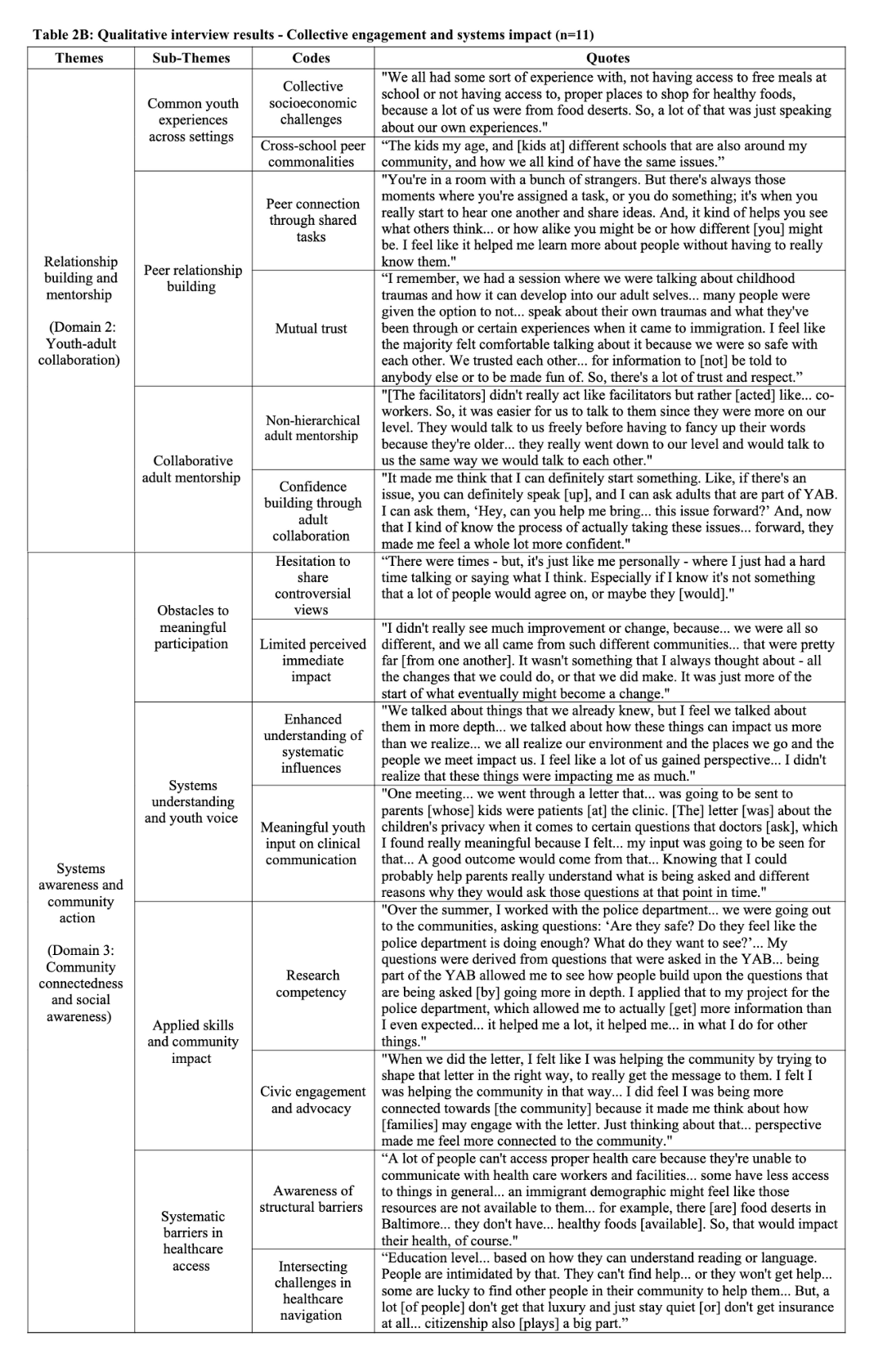
Background: Youth participatory action research (YPAR) develops critical consciousness and leadership skills among youth. However, evidence of YPAR outcomes among immigrant-origin adolescents remains limited, particularly in ambulatory settings. The Yard 56 Pediatric Clinic is a federally qualified health center serving immigrant families in Baltimore, MD. Its Youth Advisory Board (YAB) uses a YPAR curriculum to empower members as change agents in their primary care medical home, but its effects have not been previously evaluated. Objective: To conduct a cross-sectional, multi-method study of YAB members using surveys and interviews at the end of a 1-year curriculum cycle to measure three YPAR domains: 1) youth empowerment and leadership, 2) youth-adult collaboration, and 3) community connectedness and social awareness. Design/Methods: Surveys measured two domains using validated instruments: Youth-Adult Partnership Measure (Y-AP) for youth-adult collaboration as reported by youth and the Brief Sociopolitical Control Scale for Youth (BSPCS-Y) for self-reported community connectedness and social awareness. Semi-structured interviews addressed all three domains. Quantitative data was analyzed using descriptive statistics and qualitative data using thematic analysis. Results: YAB members aged 14-18 years (M=16.3, SD=1.7) participated in surveys (N=11/12) and semi-structured interviews (N=11/12). Most were female (91%), born in the United States (82%), from Latin American families (64%), with public or no insurance (82%), and non-English language spoken at home (91%). Surveys showed high scores for youth-adult collaboration (Y-AP: M=38.6, SD=4.3) and for community connectedness and social awareness (BSPCS-Y: M=30.7, SD=4.2). Interviews showed YPAR effects at two levels: individual participant experiences/development and collective engagement/systems impact. All three YPAR domains emerged through qualitative analysis: 1) youth empowerment and leadership in the individual-level theme "personal growth and leadership formation," 2) youth-adult collaboration in the collective-level theme "relationship building and mentorship," and 3) community connectedness/social awareness in the collective-level theme "systems awareness and community action."
Conclusion(s): YAB participation positively impacted all three YPAR domains among immigrant-origin youth in primary care. Future research should employ longitudinal designs to track these outcomes over time and examine how structural barriers and cultural assets influence developmental trajectories among immigrant-origin adolescents serving on youth advisory boards in ambulatory settings.
Table 1: Demographics and quantitative survey results of youth advisory board members (n=11)
Table 2A: Qualitative interview results - Individual participant experiences and development (n=11)
Table 2B: Qualitative interview results - Collective engagement and systems impact (n=11)










.png)
.png)