570 - Associations of maternal stress and social vulnerability with infant eating behavior
Monday, April 27, 2026
8:00am - 10:00am ET
Publication Number: 4558.570
Hannah Zupancic, Women & Infants Hospital of Rhode Island, Providence, RI, United States; Chloe Andrews, Women & Infants Hospital of Rhode Island, Wrentham, MA, United States; Isabella Lawandy, Brigham and Women's Hospital, Boston, MA, United States; Asimenia Angelidou, Harvard Medical School, Boston, MA, United States; Camilia R. Martin, Weill Cornell Medicine, New York, NY, United States; Sarbattama Sen, Women & Infants Hospital of Rhode Island, providence, RI, United States; Carmen Monthe-Dreze, Women & Infants Hospital of Rhode Island, Providence, RI, United States
Women & Infants Hospital of Rhode Island Providence, Rhode Island, United States
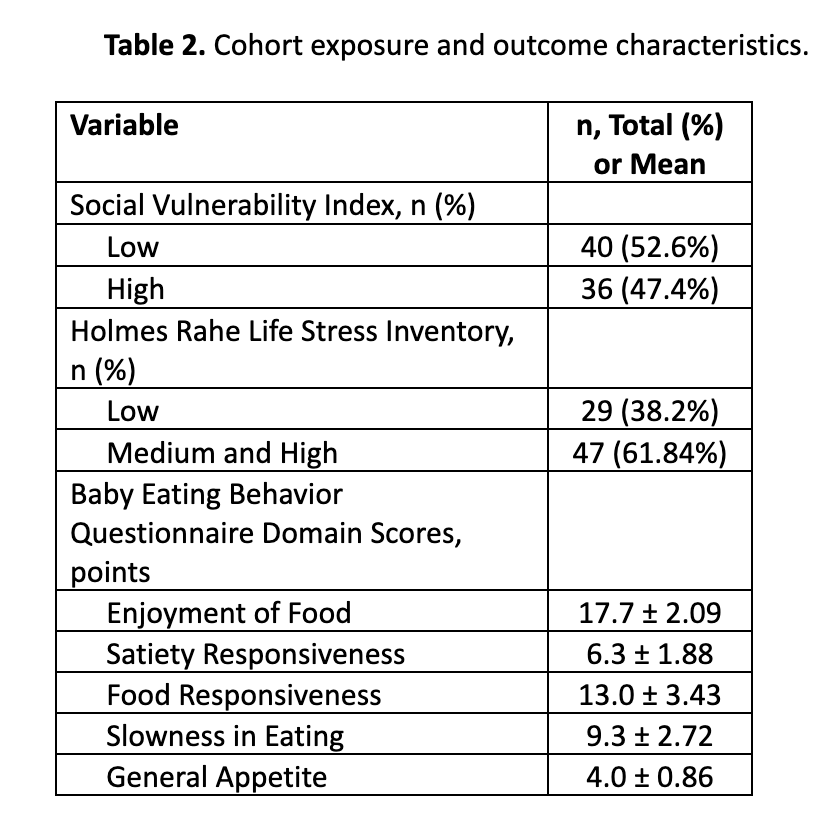
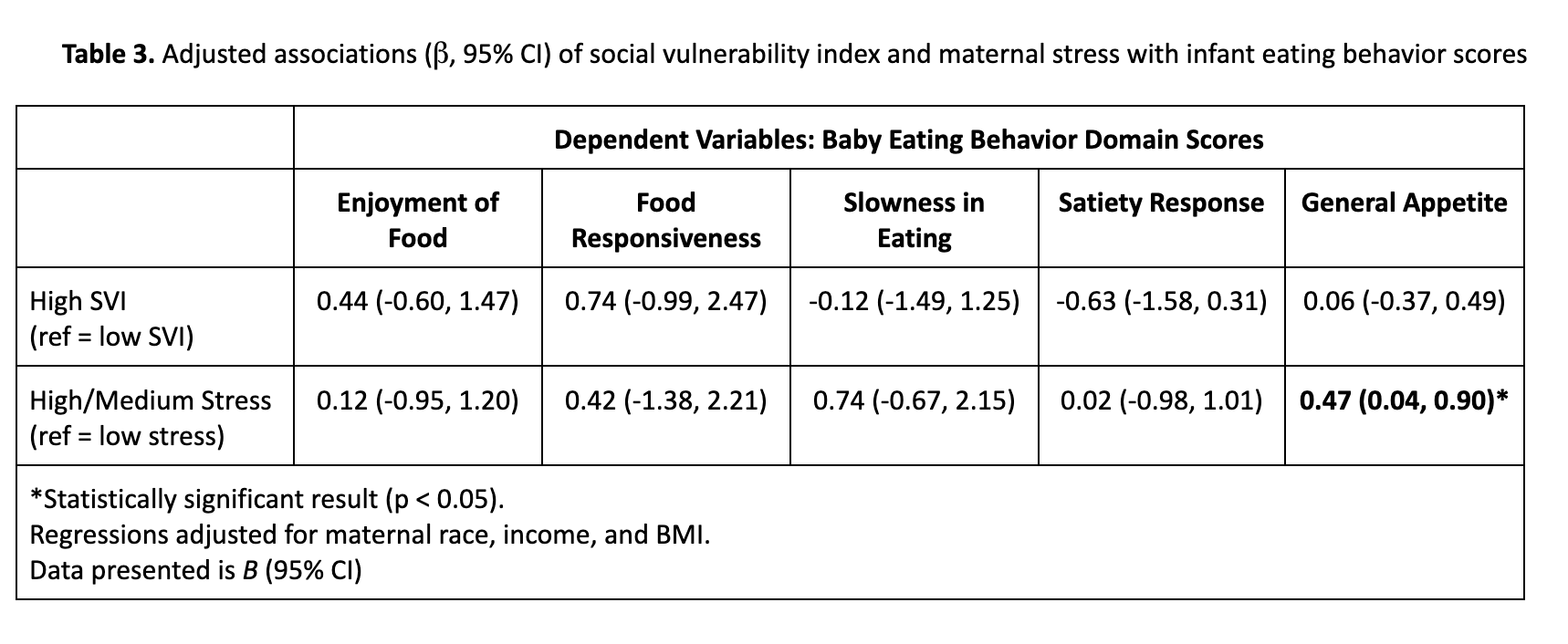
Background: Approximately three fourths of breastfeeding women in the U.S. experience one or more stressful life events during the year prior to childbirth. Previous studies have identified an association between prenatal maternal stress and infant BMI; however, the mechanisms of this are unclear. In animal models, prenatal stress induces obesogenic eating behaviors, but to our knowledge, no studies have examined the association in infants. Objective: To determine the associations of maternal social vulnerability and stress with infant eating behaviors over the first six months of life. Design/Methods: This is a secondary analysis of participants from the Mother and Infant Metabolome and Microbiome study. Mothers and their term infants were recruited during postpartum hospitalization and followed for two years. Mothers reported zip code at delivery which was used to calculate Social Vulnerability Index (SVI) with the CDC/ATSDR tool. SVI was dichotomized as high (>0.5) or low ( < 0.5) based on established literature. Participants completed the Holmes Rahe Life Stress Inventory (HRLSI) at delivery, which quantifies exposure to stressful life events in the year prior. HRSLI scores were categorized as low (>0.33), medium (0.33-0.66), and high (>0.66) based on prior research, and recategorized as binary based on histogram analysis. Participants completed the Baby Eating Behavior Questionnaire at six months postpartum to report on the time period when their infant was only consuming milk. The BEBQ was scored in five domains: General Appetite, Satiety Regulation, Enjoyment of Food, Slowness in Eating, and Food Responsiveness. We used linear regression to determine the associations of SVI and life stress with infant eating behavior. Models were adjusted for maternal race, BMI, and income. Results: Most participants were White, had at least a graduate degree, and earned >$100,000/year (Table 1). Nearly half (47%) of participants had high SVI and 61.8% had high/medium stress. In adjusted models, infants born to mothers with high/medium stress had significantly higher appetite scores compared to mothers with low-stress (β = 0.47, 95% CI: 0.04, 0.90). There were no associations between prenatal stress and other eating behavior domains. Social vulnerability was not associated with eating behaviors.
Conclusion(s): Higher stress levels during pregnancy are associated with infant appetite. Future research should examine the role of maternal stress on objective task-based measures of infant appetite, and explore the potential mediating role of infant eating behaviors in child growth.
Table 1. Maternal and infant characteristics.
Table 2. Cohort exposure and outcome characteristics.
Table 3. Adjusted associations (β, 95% CI) of social vulnerability index and maternal stress with infant eating behavior scores









.png)