431 - Missed Opportunities for Youth Discharged from the Emergency Department After Intentional Self-Poisoning
Monday, April 27, 2026
8:00am - 10:00am ET
Publication Number: 4422.431
Skyler Hammond, George Washington University School of Medicine and Health Sciences, Arlington, VA, United States; Shilpa J.. Patel, Children's National Hospital, Bethesda, MD, United States; Ilana S.. Lavina, Children's National Health System, Hyattsville, MD, United States
Medical Student George Washington University School of Medicine and Health Sciences Arlington, Virginia, United States
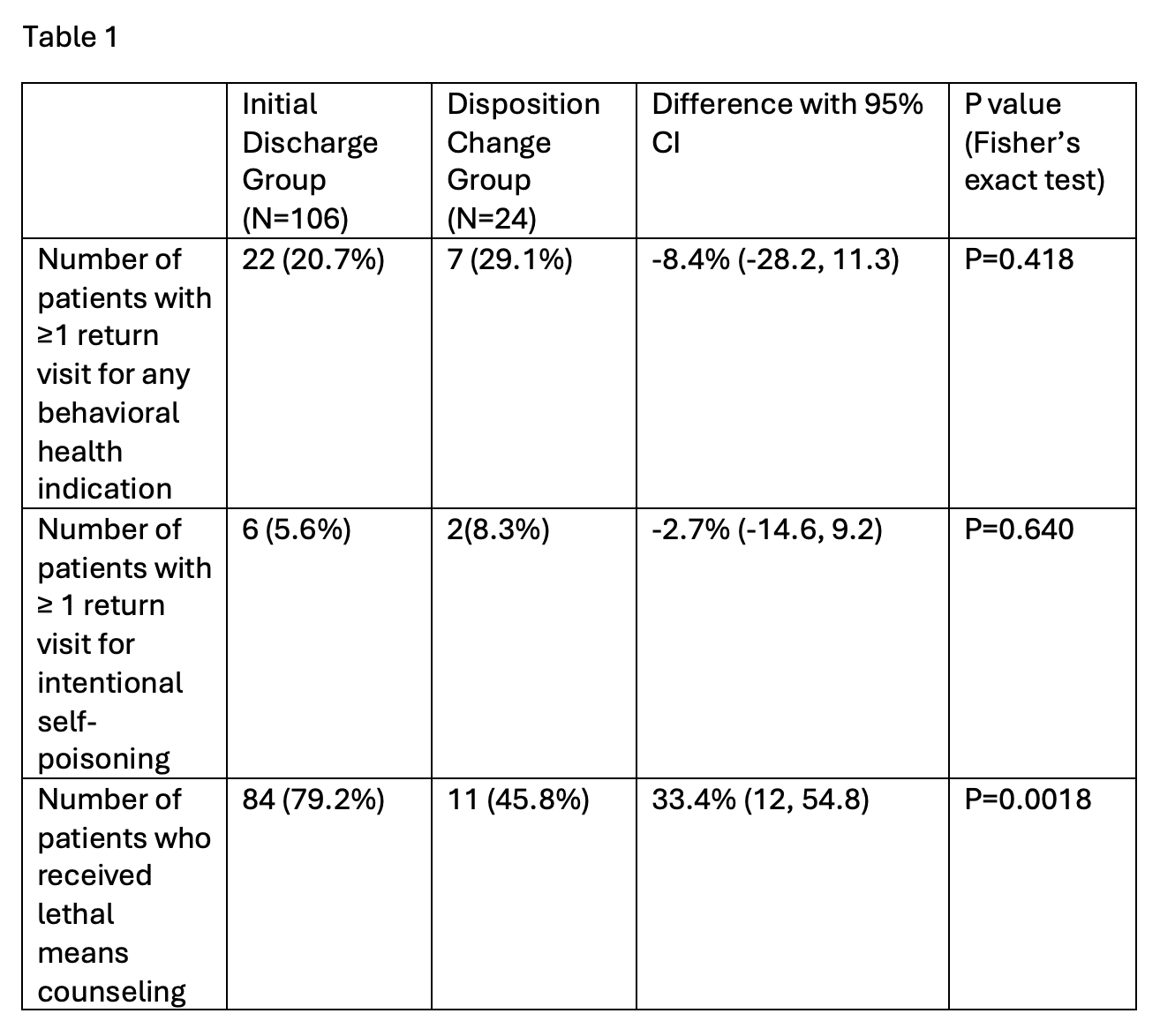
Background: Intentional self-poisoning is the most common method by which youth attempt suicide and lethal means counseling is an essential intervention to prevent subsequent harm. Opportunities to provide this counseling may be missed when youth are discharged from the emergency department (ED). Objective: To investigate reasons for change in disposition from inpatient psychiatric admission to discharge and compare rates of lethal means counseling and return ED visits between patients who had a change in disposition and those who did not. Design/Methods: Retrospective chart review of 130 patients presenting with intentional self-poisoning to a pediatric ED between 3/2020-3/2023 and discharged from the ED. Clinician notes were reviewed to determine whether a disposition change occurred (i.e. whether the patient was determined appropriate for discharge upon initial psychiatric evaluation or was initially ordered for admission but subsequently discharged after a re-evaluation) and the reason for the change. Documentation of lethal means counseling and subsequent ED presentations within 2 years of the index visit were also identified by manual chart review. Rates were compared with Fischer's exact test. Results: Among 130 discharged patients, 106 (81.5%) had a final disposition of discharge upon initial psychiatric evaluation and 24 (18.5%) had a change from inpatient psychiatric admission to discharge home. The reason for the change was lack of an available inpatient psychiatric bed in 58.3% of patients (14/24), parent/guardian refusal of admission in 20.8% (5/24), COVID exposure in 4.2% (1/24), and no documented reason in 16.7% (4/24). 20.7% (22/106) of patients in the initial discharge group and 29.1% (7/24) of patients in the disposition change group had at least 1 return visit for a behavioral health indication (p=0.418). 5.6% (6/106) of patients in the initial discharge group and 8.3% (2/24) of patients in the disposition change group had at least 1 return visit for intentional self-poisoning (p=0.640). Lethal means counseling was documented for 79.2% of patients (84/106) in the initial discharge group and 45.8% (11/24) in the disposition change group (p=0.0018).
Conclusion(s): Patients who had a disposition change were less likely to receive lethal means counseling, which illuminates the need for a process change to ensure this counseling is provided. The disposition change group had a higher rate of subsequent visits for behavioral health indications and intentional self-poisonings, though the results were not statistically significant. Further investigation of this trend with a larger sample size is warranted.