








Emergency Medicine
Session: Emergency Medicine 11

Jack R. Crowley, MS (he/him/his)
Medical Student
Frank H. Netter MD School of Medicine at Quinnipiac University
Hamden, Connecticut, United States
.png) Figure 1. Comparison of EMS and ED provider perceptions of communication quality during pediatric EMS-to-ED handoffs. Mean Likert-scale responses (1-5) are shown for six communication domains. EMS providers reported significantly higher scores for clarity (P = 0.006), confidence (P = 0.046), and respect (P = 0.007) compared with ED staff, while differences in engagement, privacy, and scope were not statistically significant. Error bars represent standard error of the mean.
Figure 1. Comparison of EMS and ED provider perceptions of communication quality during pediatric EMS-to-ED handoffs. Mean Likert-scale responses (1-5) are shown for six communication domains. EMS providers reported significantly higher scores for clarity (P = 0.006), confidence (P = 0.046), and respect (P = 0.007) compared with ED staff, while differences in engagement, privacy, and scope were not statistically significant. Error bars represent standard error of the mean..png) Figure 2. Proportion of EMS and ED providers reporting selected barriers during pediatric EMS-to-ED handoffs. Responses were dichotomous (yes/no) for each barrier type: time pressure, interruption, and repeat information. ED staff was significantly more likely than EMS providers to report repeated information as a barrier (P = 0.006), while differences in time pressure and interruption were not statistically significant. Error bars represent standard error of the mean.
Figure 2. Proportion of EMS and ED providers reporting selected barriers during pediatric EMS-to-ED handoffs. Responses were dichotomous (yes/no) for each barrier type: time pressure, interruption, and repeat information. ED staff was significantly more likely than EMS providers to report repeated information as a barrier (P = 0.006), while differences in time pressure and interruption were not statistically significant. Error bars represent standard error of the mean.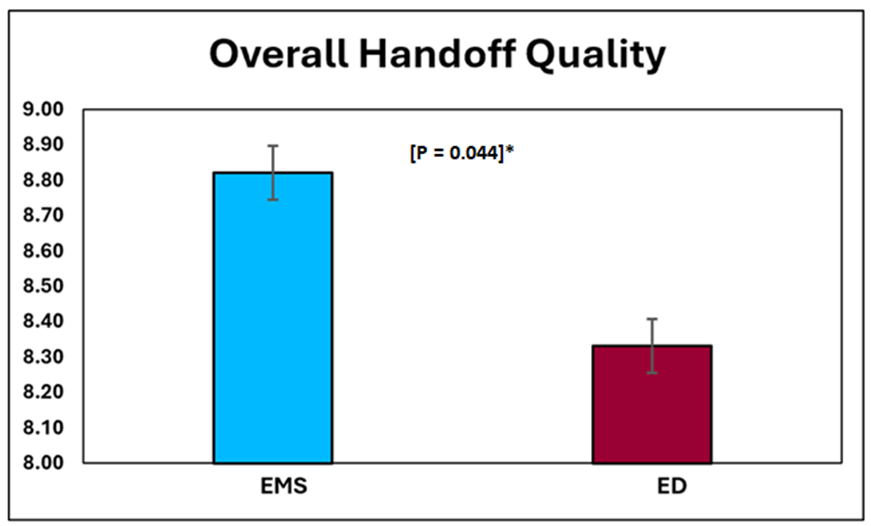 Figure 3. Mean overall handoff quality scores reported by EMS and ED providers during pediatric EMS-to-ED transitions, measured on a 1-10 Likert scale (1 = poor, 10 = excellent). EMS providers rated overall handoff quality significantly higher than ED providers (P = 0.044). Error bars represent standard error of the mean.