498 - Strengthening Families Through Partnership: Insights from the Parent Advisory Team
Monday, April 27, 2026
8:00am - 10:00am ET
Publication Number: 4489.498
Debra Best, Duke University School of Medicine, Durham, NC, United States; Elizabeth Erickson, Duke University School of Medicine, Durham, NC, United States; Danielle Alese Cooke. Little, Pediatrics Supporting Parents, Durham, NC, United States; Tiffany Solomon, Durham, Durham, NC, United States; Nicole Palmieri, Thrive, Roxboro, NC, United States; Jessica Sperling, Duke University School of Medicine, Durham, NC, United States; Nicole F. Miller, Duke University School of Medicine, Durham, NC, United States; Stella Quenstedt, Duke University School of Medicine, Durham, NC, United States; Elena Uejo, Duke University School of Medicine, Durham, NC, United States; Perusi B. Muhigaba, Duke University School of Medicine, Durham, NC, United States; Zulma Galdamez, THRIVE, Durham, NC, United States
Assistant Professor Duke University School of Medicine Durham, North Carolina, United States
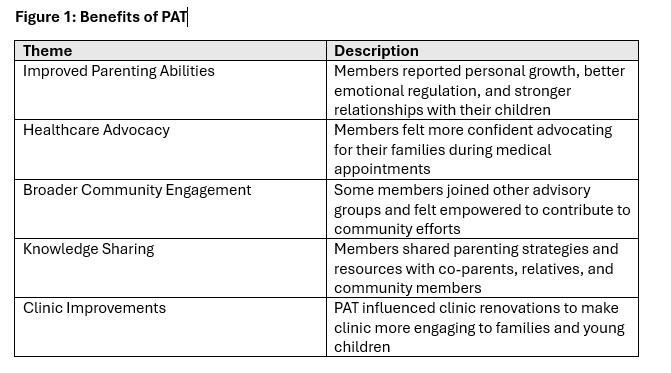
Background: The Pediatrics Supporting Parents (PSP) initiative, launched in 2022 through a partnership between Duke Children's Primary Care and key early childhood community stakeholders, aims to transform pediatric care by strengthening parent-child relationships and promoting family social-emotional health. A key component of PSP is the Parent Advisory Team (PAT), formed in April 2023 to provide input on clinic improvements and other PSP activities. PAT members also participated in training sessions, including CPR, first aid, and workshops on infant mental health, culminating in the 2024 launch of the Parent Education Suite, a series of early relational health workshops. Objective: This evaluation sought to understand the experiences of PAT members, assess how their involvement supported PSP's broader goals, and identify successes, challenges, and opportunities for improvement. Key questions included: 1. What is the experience of being involved in this specific advisory group? 2. How does this experience support members' ability to contribute to PSP goals, including knowledge, awareness, and practice outcomes? Design/Methods: In January 2025, qualitative data collection was conducted with all 13 PAT members. Two focus groups (n=4, n=8) and one individual interview were held, with one focus group conducted in Spanish with simultaneous interpretation. Data collection was facilitated by an evaluation team that collaborated with PSP in data collection design but was not involved in PSP/PAT implementation. All participants had been engaged with PAT since at least November 2024. Data were analyzed using rapid qualitative analysis and validated through member checking. Results: PAT members joined to improve parenting skills, navigate healthcare systems, and share resources with their communities. They valued the respectful, inclusive environment and were surprised by how PSP incorporated their feedback into tangible changes, such as clinic renovations and provider communication strategies. Members reported improved parenting abilities, increased confidence in healthcare advocacy, and a stronger sense of community. (Figure 1) In addition, members identified several facilitators and challenges toward the success of the PAT. (Figure 2)
Conclusion(s): The PAT model demonstrates the value of inclusive, culturally responsive family engagement in pediatric care. Members experienced personal growth, improved parenting and advocacy skills, and contributed meaningfully to clinic improvements. Sustaining and expanding PAT could inform similar efforts in healthcare transformation and community partnership.
Figure 1: Benefits of PAT
Figure 2: PAT Facilitators and Challenges to Success









.jpg)
