Session: Neonatal General 11: Social Determinants of Health / Family Engagement
646 - Comparison of Apgar scores by race and ethnicity in preterm neonates – a single-center study
Monday, April 27, 2026
8:00am - 10:00am ET
Publication Number: 4632.646
Sara Yasrebi, Baylor College of Medicine, Houston, TX, United States; Joseph Hagan, Baylor College of Medicine, Houston, TX, United States; Maya Brasher, Baylor College of Medicine, Houston, TX, United States; Monika S.. Patil, Baylor College of Medicine, Houston, TX, United States
Resident Baylor College of Medicine Houston, Texas, United States
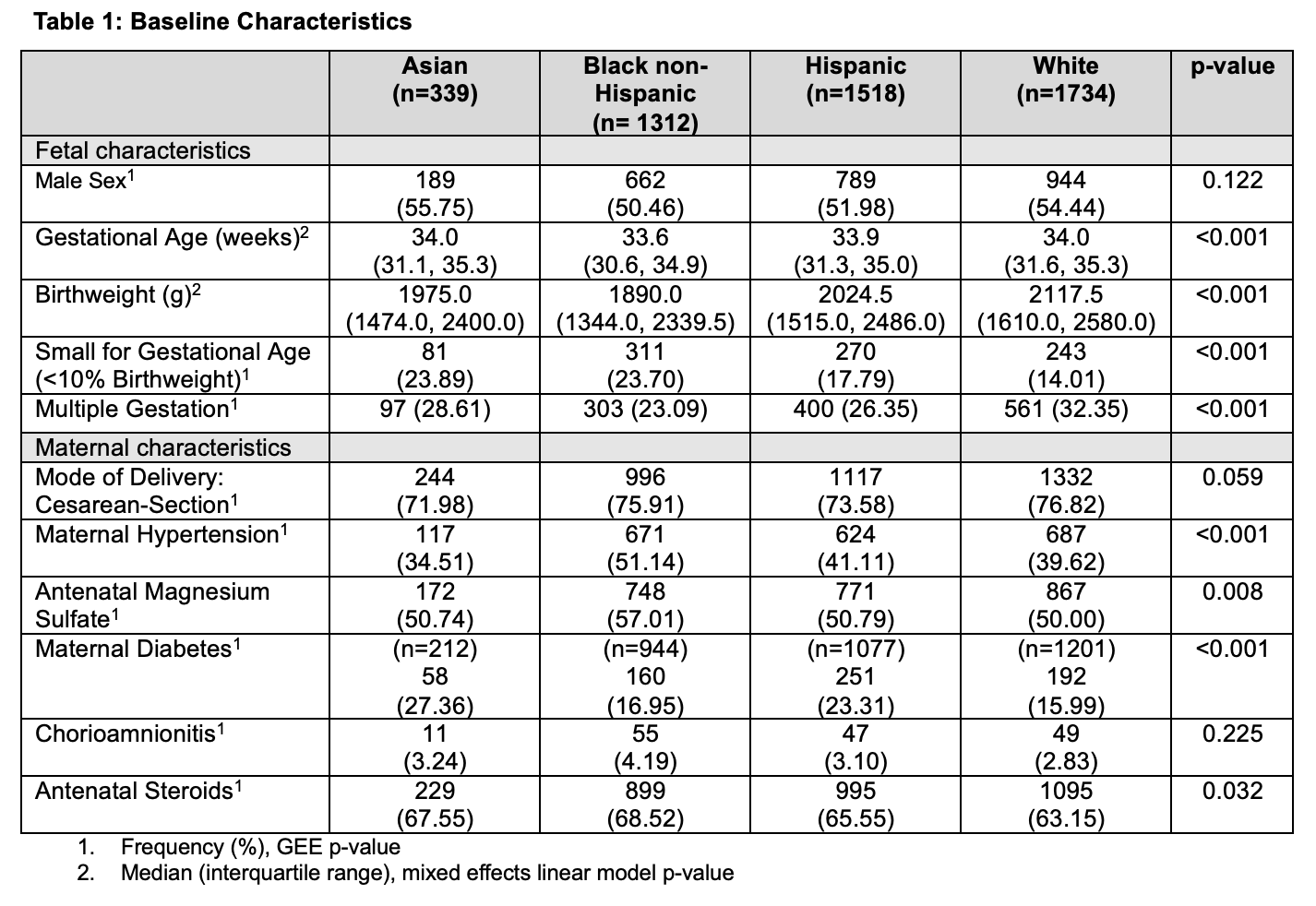
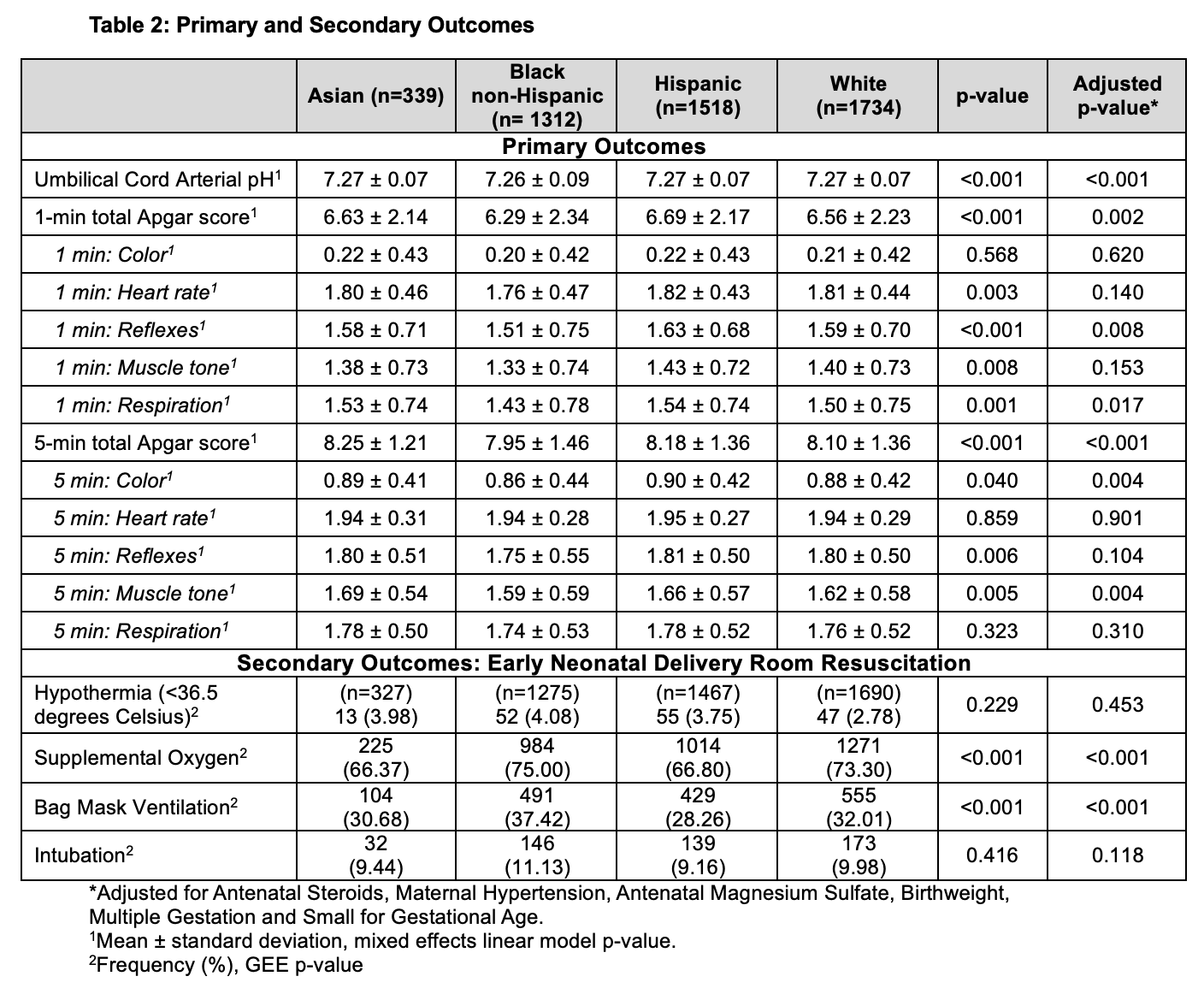
Background: Apgar scores have been used since the 1950's for rapid assessment of neonates at birth. However, assignment of scores can be subjective, especially for visually assessed components such as color which may vary with skin pigmentation. Prior studies suggest Black neonates may receive lower total Apgar scores despite similar oxygenation status, compared to White neonates. Objective: This study aims to determine if differences exist in umbilical artery pH (UA pH), Apgar scores (total and components), and neonatal resuscitation among preterm neonates born to Black, Hispanic, and Asian mothers compared to those born to White mothers. Design/Methods: This retrospective cohort study included neonates born between 22 0/7 and 36 6/7 weeks' gestation at an urban tertiary referral center from 1/1/2015 to 12/31/2024. Institutional Review Board approval was obtained. Data were collected from the Vermont Oxford Network database and electronic medical records. Infants with congenital anomalies, comfort care in the delivery room (DR), or missing UA pH were excluded. Neonates were classified as Hispanic based on maternal ethnicity; otherwise, they were grouped by maternal race. Primary outcomes were UA pH and 1- and 5-minute Apgar scores and components. Secondary outcomes included DR interventions. Multivariable binary logistic regression was used to study the association of outcomes with race/ethnicity after adjusting for differing baseline characteristics. Results: Of 6,097 eligible neonates, 4,903 were included. Characteristics differed by gestational age, birthweight, small for gestational age, and several maternal comorbidities (Table 1). After adjusting for these variables, lower UA pH and 1- and 5-minute Apgar scores were noted for neonates with Black mothers (Table 2). 1-minute color score did not differ significantly between groups, but infants of Black mothers had a lower 5-minute color score (p=0.004) and higher need for supplemental oxygen (O2) and bag mask ventilation (BMV) in the DR (Table 2).
Conclusion(s): In this large, ethnically and racially diverse cohort, maternal Black race was associated with lower UA pH and Apgar scores, and increased need for supplemental O2 and BMV in the DR. However, the 1-minute color scores did not differ between racial groups after adjustment, suggesting that variation in skin tone did not affect color-based scoring. Further investigation incorporating paternal race/ethnicity and racial sub-differentiation within Hispanic ethnicity can ensure accurate neonatal race/ethnicity and determine its association with Apgar scores.