95 - BP under 3: Overcoming challenges for success
Monday, April 27, 2026
8:00am - 10:00am ET
Publication Number: 4093.95
Rachel Hachen, Childrens Hospital of Philadelphia, Philadelphia, PA, United States; Krupal Rana, Childrens Hospital of Philadelphia, Philadelphia, PA, United States; Caitlin L. Haas, Children's Hospital of Philadelphia, Newtown Square, PA, United States; Eli M. Lourie, Perelman School of Medicine at the University of Pennsylvania, Philadelphia, PA, United States; Dayna R. Mazza, Children’s Hospital of Philadelphia, Philadelphia, PA, United States; Kevin E. Meyers, The Children's Hospital of Philadelphia and University of Pennsylvania, Drexel Hill, PA, United States
Vice Chair IRB The Children's Hospital of Philadelphia Drexel Hill, Pennsylvania, United States
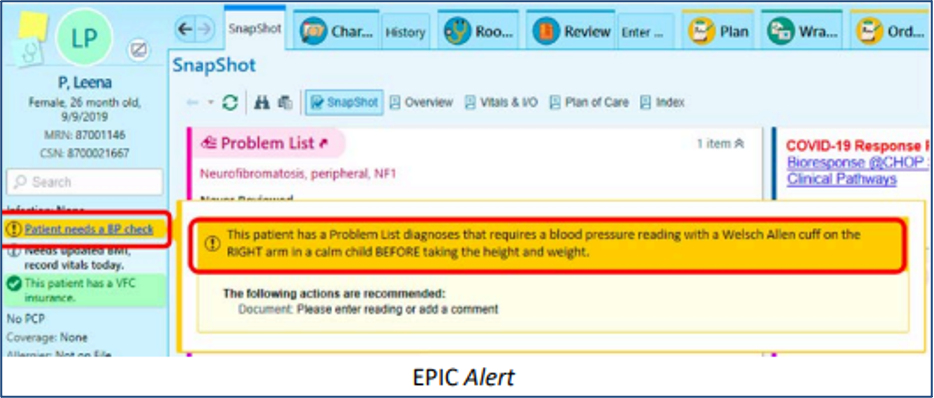
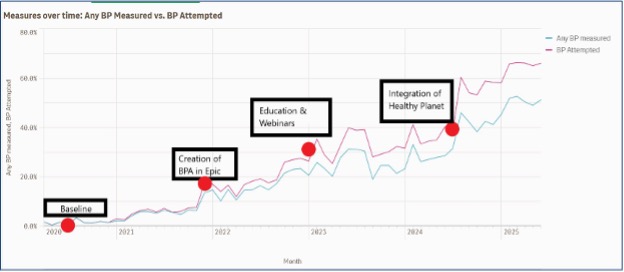
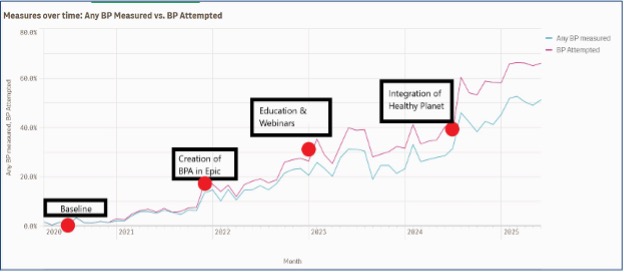
Background: CHOP continues to implement procedures to overcome challenges to obtaining accurate BP in children < 3 years at increased risk of HTN. Per 2017 AAP guidelines those at increased risk include CHD, renal disease, solid-organ transplant, bone-marrow transplant, neonatal issues (LBW, < 32 weeks' gestation, UAL), ECMO, and genetic conditions (e.g., Alagille, Turner, Williams, NF I). This represents about 4-5% of primary care WCC visits. Prior to this initiative, only 1.7% of children < 3 years received BP checks at WCC visits. Accurate BP measurement is essential for the exclusion or diagnosis of HTN. Objective: CHOP established the BP Under 3 initiative in May 2020, to standardize the process for obtaining and recording accurate BP in high-risk children < three years. Design/Methods: Barriers to obtaining BP in these children include limitations of device technology, incorrect practice, poor identification of high-risk patients, clinical difficulties of measuring BP in infants, and lack of appropriate education of the clinical team. Interventions include: (1) training videos demonstrating proper technique to accurately obtain, (2) distribution of ID badges outlining key points in obtaining BPs and normative values by age category, (3) educational sessions for clinical staff, (4) primary care site toolkits (posters, distraction toys), (5) establishment of an alert system in our EMR allowing for pre WCC visit identification (Figure 1), (6) using an EMR alert to check the BP at the WCC visit, and (7) creation of an electronic dashboard which tracks real-time data on rates of BP measurements in clinics, which permits data analysis. The dashboard data can be viewed collated or per individual clinic site and shows change of measurement practices over time. Results: WCC baseline of any BP being taken increased across 31 primary care sites from May 2020 (1.7%) to August 2025 > 50% of correctly taken BPs, (Figure 2). Primary care teams are now making 64% of BP attempts during WCC visits, up from 32% in 2024, and total missed BP checks has decreased from 521 to 270 since 2024, representing a 52% reduction. At sites using Healthy Planet (n=7) correct BP taken at WCC visits increased from a mean of 20 % to mean of 53% pre and post implementation. This effort has seen an increasing number of appropriately referred children to subspecialties for further evaluation. Between January 2025 and September 2025 this was 53/1,090 = 4.9% (Figure 3).
Conclusion(s): By determining an accurate and efficient way to measure BP much earlier in a child's life, we can provide a better path to a healthier future for these children.
Figure1: Electronic Health Care Record System (EPIC) Alert for Clinical Team
Figure 2: Improvements Over the Years for BP Measurement and BP Attempts
Figure 3: Number of Appropriate Referral/Consult Ordered Placed to Nephrology