Session: Medical Education 10: Simulation and Technology I
164 - Improving Pediatric Residents' Confidence in Managing Neonatal Hypoglycemic Seizures: A Simulation-Based Study on MCAD Deficiency
Monday, April 27, 2026
8:00am - 10:00am ET
Publication Number: 4161.164
Ngoc Van Horn, University of Texas-Southwestern Medical Center, Dallas, TX, United States; Khawar Nawaz, University of Texas Southwestern Medical School, Dallas, Texas, TX, United States; Harriet Leahy, University of Texas Southwestern Medical School, Dallas, TX, United States; Calvin Fairbourn, University of Texas Southwestern Medical School, Dallas, TX, United States
Fellow University of Texas-Southwestern Medical Center Dallas, Texas, United States
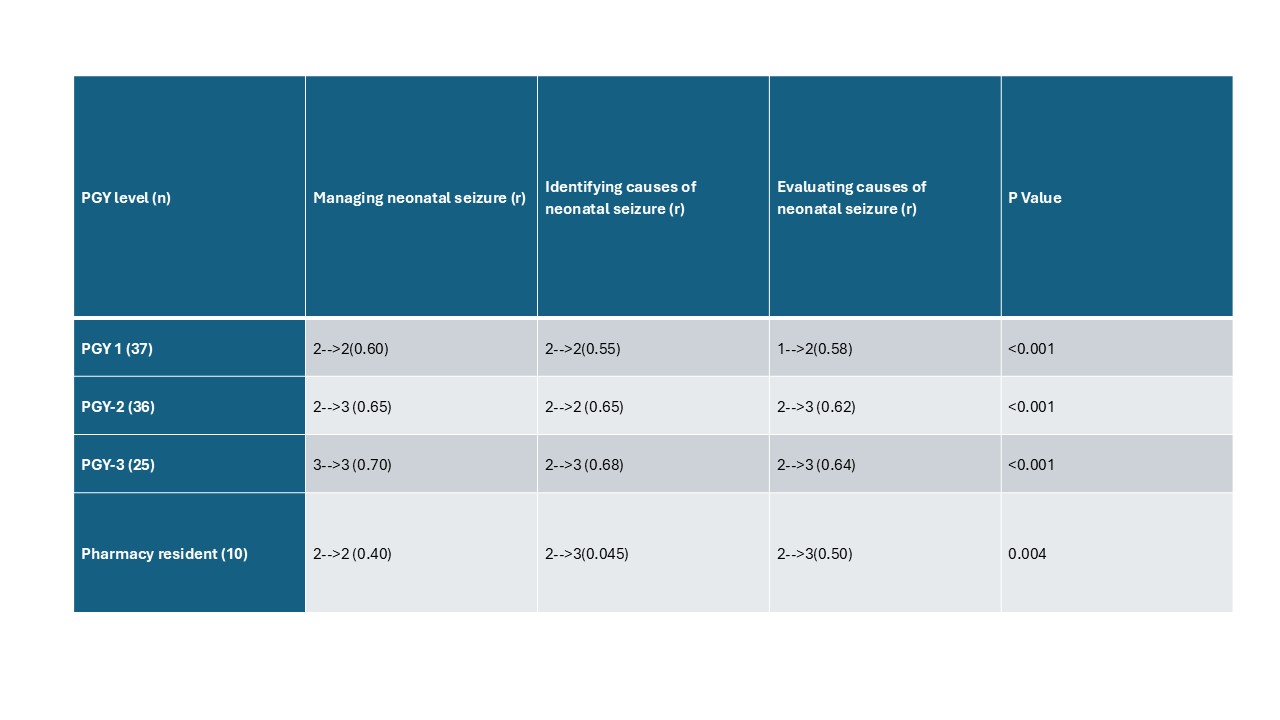
Background: Medium-chain Acyl-CoA Dehydrogenase (MCAD) deficiency is the most common disorder of mitochondrial fatty acid β-oxidation. MCAD patients and can lead to hypoketotic hypoglycemia, seizures, liver dysfunction, and death in periods of fasting or metabolic stress. Despite newborn screening, 4-8% of neonates may become symptomatic before results are available, and the disorder has a mortality rate of 13-43% at initial crises. Pediatric residents often have limited exposure to metabolic emergencies, representing a critical educational gap. Objective: This study describes and evaluates a high-fidelity simulation designed to improve recognition and management of medical residents of neonatal hypoglycemic seizures secondary to MCAD deficiency. Design/Methods: A High-fidelity neonatal simulation was implemented at a tertiary academic center for Pediatric, Med-peds, pediatric neurology, and pharmacy residents. The Scenario featured a 10-day-old neonate with hypoglycemic seizures following fasting, requiring recognition of metabolic etiology and team-based management. The facilitator used scripted roles and digital avatars to enhance realism. Effectiveness was assessed via pre- and post-simulation self-reported confidence surveys evaluating three domains: Neonatal seizure management, cause identification, and metabolic evaluation. Data were analyzed using paired t tests and the Wilcoxon signed rank test. Results: A total of 109 residents participated. Mean self-reported confidence significantly improved across all domains: managing Neonatal seizures (1.82.44, +32.6%), identifying causes (1.922.47, +28.7%), and evaluating metabolic etiologies (1.552.19, +42.3%) (p < 0.05). gains were statistically significant across all postgraduate years, and medium to large effect sizes. Qualitative feedback reflected enhanced awareness of metabolic causes and diagnostic reasoning.
Conclusion(s): A Structured, high-fidelity simulation significantly improved pediatric residents' confidence in managing neonatal hypoglycemic seizures and recognizing MCAD deficiency. This educational model addresses a key gap in pediatric training, aligns with American Board of Pediatrics Entrustable Professional Activities, and underscores simulation's value for rare, high-stakes metabolic emergencies. Future studies should evaluate knowledge retention, performance outcomes, and interprofessional integration
Table 1: Pre- and post -Simulation Self-reported mean confidence and percent improvement for key learning outcomes in simulation among participants image.jpeg
Table 2: Wilcoxan Signed analyses on self-reported confidence Improvements by training level before and after the simulation