198 - Pediatric Provider and Youth-Generated Questions for the 5 Cs of Media Use: Examining Linguistic Differences
Monday, April 27, 2026
8:00am - 10:00am ET
Publication Number: 4195.198
Nina E. Anglim, University of Wisconsin School of Medicine and Public Health, Madison, WI, United States; Kyle Palmberg, University of Wisconsin School of Medicine and Public Health, Madison, WI, United States; Nicole Owings-Fonner, American Academy of Pediatrics, washington, DC, United States; Megan A. Moreno, University of Wisconsin School of Medicine and Public Health, Madison, WI, United States; Chelsea Olson, University of Wisconsin - Madison, Madison, WI, United States
Research Intern University of Wisconsin School of Medicine and Public Health Madison, Wisconsin, United States
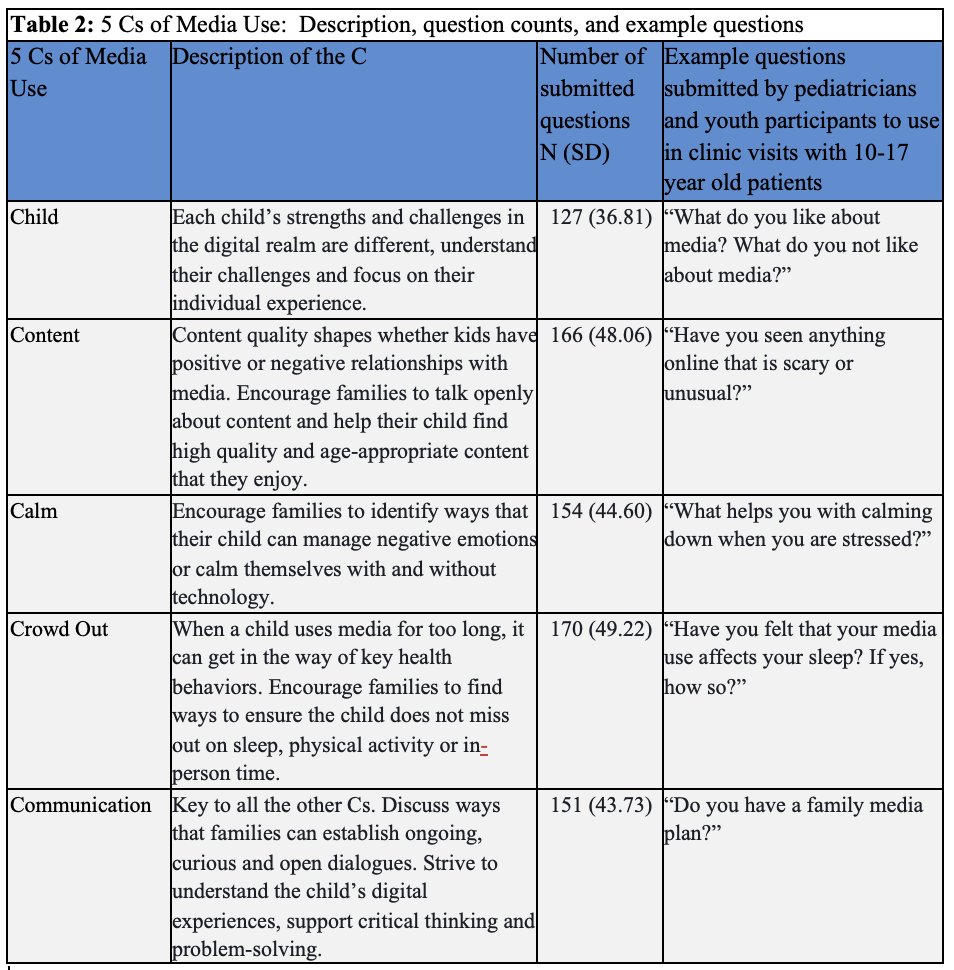
Background: The 5 Cs of Media Use is the American Academy of Pediatrics Center of Excellence on Social Media and Youth Mental Health's newly developed mnemonic for pediatric providers to discuss developmentally appropriate technology use with youth and families. The 5 Cs are Child, Content, Calm, Crowd Out and Communication. Unbiased, open-ended, and evidence-based questions that highlight the 5Cs' unique concepts are needed for implementation in standard clinical practice. Objective: This study aimed to generate screening question options for each of the 5Cs and assess 1) total counts, 2) consistencies in framing and 3) identifiable linguistic elements of the questions per C. Design/Methods: Participants included pediatricians and youth, recruited via community-based approaches. Participants were provided with a description of the 5 Cs and asked to submit 1-3 questions for each C that pediatric providers could use in clinical visits with youth aged 10-17. Demographic questions included age, state and gender. Linguistic Inquiry and Word Count (LIWC) software was used to evaluate the prevalence of linguistic elements for each C, with particular attention to language of social, cognitive, physical and affective processes. ANOVAs with Bonferroni post hoc tests were used to compare each C. Results: In total, 65 participants (Table 1) provided over one hundred questions for each C, with slightly fewer questions for Child (M=127, SD=36.81; p < .001) (Table 2). 5Cs question options were consistently framed with few references to gendered language and no significant differences across Cs for "tentative" and "certain" language. 4 of 5 Cs had at least one unique linguistic characteristic. Content was more likely to have "insight" language (M = 4.31, SD = 5.67; F[4,763] = 6.84, p < .001) than other Cs. Crowd Out was more likely to have "health" language (M = 1.33, SD = 5.56; F[4, 763] = 6.075, p < .001) than other Cs (Table 3).
Conclusion(s): Participants were able to create many question options for each C. We did not find differences in gendered, "tentative" or "certain" language, reflecting that questions across each of the 5Cs avoid gender bias and maintain a similar pattern of inquiry. We identified unique linguistic characteristics for four of the Cs which aligned with their topic and focus. The Child C yielded fewer questions generated and no unique linguistic characteristics, suggesting these questions may be more challenging to create or less specific in format. Next steps include testing selected questions via an intervention.
Table 1: Survey demographics for pediatrician and youth participants who generated questions for each of the 5 Cs: Child, Content, Calm, Crowd Out, Communication
Table 2: 5 Cs of Media Use: Description, question counts, and example questions
Table 3: LIWC results evaluating submitted questions from pediatricians and youth to represent the 5 Cs










.png)
.png)
