418 - Empiric Treatment Practices for Adolescent Chlamydia and Gonorrhea: Insights From a Multicenter Emergency Department Study
Monday, April 27, 2026
8:00am - 10:00am ET
Publication Number: 4409.418
Michelle Pickett, Medical College of Wisconsin, Milwaukee, WI, United States; Monika Goyal, Children's National Medical Center, Washington, DC, United States; Chella Palmer, University of Utah, Salt Lake City, UT, United States; Charlie Casper, University of Utah School of Medicine, Salt Lake City, UT, United States; Erin Augustine, Ann & Robert H. Lurie Children's Hospital of Chicago, Chicago, IL, United States; Andrea Cruz, Baylor College of Medicine, Houston, TX, United States; Cara Elsholz, NICHD R01HD087363, Salt Lake City, UT, United States; Cynthia Mollen, Childrens Hospital of Philadelphia, Philadelphia, PA, United States; Sarah Schmidt, Childrens Hospital Colorado, Aurora, CO, United States; Kristin S. Stukus, Nationwide Children's Hospital, Columbus, OH, United States; Jennifer Reed, Cincinnati Children's Hospital Medical Center, Cincinnati, OH, United States
Associate Professor of Pediatrics Medical College of Wisconsin Medical College of Wisconsin Milwaukee, Wisconsin, United States
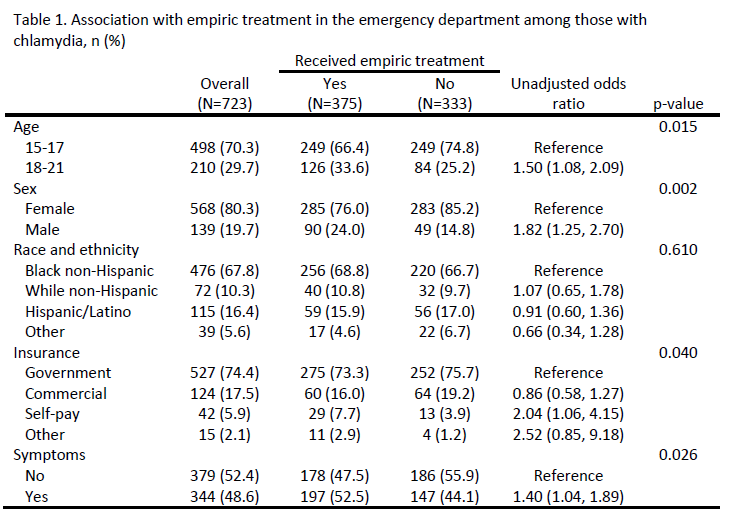
Background: Clinical management of chlamydia (CT) and gonorrhea (GC) in adolescents requires balancing empiric treatment (initiating antibiotics prior to test results) with definitive treatment (after results are known). The goal is to minimize overtreatment while avoiding delays or missed treatment, particularly given challenges with confidentially treating adolescents after emergency department (ED) visits. The decision to provide empiric treatment may be influenced by several clinical and demographic factors. Objective: To describe treatment type (empiric vs definitive) and associated factors among adolescents with CT or GC diagnosed in the ED. Design/Methods: This is a planned secondary analysis of a parent study which compared universally offered versus targeted CT/GC screening among adolescents aged 15-21 years presenting to 6 EDs between 1/2021-9/2022. Participants were included if they had a positive CT and/or GC test and received treatment. The primary outcome was treatment type: empiric or definitive. Associations between treatment type and demographic or characteristics were evaluated. Results: Among 723 adolescents with CT, 51.9% received empiric treatment, and 46.1% received definitive treatment. Compared to younger, female, and publicly insured adolescents, older (OR 1.50; 95% CI 1.08, 2.09), male (OR 1.82; 95% CI 1.25, 2.70) and self-paying (OR 2.04; 95% CI 1.06, 4.15) adolescents, respectively, had higher odds of receiving empiric treatment. Further, adolescents presenting with symptoms suggestive of STIs had higher odds of receiving empiric therapy (OR 1.40; 95% CI 1.04, 1.89) than asymptomatic patients. There was no association with race and ethnicity.
Among 290 adolescents with GC, 62.1% received empiric and 35.6% received definitive treatment. Empiric treatment was more likely among males (OR 6.34; 95% CI 3.23, 13.72), Hispanic/Latino (OR 2.79; 95% CI 1.17, 7.74) and symptomatic (OR 1.89; 95% CI 1.16, 3.09) patients compared to females, Non-Hispanic Black and asymptomatic adolescents, respectively.
Conclusion(s): More adolescents with CT/GC received empiric than definitive treatment, reflecting ED clinicians' efforts to prevent treatment delays and reduce transmission risk. Interestingly, older adolescents compared to younger were more often treated empirically, despite them likely having fewer challenges with definitive treatment, as they are no longer minors. Shared decision-making and equitable empiric treatment strategies for high-risk populations is of the upmost importance.
Table 1. Association with empiric treatment in the emergency department among those with chlamydia, n (%)
Table 2. Association with empiric treatment in the emergency department among those with gonorrhea, n (%)









.png)
