572 - Prenatal Food Insecurity and Longitudinal Trajectories of Parental Locus of Control Over the Prevention of Early Childhood Obesity
Monday, April 27, 2026
8:00am - 10:00am ET
Publication Number: 4560.572
Laura Palacio Mazo, Hassenfeld Children's Hospital at NYU Langone, New York, NY, United States; Rachel S. Gross, New York University Grossman School of Medicine, New York, NY, United States; Mary Jo Messito, New York University Grossman School of Medicine, New York, NY, United States; Michelle W. Katzow, Northwell Health, New Hyde Park, NY, United States; Christina N. Kim, New York University Grossman School of Medicine, New York, NY, United States; Carol Duh-Leong, Hassenfeld Children's Hospital at NYU Langone, New York, NY, United States
Associate Research Coordinator Hassenfeld Children's Hospital at NYU Langone New York, New York, United States
Background: Parental perceptions of control over their child's weight and health behaviors are critical for early childhood obesity prevention. Experiences of material hardship, like food insecurity (FI), can shape parents' internal locus of control (LoC) over early childhood obesity. However, there is limited research on how FI influences variations in long-term trajectories of internal LoC in parents. This study evaluates long-term trajectories of internal LoC among a control group from an early childhood obesity prevention program and examines differences by food insecurity status. Objective: To understand whether longitudinal trajectories of parental internal LoC around childhood obesity prevention are different by prenatal food insecurity status. Design/Methods: We analyzed longitudinal data from the control group of the Starting Early Program, a child obesity prevention RCT among low-income Hispanic families. Mothers' internal LoC was assessed during the 3rd trimester and at 10, 28, and 36 months postpartum using a published measure adapted from the Parental Health Belief Scale. A continuous score was calculated and dichotomized to define low internal LoC as the lowest quartile. FI was measured during the third trimester using the USDA Household Food Security Module, with food insecurity defined as experiencing three or more food-insecure conditions.
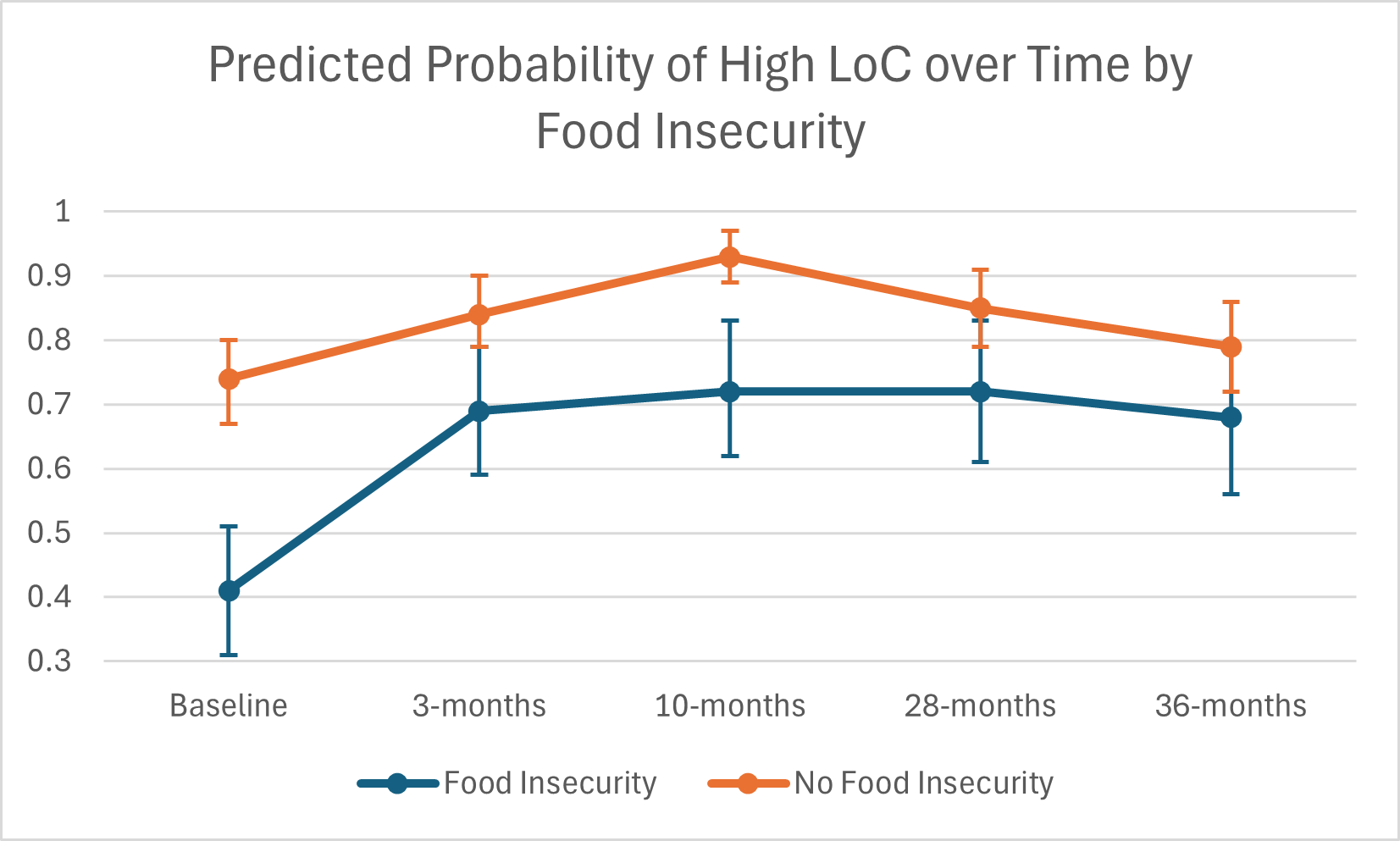
Longitudinal trajectories of the percentage of participants with high LoC were assessed using a mixed-effects logistic regression model, with repeated measures at five time points: baseline, 3, 10, 28, and 36 months postpartum. The interaction between food insecurity with time was examined to determine variations in LoC trajectories. Results: Among 267 mothers, 33% reported food insecurity at baseline. At 36 months, 75.3% of mothers exhibited high internal LoC. At baseline, 41.0% of food-insecure mothers exhibited high LoC compared to 73.8% of food-secure mothers (p < 0.001). The difference remained at 10 months postpartum (72.3% vs. 92.8%; p< 0.001).
Conclusion(s): Prenatal food insecurity is associated with lower probability of high LoC over time. These findings highlight the importance of addressing material hardships, such as FI, in obesity prevention interventions to improve parental perceptions of control over their child's health. Coordinating obesity prevention efforts with food assistance programs, like SNAP, may reduce the association between FI and parental internal LoC.