202 - Associations between Education, Employment, and Problematic Internet Use in Adolescents
and Young Adults
Monday, April 27, 2026
8:00am - 10:00am ET
Publication Number: 4199.202
Ingrid R. Anderson, University of Wisconsin School of Medicine and Public Health, Madison, WI, United States; Megan A. Moreno, University of Wisconsin School of Medicine and Public Health, Madison, WI, United States; Chelsea Olson, University of Wisconsin - Madison, Madison, WI, United States
University of Wisconsin School of Medicine and Public Health Madison, Wisconsin, United States
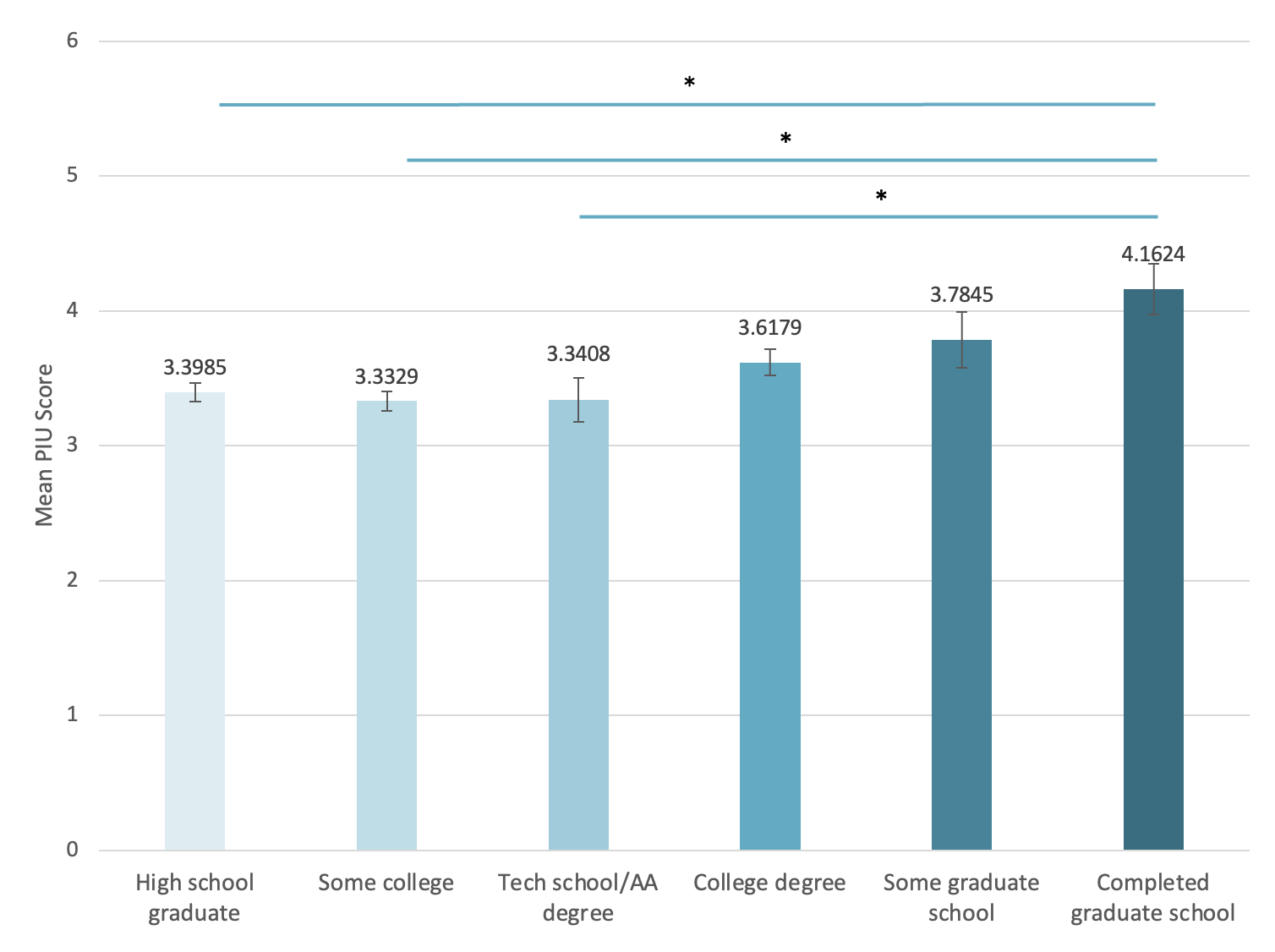
Background: Problematic internet use (PIU) affects around 10% of United States adolescents and young adults (AYA) and previous studies have found a positive association between PIU and a higher education level. Specific education and employment levels associated with PIU risk remain unknown. Objective: This study tested the associations between 1) levels of education and PIU, and 2) employment and PIU in AYAs. Design/Methods: A nationally representative sample of English-speaking U.S. AYAs aged 18-25 was recruited by Qualtrics. Participants completed a cross-sectional survey which assessed highest grade completed, level of employment, and gender. PIU was measured using the 3-item Problematic and Risky Internet Use Screening Scale (PRIUSS-3). ANOVA evaluated differences in PIU scores between different educational groups; linear regression tested for the relationship between higher levels of education and PIU scores with age as a covariate. Independent t-tests assessed PIU scores in part-time vs. full-time and employed vs. unemployed participants. Results: In total, 6000 participants completed the survey. Participants were 51% female, 42.4% non-White, with an average age of 21.8 (SD=2.35). Overall, 36.3% of participants reported completing a high school degree, 32.1% indicated part-time employment, and 54.5% scored at risk for PIU with a mean PRIUSS-3 score of 3.47. The ANOVA (Figure 1) showed that those who completed graduate school (M=4.16, SD=3.33) had significantly higher PIU scores than high school graduates (M=3.39, SD=3.17; p= <.001, 95% C.I.=.22, 1.30), those who had completed some college (M=3.33, SD=2.97; p<.001, 95% C.I.=.28, 1.37), and tech school/AA degree graduates (M=3.34, SD=2.87, p=.013, 95% C.I.=.10, 1.53). Linear regression showed that those with higher levels of education were significantly more likely to report higher PIU scores (b=.080, p=0.038, R2=0.0074). Employed participants had a higher PIU mean score than those who were unemployed (t(5979)=-1.97, p=.049). There was no significant difference in PIU scores between those employed part-time or full-time (t(2830.93)=0.27, p=.78).
Conclusion(s): Our findings indicate that higher educated and employed AYAs had higher risk of PIU, contrasting with previous research showing higher rates of addictive behaviors and impulse control disorders at lower levels of education and employment. There is a need to investigate the aspects of education and employment that most influence PIU risk and ensure screening for PIU in across all AYAs, including highly educated and employed populations.
Figure 1: Adolescent and Young Adult Mean Score for Problematic Internet Use by Education Level