404 - Association of severity of paediatric concussions symptoms with delayed return to sport: Secondary analysis of Concussion Essentials RCT
Monday, April 27, 2026
8:00am - 10:00am ET
Publication Number: 4396.404
Stephen Hearps, Murdoch Children's Research Institute, Parkville, Victoria, Australia; Vicki A. Anderson, Murdoch Children's Research Institute, Parkville, Victoria, Australia; Vanessa C. Rausa, Murdoch Children's Research Institute, Melbourne, Victoria, Australia; Gavin A. Davis, MCRI, Melbourne, Victoria, Australia; Anneke Grobler, Murdoch Children's Research Institute, Melbourne, Victoria, Australia; Franz E. Babl, The Royal Children's Hospital, Melbourne, Victoria, Australia
Attending The Royal Children's Hospital Melbourne, Victoria, Australia
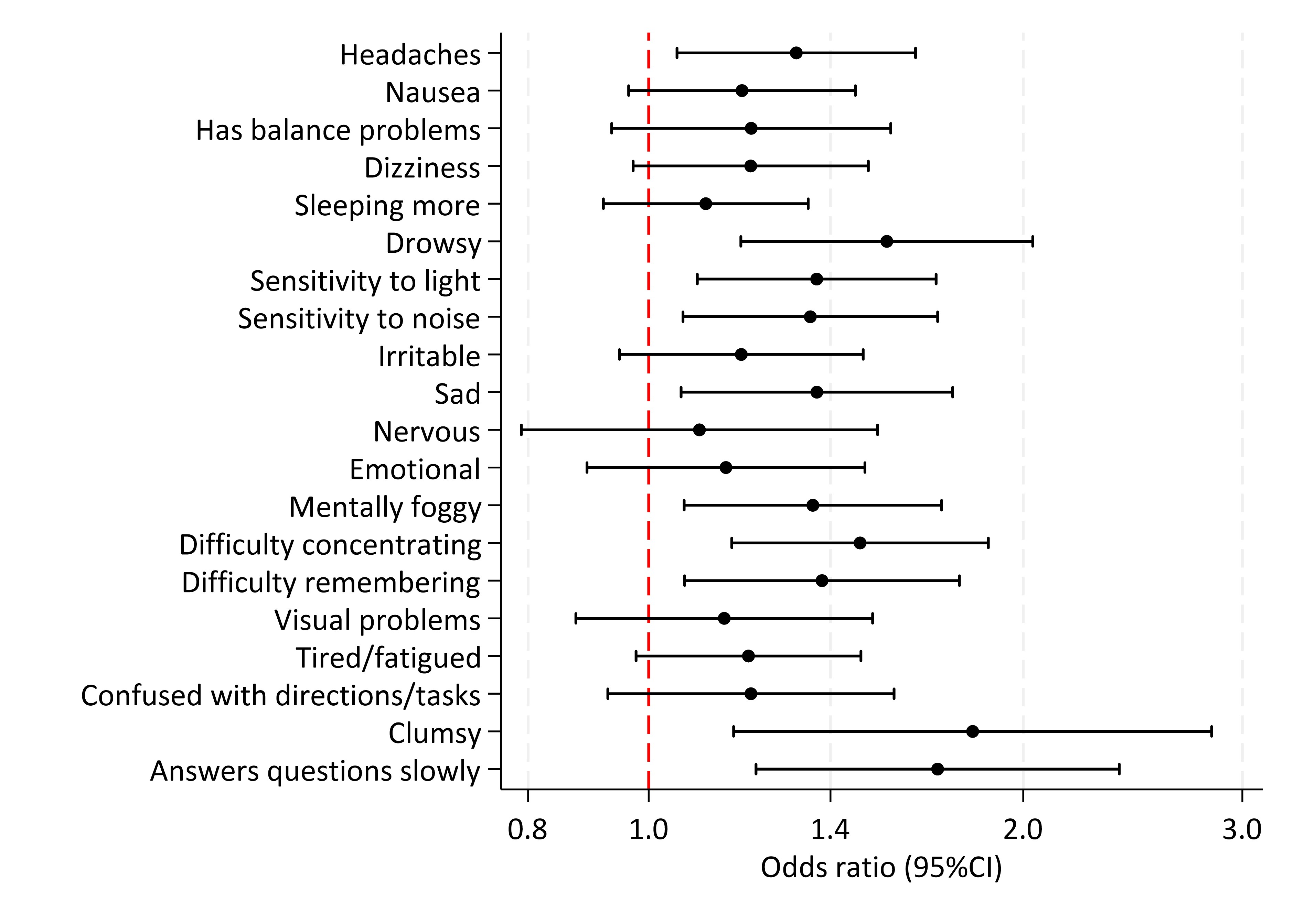
Background: Early identification of risk for prolonged recovery in children with concussion is crucial for optimised clinical management and return to sport. Symptom scales are among the most utilised tools for measuring recovery post-concussion, however in measures such as the Post Concussion Symptom Inventory (PCSI), the weight of individual symptom severity is often diluted in total severity scores, or in reduction into dichotomised symptom endorsement. Objective: Explore the relative weight of individual symptom severity on delayed return to sport. Design/Methods: Concussion symptoms were collected from 144 sport-playing children and adolescents in the Concussion Essentials Randomised Control Trial, mean age 12.6 years (SD=2.5), 59% male. Pre-injury and current symptoms were assessed using the PCSI at 10 days post-injury, and medically-cleared return to sport assessed at 1 month post-injury. Separate logistic regression models were used to determine the association of specific symptom severity with delayed return to sport, moderated by or adjusting for pre-injury severity. Results: Delayed return to sport (≥1 month post-injury) occurred in 56% of the sample. Results did not support the moderating effect of pre-injury symptom severity on the predictive value of post-injury symptom severity. Models adjusting for pre-injury symptom severity found a phenotype of post-injury symptoms being associate with delayed return to sport: 4 of 8 physical (headaches (odds ratio (OR)=1.31 [95%CI 1.05-1.64]), clumsiness (OR=1.82 [1.17-2.83]) and noise (OR=1.35 [1.07-1.71]) or light sensitivity (OR=1.36 [1.09-1.70])), 4 of 5 cognitive (mentally foggy (OR=1.36 [1.07-1.72]), answering questions slowly (OR=1.71 [1.22-2.39]), and difficulty concentrating (OR=1.48 [1.17-1.87]) or remembering (OR=1.38 [1.07-1.78]), and one each of the fatigue (appears more tired/fatigued (OR=1.20 [0.98-1.48])) and emotional (appears sad (OR=1.37 [1.06-1.76])).
Conclusion(s): Specific subacute symptoms, particularly those involving cognitive and physical symptoms, are strongly associated with delayed return to sport in children following a concussion. These findings highlight the potential imbalanced weight of concussion symptom severity in relation to return to sport, and emphasise the need for fine-grained interpretation of symptoms, as well as their severity, when assessing concussion impact.
Figure 1: Odds ratio of delayed return to sport from individual concussion symptom severity, adjusted for pre-injury severity.