








Newborn Care
Session: Newborn Care 1

Santiago Reyes, MD (he/him/his)
Postdoctoral Research Fellow
Beth Israel Deaconess Medical Center
Boston, Massachusetts, United States
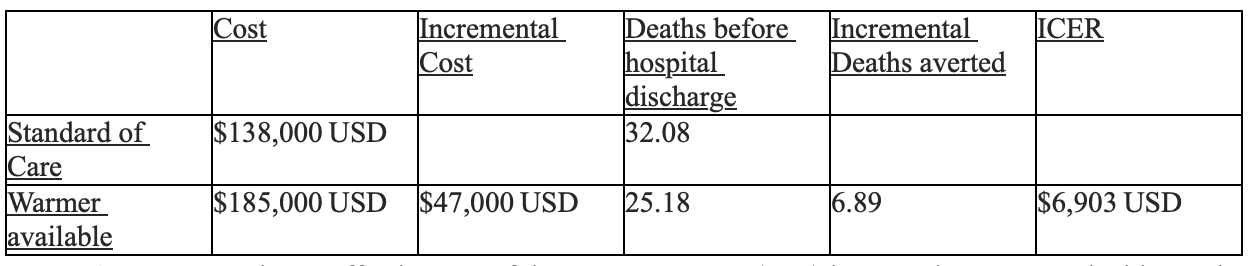 Table 1. Incremental cost-effectiveness of the Dream Warmer (DW) intervention compared with standard care, expressed per 1,000 newborns. Costs are reported in 2021 USD. The table presents total and incremental costs, deaths averted before hospital discharge, incremental deaths averted, and the resulting incremental cost-effectiveness ratio (ICER).
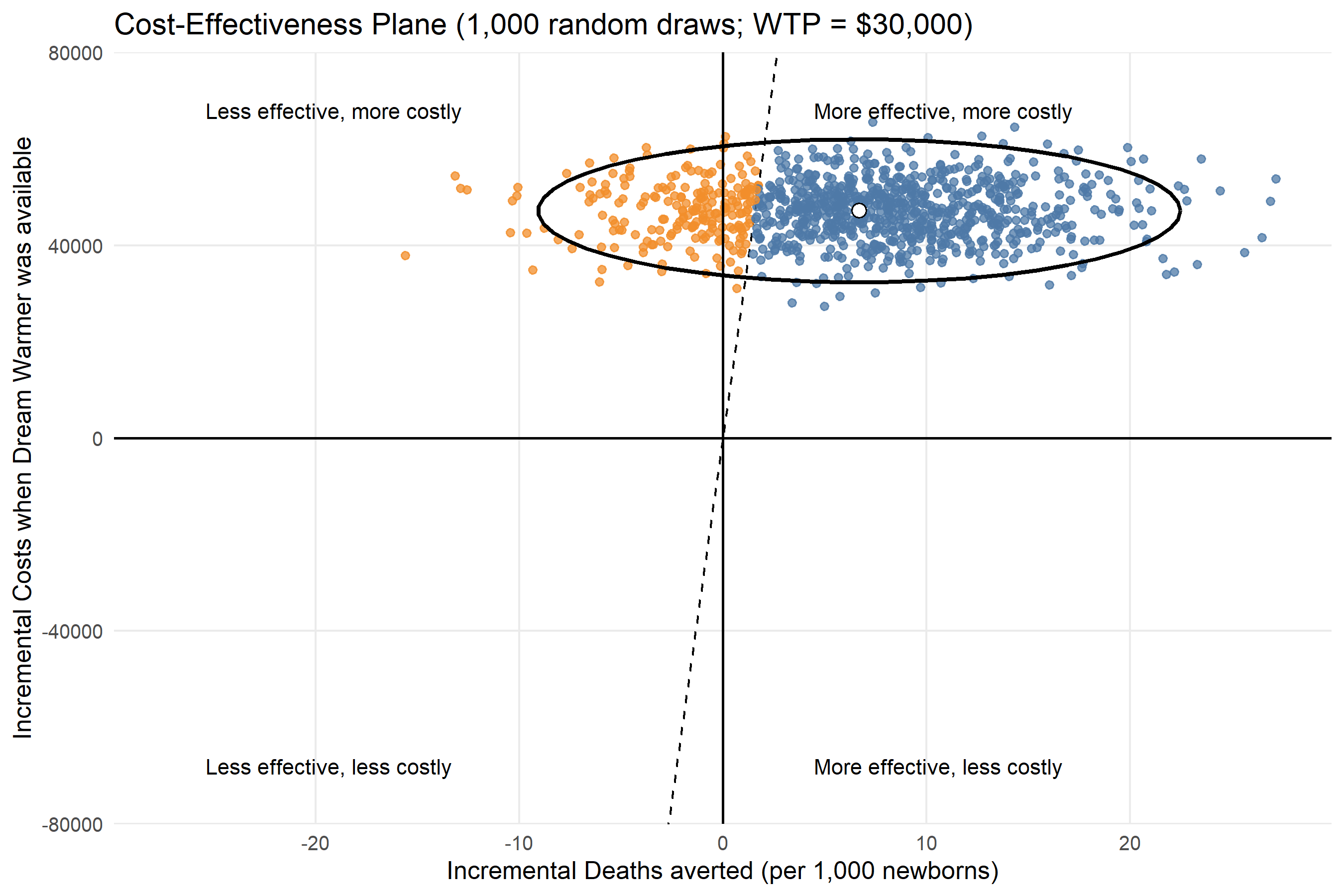 Figure 1. The cost-effectiveness plane shows that ~75% of all simulations fall within the upper right quadrant, indicating that the intervention is associated with increased effectiveness at an increased cost. The dashed line represents a WTP threshold of $30,000, with 78.5% of simulations (blue dots) falling below and 21.5% (orange dots) exceeding this value.
 .png) Figure 2. The cost-effectiveness acceptability curve (CEAC) demonstrates that the probability of the intervention being cost-effective increases rapidly as the willingness-to-pay (WTP) threshold rises. At a WTP of approximately $30,000 per death averted (1x GDP), the intervention shows a 78.5% probability of being cost-effective, increasing to 82.9% at $60,000 (2x GDP) and approaching 83.9% at WTP values above $90,000 (3x GDP).
Figure 2. The cost-effectiveness acceptability curve (CEAC) demonstrates that the probability of the intervention being cost-effective increases rapidly as the willingness-to-pay (WTP) threshold rises. At a WTP of approximately $30,000 per death averted (1x GDP), the intervention shows a 78.5% probability of being cost-effective, increasing to 82.9% at $60,000 (2x GDP) and approaching 83.9% at WTP values above $90,000 (3x GDP). 