488 - From Mom to Toddler: The Ripple Effect of Sleep Aid Supplement Use in Early Childhood
Monday, April 27, 2026
8:00am - 10:00am ET
Publication Number: 4479.488
Darcy A.. Thompson, University of Colorado Anschutz School of Medicine, Aurora, CO, United States; Melissa S. Fineman, University of Colorado School of Medicine, Aurora, CO, United States; Ariel A.. Williamson, University of Oregon, Portland, OR, United States; Suzanna Martinez, University of California, San Francisco, School of Medicine, San Francisco, CA, United States; Matthew F. Daley, Kaiser Permanente Colorado, Aukrora, CO, United States; Haley Ringwood, University of Colorado School of Medicine, Denver, CO, United States; Lisa Meltzer, National Jewish Health, Denver, CO, United States
Professor University of Colorado Anschutz School of Medicine Aurora, Colorado, United States
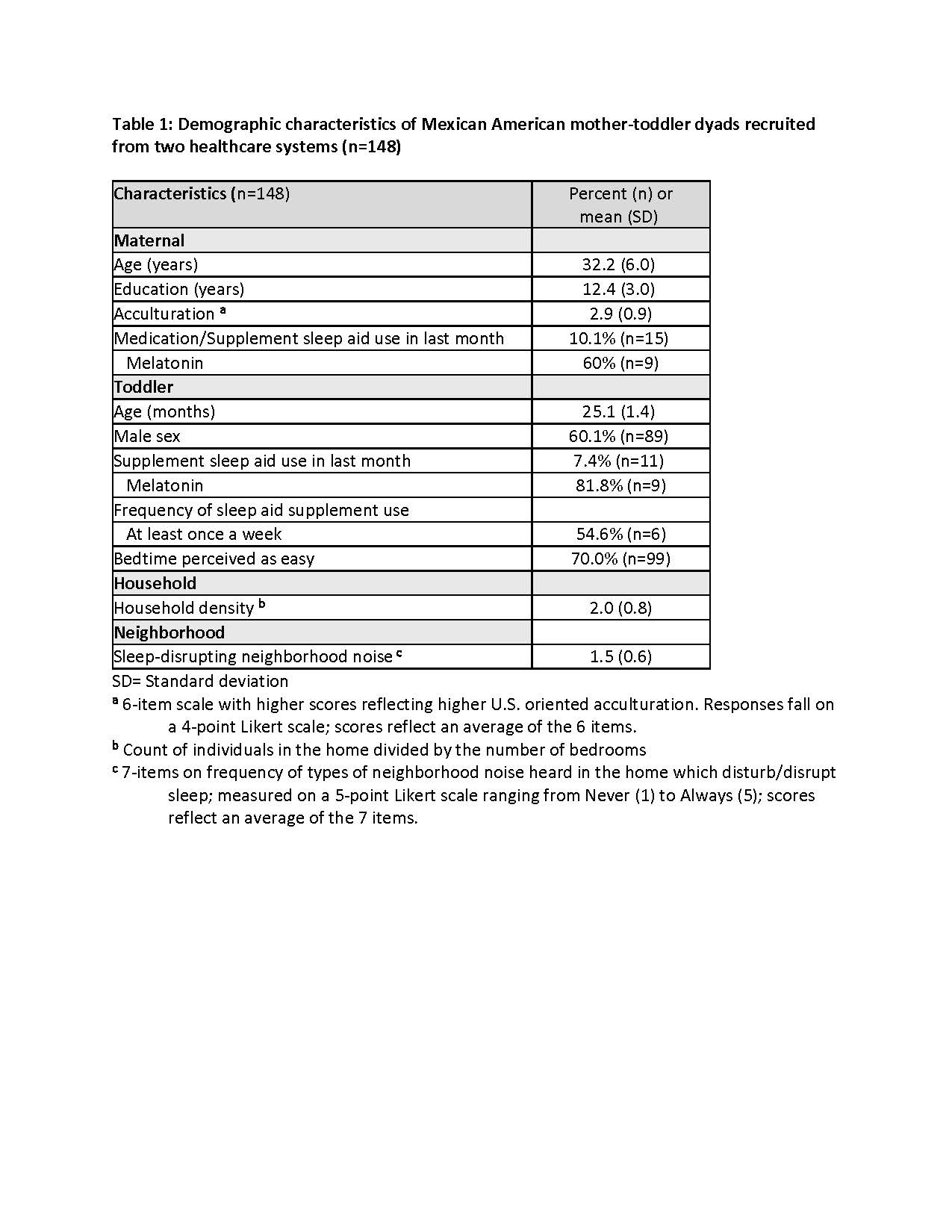
Background: Sleep aid supplement (SAS) use in young children, most notably melatonin, is increasingly common, often initiated by caregivers without medical guidance. Despite limited data on safety and efficacy in toddlers, parents report using melatonin or other supplements to address bedtime difficulties. Little is known about factors contributing to sleep aid supplement use in early childhood, particularly in Mexican American families. Objective: To evaluate neighborhood, maternal, and child-level factors contributing to SAS use among toddlers in Mexican American families. Design/Methods: Cross-sectional data were used from a convenience sample of Mexican American families with toddlers enrolled in a longitudinal observational study. Families were excluded if either the mother or child had medical conditions impacting sleep. Mothers completed questionnaires, in English or Spanish, assessing sociodemographic characteristics, sleep behaviors, and environmental factors. Toddler SAS use in the past month was the primary outcome. Bivariate analyses examined associations between toddler SAS use and characteristics listed in Table 1. Using logistic regression, we tested a model examining whether perceived neighborhood noise disrupting sleep, maternal education level, and maternal SAS use were associated with toddler SAS use. Variables with p-values <.15 were retained in the final model. Results: Sample characteristics are presented in Table 1. Among the 148 Mexican American mother-toddler dyads, 7.4% (n = 11) of toddlers (average age 25.1 months) had been given a SAS in the past month, with melatonin being the most used. Additionally, 10.1% of mothers reported SAS use themselves. In the final model, maternal SAS use was significantly associated with higher odds of toddler SAS use (OR = 8.6; 95% CI: 2.0-37.0), as was reported sleep-disrupting neighborhood noise (OR = 2.6; 95% CI: 1.0-6.5). Education level was not significantly associated with toddler SAS use.
Conclusion(s): Toddler use of a SAS was strongly associated with maternal sleep aid use and sleep-disrupting neighborhood noise. While previous studies show similarly high prevalence of SAS use in toddlers, this is first study to indicate that maternal sleep aid use is associated with sleep aid use in children of any age. Given the limited evidence on safety and efficacy in toddlers, further research is needed to guide clinical recommendations and support informed decision-making among families. (