Session: Medical Education 11: Simulation and Technology II
178 - Keeping Calm across the Spectrum: A Simulation-Based De-escalation Curriculum for Pediatric Interns on Behavioral Emergencies in Children with Autism
Monday, April 27, 2026
8:00am - 10:00am ET
Publication Number: 4175.178
Megan Schmalz, Baylor College of Medicine, Houston, TX, United States; Elizabeth Klinepeter, Baylor College of Medicine/Texas Children's Hospital, Houston, TX, United States; Evan Dalton, Baylor College of Medicine, Houston, TX, United States
Pediatric Hospital Medicine Fellow Baylor College of Medicine Houston, Texas, United States
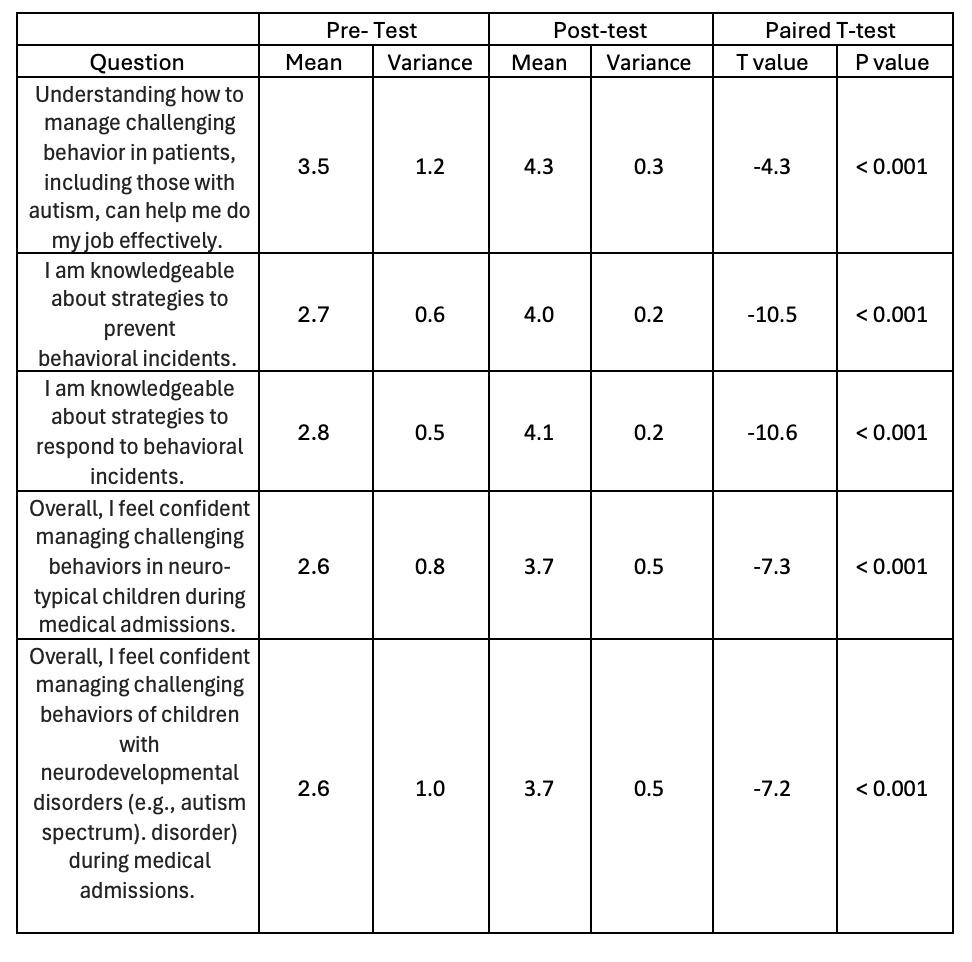
Background: The number of pediatric patients presenting with behavioral health concerns in acute care settings is rising nationwide, especially among children with autism spectrum disorder. Often the frontline providers of inpatient care, pediatric interns must be equipped with de-escalation techniques to ensure the safety of autistic patients and hospital staff. However, few curricula prepare pediatric trainees to manage behavioral emergencies in children with autism, and existing programs emphasize the treatment of mild agitation or verbal de-escalation only. Objective: To address this gap, we developed a novel, simulation-based curriculum designed to enhance pediatric interns' readiness to manage the full spectrum of behavioral emergencies for hospitalized children with autism. Interprofessional communication, systems-based practices, and procedure-related competency were emphasized. Design/Methods: Our curriculum included a pre-simulation educational session supported by digital modules, and rapid cycle deliberate practice simulation exercises. Two one-hour simulation cases were designed that focused on the presentation and management of mild to moderate agitation and severe agitation, respectively. In June 2025, 50 pediatric interns participated in the curriculum and received real-time feedback on communication, clinical decision-making, and technical proficiency. Pre- and post-simulation surveys were obtained and analyzed to assess changes in the interns' self-reported knowledge and confidence in managing behavioral emergencies. Results: Of the 50 participating interns, 35 (70%) completed both the pre- and post-simulation surveys. Paired sample t-tests demonstrated statistically significant improvements in participants' understanding of behavioral manifestations, confidence in managing behavioral emergencies, and ability to implement agitation prevention strategies (Table 1). Qualitative feedback highlighted the value of hands-on, realistic simulation experiences. Suggestions for improvement included clarification of interprofessional team roles (e.g., security, physician, nurse, etc.).
Conclusion(s): This novel simulation-based curriculum provided pediatric interns with practical experience managing behavioral crises with patients with autism. Findings suggest improved readiness to anticipate, prevent, and manage behavioral emergencies among hospitalized children across the spectrum of behavioral acuity and neurodiversity. Future studies should assess long-term knowledge retention and this curriculum's impact on clinical outcomes.
Table 1. Pediatric Intern Knowledge and Confidence Managing Behavioral Emergencies Before and After a Simulation-Based De-escalation Curriculum