628 - Cry Acoustics are Associated with Neonatal Opioid Withdrawal Syndrome Severity
Monday, April 27, 2026
8:00am - 10:00am ET
Publication Number: 4614.628
Elisabeth Conradt, Duke University School of Medicine, Durham, NC, United States; Lynne Dansereau, Women & Infants Hospital of Rhode Island, Providence, RI, United States; Madison Ramirez Heil, The Warren Alpert Medical School of Brown University, Providence, RI, United States; Macie Donahue, The Warren Alpert Medical School of Brown University, Providence, RI, United States; Sarah Maylott, Duke University School of Medicine, Durham, NC, United States; barry lester, The Warren Alpert Medical School of Brown University, east greenwich, RI, United States
Associate professor Duke University School of Medicine Durham, North Carolina, United States
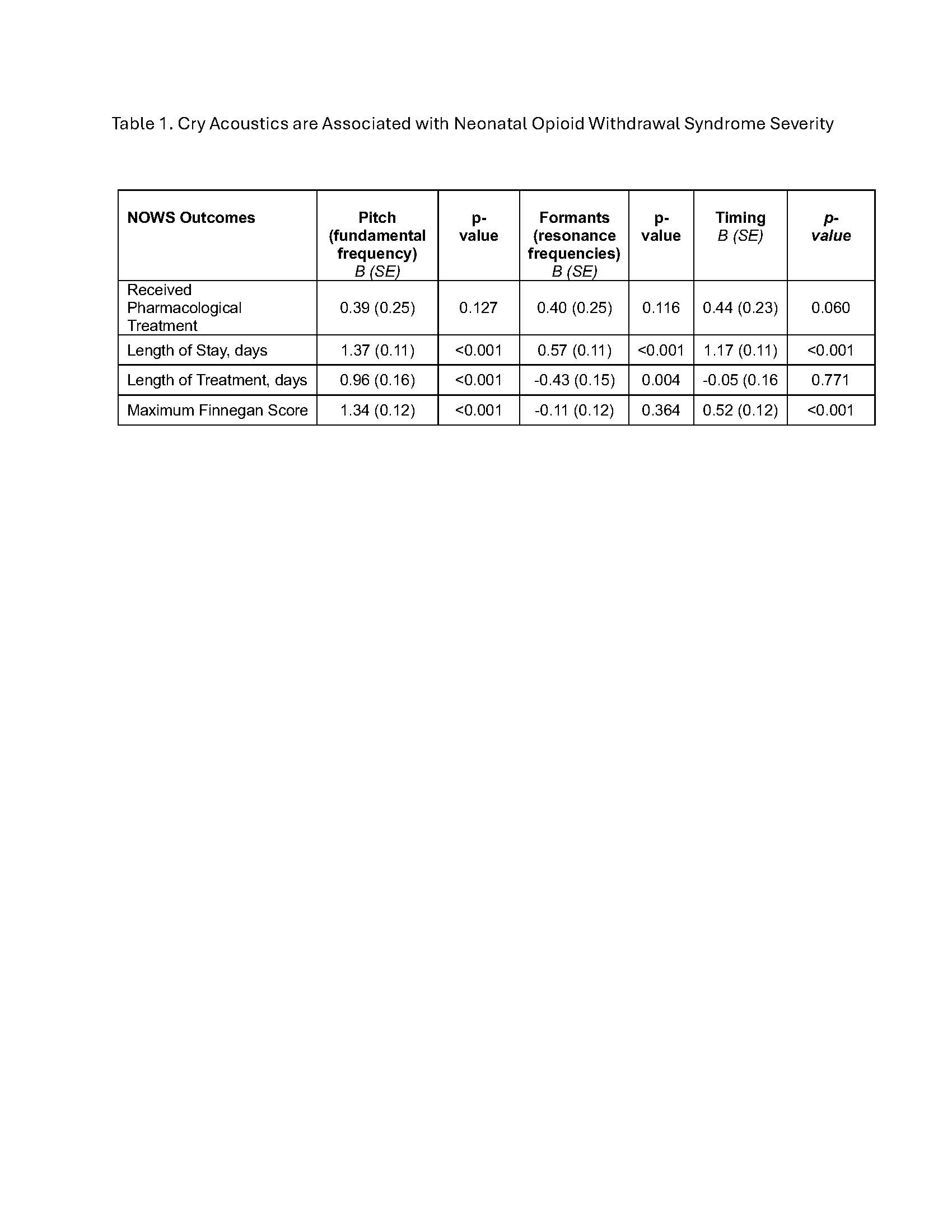
Background: Neonatal Opioid Withdrawal Syndrome (NOWS) involves impaired central, autonomic, respiratory, and gastrointestinal systems. Cry is included in NOWS assessment given that it is a biobehavioral marker of central nervous system development. An expert panel developed a standardized NOWS clinical definition that identified crying as an essential symptom. However, clinicians have noted that this criteria is subjective and reliability estimates are low. We evaluate whether newborn cry acoustics measured prior to the onset of NOWS symptoms, were associated with NOWS severity. Objective: To test the hypothesis that newborn cry acoustics are associated with NOWS severity. Design/Methods: Eighty-nine newborns with prenatal opioid exposure were enrolled at birth from two hospital sites. Cry was recorded at 24 hours after birth. Four research assistants masked for NOWS diagnosis were trained to identify suitable cry episodes based on absence of background noises and achieved excellent agreement (Krippendorff's α=.81). The cry episodes were analyzed using a computer system that extracted acoustic parameters from cry utterances. NOWS was defined as infants who received pharmacological treatment from the Finnegan Neonatal Abstinence Scoring Tool or Eat Sleep Console assessment. NOWS severity symptoms were obtained from medical records. Principal component analysis (PCA) was performed with rotation to reduce the number of cry variables for analyses. Factors used for analysis had the greatest proportion of variation, an eigenvalue >1 and explained >10% of the proportion of variation. Generalized Linear Models examined the cry factors with NOWS onset and severity after adjusting for study site. Results: Cry data was extracted from 89 infants. Three cry factors explained the greatest proportion of variation: Factor 1: Pitch (Fundamental Frequency), Factor 2: Formants (Resonance Frequencies) and Factor 3: Timing. In adjusted analyses, Factor 1 was associated with an increase in length of stay (LOS), length of treatment (LOT) and maximum Finnegan score. Factor 2 was associated with and increase in LOS and decrease in LOT. Factor 3 was associated with an increase in LOS and maximum Finnegan score (Table 1).
Conclusion(s): Automatic assessment of cry acoustics 24 hours after birth could be used to predict NOWS severity and improve understanding of the pathophysiology of NOWS.
Cry Acoustics are Associated with Neonatal Opioid Withdrawal Syndrome Severity